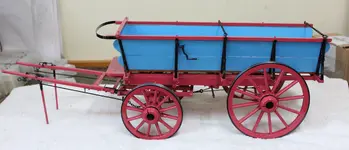
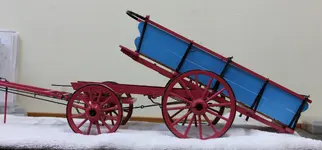
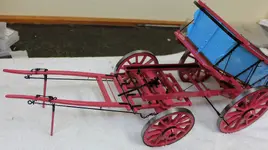
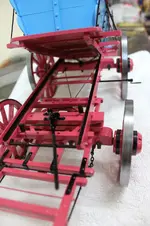
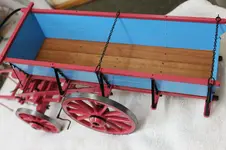
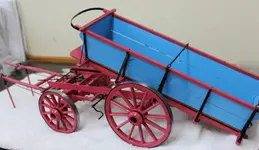
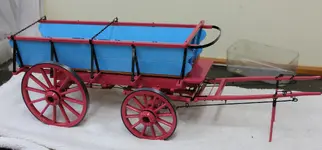
Here is a Scratchbuilt 1/12th scale Tip Waggon.
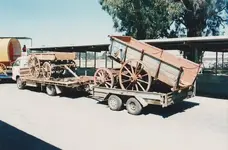
I was sent a picture of this vehicle and thought it was a bit different, so I contacted the sender of the pic and got quite a few more details about this odd ball vehicle.
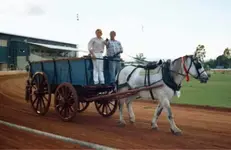
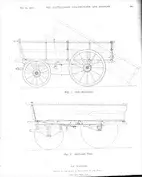
Looked thru my stash of Working Drawings and there is a drawing that was very similar to the photo.
Given another name to contact and was kindly sent some more photographs of this particular vehicle, as well as another name to contact.
Contacted the third person and I received further information about the Waggon as well.
The third person contacted explained that the Tip Waggon is in the shed at her home and I could get at it but only a little bit, it was shoved up hard against the shed wall and other vehicles were blocking it in.
It had no rear wheels on the vehicle, as they had been taken off to get the steel tyres repaired, but I could still get at it, just a little bit for some photos.
Took an hour and a half drive to get to where the vehicle actually is for a few photographs, well worth the trip to actually just see it.
The Working Drawing is not exactly the same as the vehicle as in the first picture, noticed that as soon as I saw the vehicle, so I had to alter quite a few bits on the drawing, to make the model as per the vehicle in the first photograph.
I found out that this full sized vehicle in the shed, is only one of two Tip Waggons that were ever made by a Mr. J. W. Delley, a Wheelwright from Bundaberg, Queensland, the first Tip Waggon was the same as the drawing printed in “The Australasian Coachbuilder and Saddler, December 1900” and the second Waggon was an update to that first drawing and it was in that ‘shed’.
The dimensions are approximately the same as per the drawing, but the means of tipping the second Waggon, are different than what’s on the drawing of the first Waggon.
Had to draw quite a few bits again to get it to be similar to the original photo, that took quite a bit of time with working out all those missing details.
The drawing of the first Waggon, calls for a chain to pull the body to the rear, by winding a crank handle to pull the body rearwards with the chain and when it reaches a critical point, then the body just tips and the contents are spread onto the ground.
The mechanism for tipping the body on the “actual full sized SECOND vehicle” is by a ‘rack and pinion’, crank the handle and the gears fit into the rack and the body is pushed rearward to the tipping point.
To get the body back to the horizontal position, you just grabbed the empty tipped body and pulled it back down, then start to crank the body towards the front, as the body on the full sized vehicle is very well balanced at that tipping point.
Once the body is fully forward, then you just locked the body to the chassis by operating the lever above the turntable, as seen in the third photo of the finished model.
This vehicle was made to carry sugar cane from the paddock to where-ever the load was required, could have been to the railhead, or even into the sugar mill.
You could even use it to carry chords of timber, from out of the bush to a steam engine in town, if you so desired.
Method of construction is as per all the other models I have made.
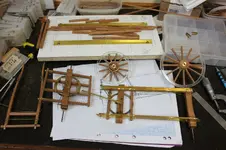
Cheated a bit with the Rack and Pinion though, it would have taken many, many hours of machining, trying to reproduce the Rack and Pinion in miniature scale, so I decided to use a Rack and Pinion used for radio controlled stuff, which I bought of Ebay.
Once fitted to the model, unless specifically told, you would never know what’s in there.
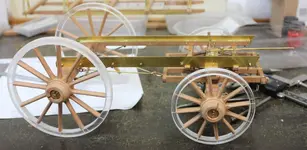
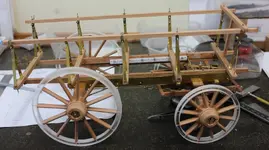
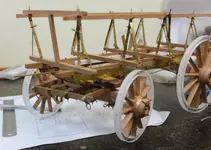
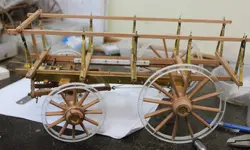
I have split the photos into two post again, a few “before photos” to show all the extra details and what materials I used, then the “after painting and assembled” photos.
—————————————
I was sent a picture of this vehicle and thought it was a bit different, so I contacted the sender of the pic and got quite a few more details about this odd ball vehicle.
Looked thru my stash of Working Drawings and there is a drawing that was very similar to the photo.
Given another name to contact and was kindly sent some more photographs of this particular vehicle, as well as another name to contact.
Contacted the third person and I received further information about the Waggon as well.
The third person contacted explained that the Tip Waggon is in the shed at her home and I could get at it but only a little bit, it was shoved up hard against the shed wall and other vehicles were blocking it in.
It had no rear wheels on the vehicle, as they had been taken off to get the steel tyres repaired, but I could still get at it, just a little bit for some photos.
Took an hour and a half drive to get to where the vehicle actually is for a few photographs, well worth the trip to actually just see it.
The Working Drawing is not exactly the same as the vehicle as in the first picture, noticed that as soon as I saw the vehicle, so I had to alter quite a few bits on the drawing, to make the model as per the vehicle in the first photograph.
I found out that this full sized vehicle in the shed, is only one of two Tip Waggons that were ever made by a Mr. J. W. Delley, a Wheelwright from Bundaberg, Queensland, the first Tip Waggon was the same as the drawing printed in “The Australasian Coachbuilder and Saddler, December 1900” and the second Waggon was an update to that first drawing and it was in that ‘shed’.
The dimensions are approximately the same as per the drawing, but the means of tipping the second Waggon, are different than what’s on the drawing of the first Waggon.
Had to draw quite a few bits again to get it to be similar to the original photo, that took quite a bit of time with working out all those missing details.
The drawing of the first Waggon, calls for a chain to pull the body to the rear, by winding a crank handle to pull the body rearwards with the chain and when it reaches a critical point, then the body just tips and the contents are spread onto the ground.
The mechanism for tipping the body on the “actual full sized SECOND vehicle” is by a ‘rack and pinion’, crank the handle and the gears fit into the rack and the body is pushed rearward to the tipping point.
To get the body back to the horizontal position, you just grabbed the empty tipped body and pulled it back down, then start to crank the body towards the front, as the body on the full sized vehicle is very well balanced at that tipping point.
Once the body is fully forward, then you just locked the body to the chassis by operating the lever above the turntable, as seen in the third photo of the finished model.
This vehicle was made to carry sugar cane from the paddock to where-ever the load was required, could have been to the railhead, or even into the sugar mill.
You could even use it to carry chords of timber, from out of the bush to a steam engine in town, if you so desired.
Method of construction is as per all the other models I have made.
Cheated a bit with the Rack and Pinion though, it would have taken many, many hours of machining, trying to reproduce the Rack and Pinion in miniature scale, so I decided to use a Rack and Pinion used for radio controlled stuff, which I bought of Ebay.
Once fitted to the model, unless specifically told, you would never know what’s in there.
I have split the photos into two post again, a few “before photos” to show all the extra details and what materials I used, then the “after painting and assembled” photos.
—————————————