Theme editor

Scale Model Shop

Landing Craft, Assault — Operation Infatuate I, 1 November 1944 (1:35 Gecko kit)

  • Thread starter Thread starter Guest
  • Start date Start date
Jakko, I'd interpret "double skin mahogany” as meaning, not plywood, but two layers of planking, which would logically be diagonal, probably at 90 degrees between the layers. There might well have been a steel plate fitted over that, to protect the wood. Looking at the door and bulkhead in your earlier post, they certainly look to me like steel panels bolted or riveted onto a wooden structure.
Pete
 
Thread owner
The thing is that for the hull, the drawings specifically say it’s a double skin of planks, and that they are to be put on diagonally. Whereas other sections just say “double skin mahogany” — if the diagonal bit was a given then they wouldn’t specify that, and I also don’t think they would specify it in one place but not another if both were meant to be like that …?

The bulkhead and door seem to be early and late varieties: early as planks with a small door, later as metal sheets (riveted to those planks perhaps?) with a larger door. But I don’t know enough to be able to say around when this change was made — or even if the hypothesis is actually correct :)

And yes, I am having a lot of fun, for a given definition of fun ;)
 
Having specified once that the planks are to be diagonal. they wouldn't need to repeat that. Perhaps.
Pete
 
Thread owner
What I mean is they say it everywhere the planks are known to be diagonal, like the sides, the stern, inside the passageway in the bow, etc. You can take a look at the drawings, maybe you will see something I’m missing :)
 
In drawing 1, the text under "Planking" is... interesting. "Double skin mahogany, bottom planking two 3/8 skins inner diag'l
Outer diagonal side planking 1/4" side, inner diagonal outer fore & aft or diagonal if preferred."
So, I'm assuming that where double diagonal is not specified, the direction of one layer planking is up to the builder.
I'll have a look at the other drawings tomorrow, cat permitting.
Pete
 
Thread owner
Also on that drawing, in the list on the right (inside the transverse cross-section), it says “Wood decks Double skin mahogany, top skin ⅜″ laid fore & aft, under skin ¼″ diag.” So maybe that does mean planks rather than plywood, but it certainly tells us there would not be diagonal seams visible on the outside of the deck. The front part of the full-width deck has no seams in any case, being made of 10 lbs (6 mm) DIHT steel plate; only aft of frame 22 is the deck made of wood at all. You can easily spot the end of the steel deck in the side view of drawing 1 because of the strip of wood that covers the seam between the metal and the wood decks.
 
This is fascinating. The build differences would not be unexpected between different yards and different interpretations of the drawings. After all, speed was probably more important than absolute fidelity to the design. Strikes me that a huge amount of mahogany must have been used building these.
 
Thread owner
I'm of the opinion is was ply, Mahogany would be in short supply esp with having to be imported. Ply would have better stability than two solid planks .
 
I'm of the opinion is was ply, Mahogany would be in short supply esp with having to be imported. Ply would have better stability than two solid planks .
Maybe, but it was used a great deal on all sorts of construction at the time. Its resistance to impact damage would be far greater than plywood as well.
 
Things are getting more and more thrilling :cold-sweat: :upside::tongue-out3:. I'll join the audience being sure I'll learn something new.
 
Thread owner
Maybe, but it was used a great deal on all sorts of construction at the time. Its resistance to impact damage would be far greater than plywood as well.
Depending on the thickness of the ply Tim. Would like to find more information on that door, quite an interesting thread.
 
Any plywood used would obviously have to be a marine grade, the adhesive which was in short supply late in the war. I think if the designers intended ply to be used they'd have said so as well as specifying the grade.
Pete
 
As far as I can tell John, it’s the whole bulkhead. Surprised they didn’t use a native species like Oak though.
 
Thread owner
Any plywood used would obviously have to be a marine grade, the adhesive which was in short supply late in the war. I think if the designers intended ply to be used they'd have said so as well as specifying the grade.
Pete
Fair point Pete.
 
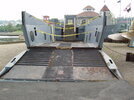
Here's a landing craft in Battleship Cove, Maryland, which is no help at all! :cool:
PeteP6130006.JPG
 
As far as I can tell John, it’s the whole bulkhead. Surprised they didn’t use a native species like Oak though.
Shortage of lumberjacks and sawmills, and oak is very prone to expansion and contraction with variable moisture content, so wouldn't work well with an iron frame.
Also very slow to season.
Pete
 
Shortage of lumberjacks and sawmills, and oak is very prone to expansion and contraction with variable moisture content, so wouldn't work well with an iron frame.
Also very slow to season.
Pete
What about other species like Ash, Elm (it was still around then), or Beech then Pete…..same problem I suppose….
 
They'd season quicker than oak, but would still take a year or two.
I suspect that most UK boatyards had substantial stock of mahogany at the start of WW2, and they would have been unable to build civvie boats for the duration.
The college where I used to work was built in 1952. Most of the furniture was made of Japanese oak, imported as war reparation. In some outside storage there were several mahogany planks, for memory about 30 feet long and three feet wide, six inches thick. Clear and knot-free. They were for the foundry department to cut up for pattern-making! One of our technicians managed to spirit one away to use as a lintel over a picture window in a bungalow he was building in the Rhondda.
Pete
 
Those planks must have been worth a fortune.
I’m pretty sure all the benches in my school chemistry labs were topped with mahogany, and they were built in the fifties. I know for certain that the original labs at Porton down (built at the same time, and with at least a couple of miles worth of bench when all added together) were topped with it. All the chairs and stools were made from beech though. The worst bit of this is that as the labs were gradually refurbished in the eighties and beyond the tops and furnishings were scrapped and replaced with more suitable materials. However because of the potential uses they had been subjected to over the years the wood could only be taken off site broken up as firewood. A great deal of it was simple burned on site as I recall.
 
Back
Top