Theme editor

Scale Model Shop

Info please

Airborne01

Active member
SMF Supporters
Joined
Mar 30, 2021
Messages
4,413
Reaction score
446
Points
83
Location
Essex
1/3
Thread owner
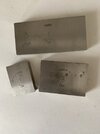
I've recently come into possession of these with a promise of more to come in various sizes; they're slightly magnetised and already proving very useful in conjunction with set squares etc. I'm intrigued as to whether I can find a definitive answer as to their original purpose! Are there any 'vintage' engineers out there who can enlighten me? My gratitude will be unbounded!
Steve
IMG_0299.JPG
 
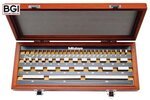
They look like part of a set of slip gauges
slip gauges.jpg
Obviously they are Imperial
https://www.ebay.co.uk/itm/163190720465
They were used as standard measurements for cailbrating inspection equipment. They were generally checked against a national standard set of gauges & paper certified as being a 'Standard' , You can see from the Ebay listing Matrix were a maker. They are highly machined, ground & polished precision items. They were very expensive items & in original boxes & paperwork collectable
Dave
 
any 'vintage' engineers out there
Steve,
I don't know about vintage! In an engineering company of any size, there will be a standards room, where these gauges would be kept. Measuring gear in 'goods inward' & machine shops would be calibrated against the standards regularly. Even digital calipers had to be calibrated & certified. The storage rooms were temperature & humidity controlled, so comparisons were done at a stated temperature.
The standards room also had the library of paper standards - BS, DIN, ISO, SAE, JIS & others, on all subjects from paint specifications to cast iron. As a Design Engineer, anything I cooked up had to comply with the relevant standard. Much easier with computerised storage. The paper standards had to be logged in and out & had to be kept updated - old copies having every single page stamped 'superseded'
A good steady job for the more methodical worker
Dave
 
Well Steve you now know what they are. I bought some steel blocks and they have proved useful in many ways. I'm sure you will find loads of uses for yours, to keep things square, as weights etc. You're a lucky guy.
 
Thread owner
Thanks so much Dave(s) - I feel vindicated in my original thoughts! (And - 'Vintage' surely doesn't apply to a stripling like both of you :rolling: !). And you're absolutely correct Jim - they've proved indispensable already! Thanks Gents!
Steve
 
Well Steve you now know what they are. I bought some steel blocks and they have proved useful in many ways. I'm sure you will find loads of uses for yours, to keep things square, as weights etc. You're a lucky guy.

I reckon I could find a use for some larger blocks. I wouldn't need them to be precisely machined, just heavy with accurate, square sides. I've seen pictures of blocks with threaded holes which would possibly suit. Does anyone know what they are?

I've looked on ebay and the sets of blocks have lots of thinner ones which would be of no use to me - plus they're expensive for what I want. What sort of blocks did you get Jim?
 
I reckon I could find a use for some larger blocks. I wouldn't need them to be precisely machined, just heavy with accurate, square sides. I've seen pictures of blocks with threaded holes which would possibly suit. Does anyone know what they are?
Sounds like you mean 321or 123 blocks, so called because they are 3 by 2 by 1 inch.

I bought a bundle of metric ones which are various sizes and can be bolted together if needed. I'm pretty sure Steve Jones bought the same ones after asking about mine.

https://www.arceurotrade.co.uk/Cata...-Blocks-Angle-Plates/Stevensons-Metric-Blocks
 
What sort of blocks did you get Jim?
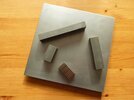
I can't remember where I bought them, Dave. I bought 3 different sized steel blocks, a steel sheet and some magnets. To be honest the blocks have been used often but my idea to hold things in place with the magnets on the steel sheet didn't work. The smallest block is about 3cm long.
P1050064.JPG
 
I can't remember where I bought them, Dave. I bought 3 different sized steel blocks, a steel sheet and some magnets. To be honest the blocks have been used often but my idea to hold things in place with the magnets on the steel sheet didn't work. The smallest block is about 3cm long.

Using blocks and magnets to hold things together - and create square corners - seems such a good idea. Pity it didn't work out as planned Jim.

I'm hoping the sheer weight of the blocks I have bought - which can be bolted together once I've got hold of some suitable bolts - will do the job.
 
They could have been used in the layout of parts to be checked, you were nearly there with the set squares. We used to use magnetic blocks at British Aerospace in the mock up shop to make sure the parts would not move and other parts checked against them. Bit hard to describe, but in working practice it was part of the job.
 
I know it's possible to magnetise steel blocks by wrapping them with wire and running an electrical current through the wire. I don't know what sort - AC or DC - or what strength of current you'd need to get a decent magnetic strength in your blocks (there's bound to be a website that would help you with that - obviously no good if you need tens of thousands of turns of wire and forty eleven zillion amps), but if your blocks were magnetised Jim, you ought to be able to use them for the purpose intended?
 
Thread owner
I know it's possible to magnetise steel blocks by wrapping them with wire and running an electrical current through the wire. I don't know what sort - AC or DC - or what strength of current you'd need to get a decent magnetic strength in your blocks (there's bound to be a website that would help you with that - obviously no good if you need tens of thousands of turns of wire and forty eleven zillion amps), but if your blocks were magnetised Jim, you ought to be able to use them for the purpose intended?
It is possible to magnetise steel without the use of electrickery (albeit on a very small scale!); as a survival tool we were taught to create a compass by stroking a needle in one direction (generally towards the point) with the back of a knife - the magnetised needle was then carefully placed on a small floating leaf and voila! Off into the wild blue yonder!
Steve
 
It is possible to magnetise steel without the use of electrickery (albeit on a very small scale!); as a survival tool we were taught to create a compass by stroking a needle in one direction (generally towards the point) with the back of a knife - the magnetised needle was then carefully placed on a small floating leaf and voila! Off into the wild blue yonder!
Steve
I've seen compass needles made like that but with the needle stuck through a piece of straw to make it float.

How did you know which end of the needle pointed North? Did moving the knife blade towards the point always make the point the North (or South) pole, or did it change?

Thinking about it, wouldn't you be able to work out which one it was if you knew the direction of the sunrise (or sunset)?
 
Thread owner
I've seen compass needles made like that but with the needle stuck through a piece of straw to make it float.

How did you know which end of the needle pointed North? Did moving the knife blade towards the point always make the point the North (or South) pole, or did it change?

Thinking about it, wouldn't you be able to work out which one it was if you knew the direction of the sunrise (or sunset)?
Pointy end is (magnetic) North if you've stroked the knife towards it! And it's not always possible to observe sunrise/set eg midday - appropriate hemispheres also have an effect! That's really just another tool in your survival armoury - like a bag of gob-stoppers :smiling: ! Knowledge is power!
Steve
 
Back
Top