Theme editor

Scale Model Shop

Dragon 1/35 sd.kfz.184 Ferdinand

Hi Dave,
I did like your 72 nd elefant/ferdinand, you made a cracking job of that :cool:

I had planned on just free handing camo but when I saw this scheme I knew there was no way I’d get it neat enough.

As to the Bison, well I seem to of misplaced it :thinking:……I got a little 1/100 Pz III on the go if your interested ;)

Some of this really small stuff is so well detailed ,nice bit of airbrushing on it as well what on earth did you mask the ferdinand for you should have braved it free hand ,still the big boys looking great you must be chuffed well done. Dave
 
Blimy Si you had me thinking for a bit rember the little zvezda 72nd one I built ,couldn't remember using masking tape or silly putty (hope you don't mind a pic)

Then the light went on i used masking fluid pretty sure did the whole thing yellow masked up with the fluid and squirted the green looking back now would have made a better job the other way around still looks like yours is a bit big for this way of doing it ,good to see it making it way to the airbrush though. Is the little bison next up ?you do realise I won't stop haggling about that one. Dave
Wow thats a nice Ferdinand Dave.Love the camouflage.Must do some more 1.72nd stuff soon.Got a few in stock.Have you seen the First to fight kits from Poland?.Seen a few on youtube.Look good with some tweaking.
Richard
 
Thread owner
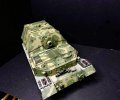
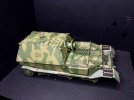
Been adding some weathering over the last few days. Think I’m getting there.

Still have the recovery cables to put together and paint up.

Haven’t even thought about the tracks yet:flushed:

IMG_1667.jpegIMG_1666.jpeg
 
Thread owner
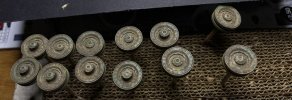
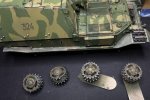
Leaving the beast and moving onto weathering of wheels and sprockets……two lots of drive sprockets as, unusually it has them at both ends :surprised:!

IMG_1693.jpegIMG_1692.jpeg
 
Looking great Si, can't see you having a problem with the tracks .
Nice paintwork.Whats with the two sets of drive sockets ? Please.
 
Thread owner
Looking great Si, can't see you having a problem with the tracks .
Nice paintwork.Whats with the two sets of drive sockets ? Please.
Cheers John :thumb2:

Porche designed the chassis and it was driven by twin petrol engines each driving a generator supplying power to drive motors at the rear on each track. It has no return rollers and Im guess but having a sprocket on either end helps keep the track tension?
 
Cheers John :thumb2:

Porche designed the chassis and it was driven by twin petrol engines each driving a generator supplying power to drive motors at the rear on each track. It has no return rollers and Im guess but having a sprocket on either end helps keep the track tension?
Thanks Si. We need Allen or Jakko to tell us more on this maybe ?
Twin engines must have been fun getting them to run in a synchronised fashion.
 
The engines didn’t need to be synchonised, as they drove electrical generators like Si mentions: the petrol engines just provided the electrical power that went to the motors which actually powered the vehicle — just like in a modern hybrid electric car.

In any case, if two (or more) engines are mounted to the same crankcase, they work fine with a bit of decent design work. The M4A2 Sherman (and its derivative, the M10 gun motor carriage in your latest diorama), for example, had two diesels attached to a common crankcase, and was considered pretty reliable. The M4A4 even had five engines on a single crankcase and ran fine.

One tank in which two engines caused much more trouble, though, was the Whippet from the First World War: in that, each engine drove one track. The idea was that the vehicle could be steered by changing the RPM of one engine only, or by speeding up one while slowing down the other. In practice, of course, it’s just about impossible to have both running at exactly the same RPM, so the driver was constantly busy tinkering with both to keep the vehicle going in a nominally straight line.

Not sure of the reason for using a sprocket at either end, but only driving one, though. The front one was mounted on a crank, so it’s basically just an adjustable idler with teeth on it.
 
Been adding some weathering over the last few days. Think I’m getting there.

Still have the recovery cables to put together and paint up.

Haven’t even thought about the tracks yet:flushed:

Blimey, just caught up with this Si...
...looking superb mate, very nice indeed mate :cool:
 
Thread owner
The engines didn’t need to be synchonised, as they drove electrical generators like Si mentions: the petrol engines just provided the electrical power that went to the motors which actually powered the vehicle — just like in a modern hybrid electric car.

In any case, if two (or more) engines are mounted to the same crankcase, they work fine with a bit of decent design work. The M4A2 Sherman (and its derivative, the M10 gun motor carriage in your latest diorama), for example, had two diesels attached to a common crankcase, and was considered pretty reliable. The M4A4 even had five engines on a single crankcase and ran fine.

One tank in which two engines caused much more trouble, though, was the Whippet from the First World War: in that, each engine drove one track. The idea was that the vehicle could be steered by changing the RPM of one engine only, or by speeding up one while slowing down the other. In practice, of course, it’s just about impossible to have both running at exactly the same RPM, so the driver was constantly busy tinkering with both to keep the vehicle going in a nominally straight line.

Not sure of the reason for using a sprocket at either end, but only driving one, though. The front one was mounted on a crank, so it’s basically just an adjustable idler with teeth on it.

Thanks for the info Jakko :thumb2:
 
Thread owner
That's looking very nice So. I hope the running gear doesn't cause you any problems.
Thanks Jim :smiling4:
I’m also hoping for a headache free final fitting of the tracks and wheels ! :flushed:
 
Si I've said it before but can't see you ever having problems fitting tracks.
 
Been awhile since I looked in last. That is looking the Bomb Si! keep it coming Sir. :thumb2:
 
Not sure of the reason for using a sprocket at either end, but only driving one, though.
Yesterday evening, I was doing some light reading in Schwere Jagdpanzer: Entwicklung – Fertigung – Einsatz by Spielberger, Doyle and Jentz, and on page 60, happened across this diagram of the Porsche Tiger’s driveline:

View attachment 498543

It would have been almost identical in Ferdinand, other than the generators and petrol engines being in the middle rather than the rear (Fahrtrichtung meaning “direction of travel”, so the arrow points to the front), and the petrol engines being twelve-cylinder types instead of ten like here.

I can’t quite make complete sense of it, largely because of unfamiliarity with the symbols used, and not helped by it mixing electrical and mechanical systems in one drawing, but the lettered bits in the legend translate as follows:

G Generator
O Petrol engine (“Ottomotor” is a common German term for this type of engine, after Nicolaus Otto who is said to have invented this type of engine)
E Electric motor
F Drive switch
R Regulator for generator’s external power generation [R is not actually in the drawing]
U Field reversing controller
M Controller for motor’s external power generation
T Electric turret drive [not present on Ferdinand, obviously]

The positions of the two levers are:

0°: Full forward speed
61°: Start of external power generation
100°: Complete short-circuit of main power coil
154°: External power generation at full strength, start of reverse normal power generation, application of hydraulic brakes
254°: Maximum brake position, full reverse speed

I: Generators I and II parallel
II: Starter generators I and II
III: Driving using generators I and II in series
IV: Driving using generator I
V: Driving using generator II

Notice, though, that there is something inside the idler wheels at the front of the vehicle. I first thought these might be electrical, but after studying the drawing and legend more, I think they are the hydraulic brakes that are mentioned for pulling the driving levers back 154°. This would explain the need for sprockets rather than plain idler wheels: without teeth on the idlers, they wouldn’t brake the track very much at all, just the wheels. But with teeth, these brakes will help stop the vehicle completely.

On the next page are some diagrams comparing the Porsche Tiger’s steering to that of the Henschel design, and though it’s even harder to make sense of, what they do make clear is that when steering, the electric motor on the side being steered to, was switched to become a generator at some point — I think with the lever between 61° and 154°.


Aside from all of this, the stats table at the end of the book also makes clear why all of this was not a great success. Not only would it need huge amounts of copper for the generators and electric motors, but a quick comparison with the Jagdtiger shows it even needed more petrol even though the Ferdinand was lighter: Ferdinand held 1080 litres of fuel and could do 150 km on the road with that. Jagdtiger, despite weighing 6.5 tonnes more, could do 170 km on 860 litres …
 
Back
Top