Theme editor

Scale Model Shop

Doug's Westland Wasp by LF, the build!

As I mentioned yesterday, I'm having a rest from the build today - so far I have kept away.

However, I have touched on the wheels and brakes previously so I thought I'd expand on them.
The Wasps wheels fully castor for a variety of reasons. Wasps never ground taxi, in all my years working around them I have only ever seen one ground taxi and it never took off post taxi either. To taxi, you have to lock the rear wheels in the fore and aft positions. Each wheel is indipendat of the others. The two front wheels are then left un-castored! This allows it to steer. on the ground, exactly the same when manoeuvring without power. (IE being pushed).

If flying over land or with 12 nautical miles of land. The back wheels would be towed in 45 degrees and locked in that position. The front wheels locked fore and aft. You may now be able to see why ground taxiing wasn't possible!! The reason for this, as I touched on, the Wasp has no hydraulic brakes to stop forward motion. Just a parking brake.
So!! If the Wasp has to do a running landing for example in emergency. The rear wheels would act the same way towing in ski's work when on snow!! Exactly the same principle.
Pic 1


When over the sea, totally different. If you have to land in an emergency, landing in the sea, it doesn't matter about the rear wheels slowing the helicopter down.
At sea, operating from a warship, the rear wheels are towed 'OUT' 45 degrees. The front wheels are now towed 'IN' 45 degrees. This now allows the helicopter to rotate 360 degrees. Why?
Well, under normal conditions an aircraft will take off into wind. If this is not possible, eg, if the ship is under fire or has to remain on its non flying course for operational reasons. Then the Wasp will rotate on the flight deck and turn into the wind itself.
Also, if weapons, mainly missiles, are carried and armed then you don't want to be facing the ship and have one come off the rail!! Not good!!
To help with this rotating on the flight deck a 'swivel' is attached to the Wasp and then to the flight deck.
The Lynx uses a similar system called the harpoon which grabs the deck when landing. The swivel on the wasp doesn't have that ability.

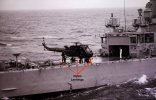
Pic 2

A pic I took of HMS Rothesay's Wasp with my mate Kim casually dangling a leg!!! It shows the wheel configuration.

Another useful function the Wasp had to keep it on deck in rough seas was negative pitch on the main rotors. The pilot would 'push' the collective lever through a stop and literally push the Wasp onto the flight deck keeping it in place. Although I have been in one with neg pitch applied and we slid across the deck. Luckily the quick thinking deck crew ran out and banged lashings on before we toppled into the sea. (Scary :poop: ).

That's all for today folks. Hopefully I'll get back to the little plastic thing tomorrow!!
Hope you have all fallen asleep!!
Doug
Fascinating. Quite complex and sophisticated for something that looks like a shopping trolley with an engine on top……..
 
Thread owner
Thanks Doug that was very informative. My first helicopter ride was in the Army's version of this, which I believe was the Scout.
Indeed the Scout. No wheels - skids!! More power as well due to the reduced weight, no undercarriage, no flotation gear!!!
 
Thread owner
Fascinating. Quite complex and sophisticated for something that looks like a shopping trolley with an engine on top……..
Describes it to a 'T' Tim.
Everything was basic - very basic. But it worked.
It was always joked about it being elastic band powered. Made me think!! So I made a huge key for the back and used to ask passengers to wind it up. To help with this, the pilot would start descending then if the passengers played along he would start going up again!!! All good fun.
 
Okay, semi-serious question. Why do the Navy variants of the Lynx and Wasp have wheels, while the Army variants have skids? You'd sort of think it would be the other way around so they don't roll around on a pitching deck. Or did I just answer my own question?
 
Thread owner
Okay, semi-serious question. Why do the Navy variants of the Lynx and Wasp have wheels, while the Army variants have skids? You'd sort of think it would be the other way around so they don't roll around on a pitching deck. Or did I just answer my own question?
Never a stupid question if you don't know Chris!!

If the Wasp had skids;
1. it, Wasp), would not have the manoeuvrability on deck as mentioned in my previous post.
The aircraft are lashed to the deck immediately prior to taking off. If they, (Wasp & Lynx), had skids they would be unable to turn into wind before take off.
Pic
Wasp lashed to deck with quick release nylon lashings.
Scan10009.jpg

The way it works in basic terms. Aircraft need to take off into wind. The helicopters on deck are sitting in the lee of the ships superstructure, thereby being denied wind! So, to get wind across the flight deck the ship turns to get a suitable wind to enable the wind to be facing the helicopter. (Into wind). A warship will maintain its operational course until immediately prior to take off. Then when ready to launch, the ship will turn, give the helicopter a flying wind, get shot of the helicopter and then return to its operational course.

2. If the Wasp, (can't speak for the Lynx), had skids. It would be unable to get the weapons onto the weapon hard points under the helicopter as the weapons wouldn't have the clearance. (I'm talking torpedoes and depth charges).

The down side of the undercarriage and flotation gear is the weight. It reduces the payload the Wasp can carry. Before every sortie, the pilot and myself would calculate the weight to know what we had, if anything, weight wise to play with. Likewise, if we had a specific weight to carry, we would then sit and calculate how much fuel we could carry and top up accordingly. We had a Max AUW, (Maximum All Up Weight of 5500Lbs. Not a great deal. The pilot and myself know our weights dressed for flight and assumed each passenger was 200Lbs. And so it went on.

The gearbox was fine if we didn't stress it but if we exceeded 107% torque it meant the maintainers would have to change the gearbox. (More to it but that's the basics).
 
Now it makes perfect sense. I knew carriers turned into the wind to aid take-off (I assume they still do with jets and catapults), but I never appreciated helos would need that too
 
Thread owner
Now it makes perfect sense. I knew carriers turned into the wind to aid take-off (I assume they still do with jets and catapults), but I never appreciated helos eould need that too
We had a little booklet we always used and referred to call SHOLS. Ship, Helicopter Operating Limits. It was the Bible for all naval vessels and a few civvy ones too. Not just for us but RN ships officers of the watch who controlled the ship when at sea. If he got his calculations wrong for our wind over the deck it could make life very difficult indeed!!!
 
I was just thinking the last helo I built was the Matchbox Navy Lynx when it first came out, then I remembered the, pre-painted, Hind-A last year. It's 1/144, so easily missed

And smaller than this Wasp

Probably
 
Thanks Doug that was very informative to us that haven't a clue about how helo's operate.
 
Just had a catch up Doug,all very informative. You are too hard on yourself mate. Only your 7th(?) kit and you're doing stuff like this at braille scale? And without magnifying aids? Hats off sir!
 
Thread owner
Just had a catch up Doug,all very informative. You are too hard on yourself mate. Only your 7th(?) kit and you're doing stuff like this at braille scale? And without magnifying aids? Hats off sir!
Thanks Neil, too kind sir. (it’s 5th!!!) But it’s still not a good kit!!! I’m sure the more experienced would do better but I can only do my best and battle on.
 
PLUS back to this wheel bussiness if it hadnt wheels you would not have been able to role it into the ships hanger ?
 
You're making a great job of a troublesome kit. thanks for adding the info too, very informative indeed.
 
There is the thoyght that you learn more from a difficult or even bad kit than from a high quality well-engineered one

What you learn is you never want to build another one of those kits / manufacturers ever again!:tongue-out2:
 
There is the thoyght that you learn more from a difficult or even bad kit than from a high quality well-engineered one

What you learn is you never want to build another one of those kits / manufacturers ever again!:tongue-out2:
YES Steve the duck you are right there like my tomcat build never had such a bad fiittin build like Doug but trouble is for me ive got anothe trumpy SUPER HORNET TO BUILD an just hope its a better fit
 
Thread owner
PLUS back to this wheel bussiness if it hadnt wheels you would not have been able to role it into the ships hanger ?
Very true Chris. However as Jakko has mentioned, the helicopters that only have skids are moved about by fitting jockey type wheels to the skids to move them about. Having skids when operating from ships is simply not practicable, as the helo's have to face into wind on take off. As I mentioned yesterday, the ship moving along will produce its own wind so it and the helicopter have to move to give the helicopter a relative wind to launch into!!
I should add, it's similar to recover the helicopter too. We fly down a pre determined line by the use of a light beam called a GPS, Glide Path System. Green on line, red - too low, amber - too high. then the ship will turn to give us a suitable wind to enable us to land.
I've actually hovered alongside a war canoe and the ship didn't give us a wind for landing. Fuel fell below our designated minima, so the pilot declared a 'Mayday'! We were on fumes!! The ship bounced round onto a heading that gave us a good wind for landing. Whilst hovering over the deck immediately prior to sticking it on the deck - fuel ran out. We landed with a serious bang!!!! My boss, (the pilot), stormed up to the operations room so 'discuss' flying operations with the PWO, (Principle Warfare Officer), to have an exchange of views on flight safety!! By all accounts the ops room emptied. End result; Pilot 1 - PWO 0.
It has it's moments operating a helicopter from a ship at sea!!!
 
Thread owner
There is the thoyght that you learn more from a difficult or even bad kit than from a high quality well-engineered one

What you learn is you never want to build another one of those kits / manufacturers ever again!:tongue-out2:
I agree Chris. I will NEVER build another LF kit ever!! I would rather bang a hit stick on a previous build and rebuild that than build another LF model!!
 
Back
Top