Theme editor

Scale Model Shop

Help

Status
Not open for further replies.

Greyhead

New member
Joined
Oct 13, 2004
Messages
581
Reaction score
0
Points
0
1/3
Thread owner
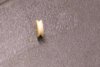
My next scale project, an SE5a, is at the early design stage. One thing I’m considering is to use scale closed loop control runs for the ailerons and elevators but for this I need some small pulleys. They need to be near enough the correct dimensions as they will be visible through the transparent inspection covers. See Photo.

The size I need is approx. 9mm diameter by 3mm thick to take 0.8mm control cable. Does anyone here know where I might get some? I thought this sort of thing might be used for model boats but I’ve “Googled” the Internet without much success.

Any suggestions will be gratefully received.

View attachment 13424

View attachment 125950

 

Attachments

  • SE5a Control.jpg
    SE5a Control.jpg
    5.2 KB · Views: 0
Thread owner
Thanks Jim, from their web site it looks quite promising, I've sent for a catalogue, I'll let you know the results.
 
If you are looking at making quite a number of pulleys, and you might do so again in the future, it may well be worth while looking into the possibility of getting hold of a small bench top modellers lathe.

Emco Unimats go second hand for about £150.00, depending on model and condition, and making pulleys to your exact dimensions would be very easy with one of these.
 
Thread owner
Nice idea Richard, now can anyone lend £150?

Seriously I know that this would be the ideal solution but I really don’t do that much “engineering” when building model aircraft so don’t feel that I could justify the expense to senior management (the wife!)
 
Catalogue search

Hello all, Grahame, while searching through my copy of "Squires" catalogue last night, I came across the following items which might be of interest and by no way close to the £150 spend mark :music_too

On page 356 of the Yellow 2006 catalogue there is a selection of size of miniature brass pulley wheels

Ref ECP050 4mm dia x 1.4mm bore £ 0.35 each

ECP051 6mm -1.4mm £ 0.35

ECP052 8mm - 1.4mm £ 0.40

ECP053 10mm - 1.4mm £ 0.40

ECP054 12mm - 1.4mm £ 0.55

ECP055 15mm - 1.4mm £ 0.55

4850/02 2mm 0.8mm £ 2.95 /10 pk

4850/04 4mm - 1.1mm £ 2.95 /10 pk

4850/06 6mm - 2.0mm £ 2.95 /10pk

sorry there is no indication of thicknesses.

Remember the only stipulation for carriage paid is £ 7.50 can't be bad.

If anyone needs their tel no it is 01243 842424 or order the catalogue on-line www.squirestools.com No Shop feature as yet.

cheers

Jim
 
Thread owner
No luck with HPC Gears; the web site states:

VB Round Belt Pulleys

2mm, 3mm, 4mm, 5mm, 6mm, 8mm, and 10mm

but the size is the diameter of the belts not the pulleys; the smallest pulleys are 20mm diameter.

Still awaiting the Squires catalogue, although I’m a bit concerned about the weight of brass pulleys.

They do produce custom pulleys if all else fails.
 
Thread owner
My search for small, thin pulleys has proved to be fruitless, time to exercise the old grey matter.

The end results are quite acceptable for the use to which I’ll be putting them; they will only really be acting as guides for the control cables and as such will turn slowly and without much force being applied to the pivot.

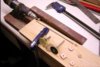
Photo 1 shows all the stages of construction and the tools used; a mini drill with home made horizontal stand, a sanding block and a length of piano wire.

First two 10mm squares of circuit board are glued together with cyano, a centre point drilled and then roughly rounded.

The “sandwich” is then fitted to a mandrel, spun in the mini drill and the sanding block used to take it down to the required diameter and to make it truly circular.

With the drill in the horizontal stand the groove is cut using the length of piano wire, which is bent at 90° and cut off just after the bend to form a cutting tool to produce a round-bottomed groove.

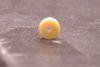
The whole process only takes about 10 minutes per pulley.

View attachment 13456

View attachment 13457

View attachment 13458

View attachment 125982

View attachment 125983

View attachment 125984
 

Attachments

  • pulley 1.jpg
    pulley 1.jpg
    6.6 KB · Views: 0
  • pulley 2.jpg
    pulley 2.jpg
    4.9 KB · Views: 0
  • pulley 3.jpg
    pulley 3.jpg
    4.7 KB · Views: 0
Well Graeme,

You maybe don't have the readies for a lathe but you have done the next best thing and that is make one for yourself!! Excellent job and a prime example of necessity being the mother of invention. I am sure that with this technique you will be able to make as many pulleys of whatever dimensions you want.

Don't fall into the trap though of thinking that just because a pulley is not rotating it is not heavily loaded. It can be just as heavily loaded as a rotating pulley but it has the additional concern of having the load on the same small area of the pin. As the pulley rotates back and forth it acts as a sawing action which can lead to an early failure of the pin or premature misalignment of the pulley.

Not knowing what sort of loading you are applying I would consider adding a metal bush to the pulley centre. This can easily be made from a short length of brass tube bonded to the pulley. This can then run on a brass pin, making the assembly very much stronger and more reliable.

If yours are very lightly loaded this may be complete overkill but, with aircraft control surfaces you cannot afford a failure from an unreliable linkage so it may well be a prudent measure.
 
Excellent job Graeme and well solved,can I also suggest that you incorporate a simple shroud to stop the cable jumping or riding over the pulley,take a look at full size aircraft to see what I mean,certification of full sized aircraft require this on control cable pulley runs,nothing complicated is required just a small piece of tinplate bent over and resting clear of the pulley will do.
 
I have just realised the shroud is already there in your photograph as the cable 'anti-jump' this looks like a modern modification to the S.E.5A,probably for certification at Old Warden.
 
The raised triangular piece is made from celluloid,note the period frayed fabric edges typical of WW.1 machines to stop any fabric lifting in the slipstream,the frame is simply doped onto the aircraft fabric,then the hole is cut in the centre and fabric re-inforcing added,the name for these frames are 'Woods frames' I really do not know who 'Woods' was ?
 
Status
Not open for further replies.
Back
Top