Theme editor

Scale Model Shop

Mad Idea

  • Thread starter Thread starter Guest
  • Start date Start date
Status
Not open for further replies.
G

Guest

Guest
Thread owner
Just a rambling late night idea. The awesome real rust on tiking's models got me thinking.

As most of you know, plastics can be chrome plated. I wondered if anyone had any knowledge about the possibillity of plating plastic with steel or a metal that corodes in a similar way. This would take one hell of a lot of weathering work out of the build. I mean plate the plastic, dunk in vinegar....voila!

Probably not doable but i thought i would ask..
 
Thread owner
i doubt it terry. unless you have an elctro-plating machine and something hot enough to melt down the metals and presses to make them into foils and probably loads of other stuff in your garage im guessing its not easy!
 
Thread owner
Howdy Tiger,

Well, having been a machinist working with copper, steel and aluminum for some 21 yrs now, I know for a fact that you can coat plastic with sprayed on molten tin (Sn) plating.

I work in the power distribution market, our factory builds transformers, the ones on poles, not the ones that go from car to jet lol. Anyway, we tin plate copper conductors and have had call to tin plate plastic before with a spray on tin plater (similar to an airbrush).

Now industrial tin is mixed with lead which is hazardous and turns black as it oxidizes (actually tin is a hazardous "Heavy metal" just like lead also). But, we occassionally do work with tin with a lesser amount of lead, it oxidizes more like a ferrous metalturning brown or rust colored with some dark streaks in it due to the remaining lead in the metal.

Anyway, back to what I was saying about plastic, we occassionally have reason to tin plate plastic, and using this "sprayer, the molten metal cools instantly as it is applied to the object being plated....there is very little heat transfer. So, I would say that yes you could "metalize" plastic with real metal, however it would have to be a soft metal that melts at low temp, which would more than likely leave you with few choices other than "heavy metals" such as tin, lead, chrome, etc..etc.

The cost of tin is very expensive also, to the point where it would be cost prohibitive to the average person. Back in the mid to late 80's, Argentina nearly cornered the tin market and ever since then, the cost has done nothing but go up year after year.

anyway, I hope this helped,

Have a good evening,

Greg
 
Remember in the early days of plastic models,you could buy lots of chromed kits,some had individual sprues others were complete overall chrome.

The problem was sticking the items together,a good scraping and sanding being needed.

How about developing a self rusting paint ? the paint could be activated with say salt water as the regent.

You would then just paint it on and rust up the bits that you wanted ? just a thought, perhaps using iron which always seems to rust up quicker than anything else ?
 
Thread owner
A "paint" made from a mixture of wallpaper paste,fine iron filings and ordinary domestic salt is used by ship modellers and the submarine builders to good effect. Let the mixture dry then keep wetting it with water for a few days. the salt dissolves leaving a pitted appearance while the iron does really rust leaving streaks where the water drains off the model. When satisfied with your efforts , let it dry and fix with your favourite coating, varnish, Klear etc. Some experiments along this line might be worthwhile.
 
Thread owner
How about developing a self rusting paint ? the paint could be activated with say salt water as the regent.

You would then just paint it on and rust up the bits that you wanted ? just a thought, perhaps using iron which always seems to rust up quicker than anything else ?
now theres the idea!
 
Thread owner
Howdy guys and gals,

Ok, I just want to make a few observations then I will provide a tip I found online for making rust on models.

First, WWI cloth covered planes rarely rusted, second, Aluminum skinned aircraft do "oxidize", but not in the same way Iron rust. Aluminum oxidized with a more whitish powdery looking "rust" and will cause the metal to "dull" over all. Copper and brass and similar metals oxidize "green", soft metals such as lead, oxidize black (hence the historic use of lead in pencils).

This tip is for the making of "Iron oxide" for use on models, in this case train cars, but could be adapted for use on military vehicles. The article was "barrowed" from: http://www.nscale.net/Article161.html by Paul Orvosh, Jr. (PJ) of Jacksonville, FL. USA.

Putting rust weathering on models can be accomplished in many ways. Paints, chalks and pastels are the most common methods. This article will discuss making and using real rust for model weathering.

  1. Materials & Methods
  2. Steel wool
  3. Glass container
  4. White vinegar
  5. Water
  6. 70% IPA
  7. Jet dry
  8. Prototype photos
  9. Fine paint brushes
  10. Toothpicks
  11. India ink
  12. Polly scale acrylics #505366 US Red Earth
  13. Tube oil paint – burnt sienna
  14. Testors dull cote (spraycan)
Making rust

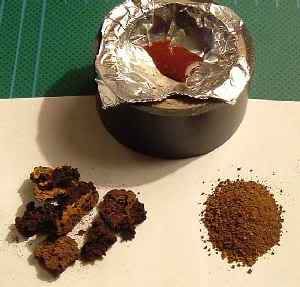
For the chemists out there rust is made by the oxidation of iron. Iron + Oxygen = Iron oxide (2Fe + 3O2 = Fe2O3). The easiest way to make rust is to scrape it off of something that Mother Nature has already taken care of like a railroad spike. I made rust with steel wool and white vinegar in an open glass container. The vinegar helps etch the steel and oxygen in the air and water in the vinegar naturally oxidizes it. I allowed the rust to form over a 3-week period while stirring occasionally. At this point the water was completely evaporated and all the steel wool had fallen apart and formed rust. Larger pieces were separated and the rest was crushed to form rust powder. Thanks to Joekc6nlx for suggesting peroxide and/or chlorine bleach which act as oxidizers and could aid is speeding up the formation of rust.

sample_080704_003_g.jpg


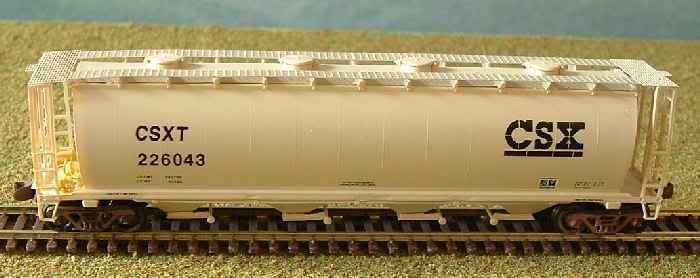
Model

Other than the truck faces, which had been painted with model master flat enamel rust, an un-weathered IM 4 bay cylindrical hopper was used for this article.

before_shot_080504_g.jpg


Prototypes

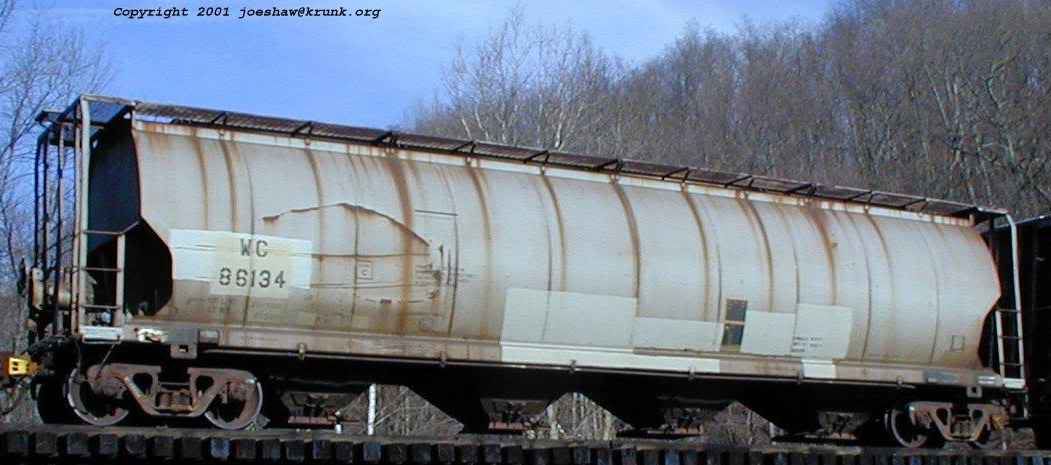
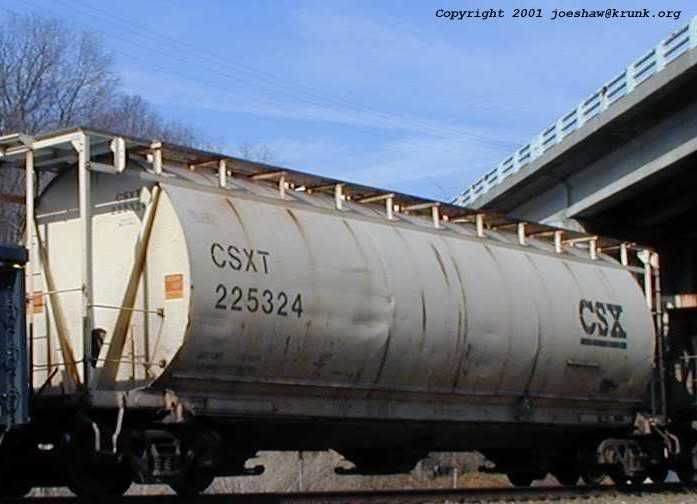
Rust can be found just about anywhere there is exposed steel. Here are some examples of the prototype effects that I was trying to achieve on cylindrical hoppers. Note that the rust mainly forms on the upper roofwalk supports and bleeds downwards. Additionally there are other smaller rust bleeds from areas on the roof. There is also rust on the panel weld lines but it is not nearly as prominent. Note the big gash in the WC hopper and the rust that formed on this exposed metal. This would be a good feature to try and achieve also.

wc86134-1_krunk2.jpg


This CSXT hopper shows very similar effects.

csxt225324_krunk2.jpg


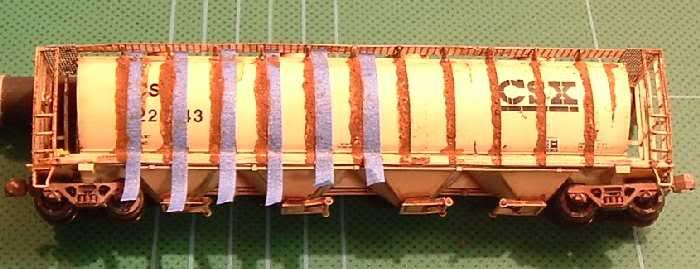
Many thanks for the prototype photos from www.krunk.org courtesy of Joe Shaw. Krunk.org is an excellent and well organized website dedicated primarily to SW Virginia and West Virginia railroading. I spent about 12 years in Roanoke, Christiansburg and Blacksburg so many of the locations are familiar to me. Applying rust to the model I first applied thin India ink and red earth acrylic washes to the hopper. It turns out this was a mistake, the washes should have been applied last. Powdered rust was made into a slurry by mixing with some water/IPA and a small drop of Jet Dry. I applied the slurry very thick with a small paintbrush and used tape to make sure the bleed lines would be straight.

pre_080604_004_g.jpg


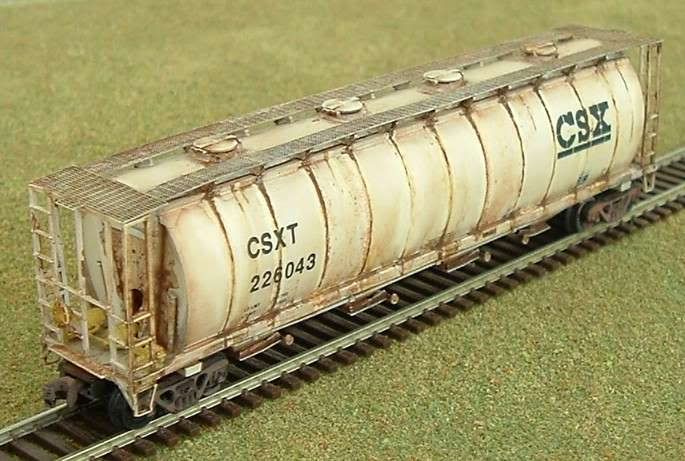
The rust bleed lines were scraped carefully with a small eraser and sharpened toothpick. Thanks to 70runner for suggesting the use of an eraser. Dull cote was applied and worked very well to fix the rust in place. Further washes were done with both acrylic paint and oil paint.

post_080704_004_g.jpg


Conclusion Well first the pros. For the tinkerer or experimenter, this is a fun project to take on. Rust is a unique media to work with. I would say it is somewhere in between chalks and paint. Very fine rust powder can be applied just like chalk and the painted on rust slurry can be removed easily before it has been fixed. Now the cons. Be careful where you wash your hands after working with rust. Rust slurry will stain just about every surface it comes into contact with especially porcelain sinks. Overall, paint and chalk/pastels are easier to work with and produce better results. Dependent on the skill level of the modeler. Other weathering uses for rust could include the stippled effect that is often seen on railcars or the rust areas seen on locomotives around areas where the paint has worn away from the intense heat produced by dynamic brake resistors.

I hope this helps someone, I will add a few more since there are numerous methods for creating rust for modeling.

have a good day,

Greg
 
Excellent research Greg,the most obvious things like degraded wire wool ! that railroad wagon certainly looks the part.

But go easy,a oxidising aircraft would be unserviceable but for one standing outside alloy corrosion is common,as pointed out it forms a white powder,aircraft toilet areas are prone to rusting through,in fact a Vickers Viscount broke in two once on the ground due to severe oxidisation of the bulkhead in that area.

Really it just looks at first like a dull time worn alloy,look in any outside storage air museum to see the effects,the cure to stop it is bicarbonate of soda mixed into a paste and spread across the metal,the problem is that alloy is coated with a protective coating,people that polish this are actually destroying that suface protection.

But you will not find true iron rust in aircraft because there is very little or no iron present.

As for those railroad items well that is a totally different story.
 
Thread owner
Lovely tutorial Greg. I really enjoy playing with rust effects and trying to create a realistic, lifelike finish.

As you so rightly point out, you can't beat studying real life. Get hold of as many pictures as you can and study them and practise on scrap until you are happy to give it a go.
 
Status
Not open for further replies.
Back
Top