

I needed something to be able to make the timber I required for the models to be of a very uniform thickness, so I checked on the web and found a working drawing for a Thickness Sander.
This was tad on the larger size for the timber bits that I required, so I drew it up to a size that what I reckoned, would be about the correct sized machine, for what I needed.
Found a bit of scrap Aluminium sheet at work and the boss said - ‘go’.
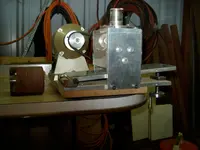
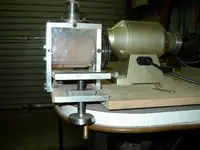
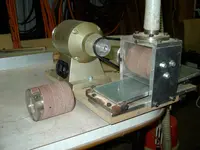
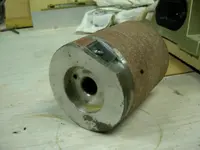
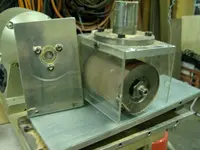
Mainly of Aluminium construction and has a sheet of 1mm glass on the rise and fall table, to enable easy pushing of the timber thru the sander. It has two drums for the sanding, they are loaded with different grades of Emery Paper, one coarse and the other fine. Easy to change the drums, whenever they are needed to be changed.
This works so well, I can keep shoving a bit of timer into the machine until it was about 0.010 thous thick, the next time thru the sander it turns to $hite. The timber was so thin, you can hold it up to the light and nearly see thru it, but it showed all the tiny minute grain holes that the timber has.
The table is raised by the hand wheel underneath the front of the table, the thread is M14 x 2, so with the drum at the centre of the table, as you raise it one turn, the table raises 1mm, it’s very accurate and the thickness can be controlled very very easily.
The timber I use for my models is of the Beech family, it’s Tasmanian Myrtle, the grain is just about non existent, it is a very, very fine grained timber, that could be used from 1/87 th scale right thru to full sized furniture, bloody marvellous stuff actually.
It takes a coat of paint just like a sheet of polystyrene, big bonus actually, you can give it an undercoat WITHOUT any grain standing up and ruining the fine finish that I am after. If some grain does try to rear its ugly head, then a used toothbrush rubbed over any imperfections, soon removes it. The only time I have to do any sanding, is if I have stuffed it up and got some runs on the model.
Now other modellers use the actual timber that the full sized item is made from, but to me, some of these timbers have a very opened large pored grain.
So when you use it in a model, it actually looks like crap with bloody great big holes in it from all the open pores in the grain.
Choice is your’s alone to use whatever Timber you want too, but take a close look at the timber you want to use and think of what it would look like when it’s used on a model, would it have any big unsightly holes showing in the finish of the timber.
So as you can see, it takes a lot more effort, than just buying another sheet of whatever thickness that is required of polystyrene, or some more bit’s of Evergreen, plus some more glue, to make one of these “scratchbuilt” models.
Not only do I have to make the timber the correct thickness, I have had to make the machinery that can do all this for me as well.
Anybody got any questions ? ------
A few photo’s showing the Thickness Sander, followed by a photo showing the grain in the timber I use, Tasmanian Myrtle ( Northafagus Cunninghamii ) WITHOUT any pore hole craters showing AT ALL.
This was tad on the larger size for the timber bits that I required, so I drew it up to a size that what I reckoned, would be about the correct sized machine, for what I needed.
Found a bit of scrap Aluminium sheet at work and the boss said - ‘go’.
Mainly of Aluminium construction and has a sheet of 1mm glass on the rise and fall table, to enable easy pushing of the timber thru the sander. It has two drums for the sanding, they are loaded with different grades of Emery Paper, one coarse and the other fine. Easy to change the drums, whenever they are needed to be changed.
This works so well, I can keep shoving a bit of timer into the machine until it was about 0.010 thous thick, the next time thru the sander it turns to $hite. The timber was so thin, you can hold it up to the light and nearly see thru it, but it showed all the tiny minute grain holes that the timber has.
The table is raised by the hand wheel underneath the front of the table, the thread is M14 x 2, so with the drum at the centre of the table, as you raise it one turn, the table raises 1mm, it’s very accurate and the thickness can be controlled very very easily.
The timber I use for my models is of the Beech family, it’s Tasmanian Myrtle, the grain is just about non existent, it is a very, very fine grained timber, that could be used from 1/87 th scale right thru to full sized furniture, bloody marvellous stuff actually.
It takes a coat of paint just like a sheet of polystyrene, big bonus actually, you can give it an undercoat WITHOUT any grain standing up and ruining the fine finish that I am after. If some grain does try to rear its ugly head, then a used toothbrush rubbed over any imperfections, soon removes it. The only time I have to do any sanding, is if I have stuffed it up and got some runs on the model.
Now other modellers use the actual timber that the full sized item is made from, but to me, some of these timbers have a very opened large pored grain.
So when you use it in a model, it actually looks like crap with bloody great big holes in it from all the open pores in the grain.
Choice is your’s alone to use whatever Timber you want too, but take a close look at the timber you want to use and think of what it would look like when it’s used on a model, would it have any big unsightly holes showing in the finish of the timber.
So as you can see, it takes a lot more effort, than just buying another sheet of whatever thickness that is required of polystyrene, or some more bit’s of Evergreen, plus some more glue, to make one of these “scratchbuilt” models.
Not only do I have to make the timber the correct thickness, I have had to make the machinery that can do all this for me as well.
Anybody got any questions ? ------
A few photo’s showing the Thickness Sander, followed by a photo showing the grain in the timber I use, Tasmanian Myrtle ( Northafagus Cunninghamii ) WITHOUT any pore hole craters showing AT ALL.

