

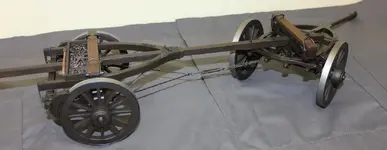
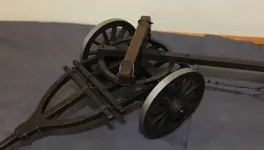
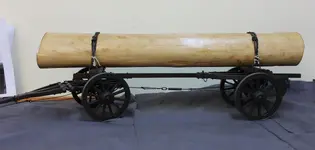
Heavy Timber Waggon, — made to 1/12th scale, or, the old ‘one inch to the foot’ scale.
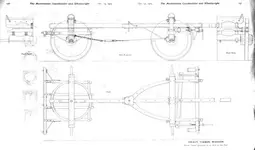
This model had been made from the drawings of J.E.Bishop, printed in “The Australasian Coachbuilder and Wheelwright, Oct 1903”.
The working drawings in ‘The Australasian Coachbuilder and Wheelwright’, are what the original vehicle builders used to make the full sized vehicles.
These drawings have every detail that is required for the full sized vehicle including showing where every nut and bolt has to go.
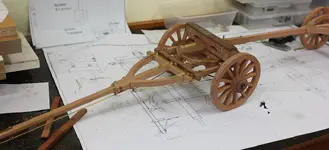
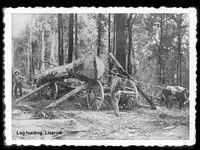
This type of vehicle was used to haul the timber from the forests, it could have been used with either horses or bullocks, had plenty of 1/12th scale horse drawn models, so, I changed out the shafts used for horses and put in a pole that’s used by bullocks.
Still well within what you could call an “historically accurate” scale model.
Bullocks can work far better in the hilly country, where-as horses were far quicker over any flat country.
Not to many forest out in the flat country, so bullocks were the preferred animal to be used carting logs from out of the hills in the bush with these vehicles.
The way it is set-up, you could have up to 20 or more bullocks pulling in pairs, all depended on how hilly the country is your working in, and how big the ‘toothpicks’ were in that area. Brakes work on the model just as per the full sized vehicle.
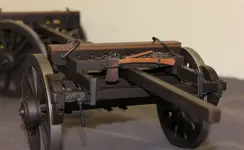
I make every nut and bolt for the models, mainly 12 BA sized, but I do use 8 BA, 10 BA and 14 BA as well, I even had to make a nut making machine, so I can make the nuts by the thousands. All the small coach-bolts are hand made on a lathe using bronzing rod, which is much harder than just plain brass, cuts easier and takes a thread without breaking off like brass does.
The main material that I use in the construction of the models is a timber called Tasmanian Myrtle, ( Nothofagus Cunninghamii ), it has a very close grain structure and there are NO pore holes in the timber to ruin a fine finish, it even takes a coat of paint like a piece of styrene plastic, with virtually NO grain lifting when painted, B-O-N-U-S, eh.
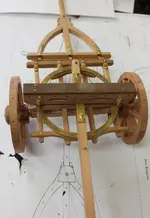
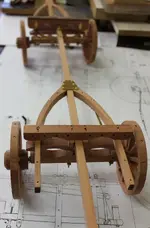
All timber construction as per the drawings once again, all the smaller bits of metalwork is Brass, as can be seen in the photo’s of the construction of the model.
The tyres are turned from steel, then heated over an electric stove so the bright shiny steel turns a blueish black colour, to give it the look that it had been thru the fire before fitting the hot tyre to the fellies.
I have added a photo of a full sized working Log Waggon, which is owned by a Mr Phil Thompson from the Numinbar Valley, which is just in the hinterland behind that glitzy concrete canyon called Surfers Paradise, only 20 mile away actually. He still regularly falls timber and retrieves it from the bush with a working team of bullocks, bit of an anomaly for today, eh.
I used his Log Waggon for a reference, for all the hardware on the pole that’s required for a bullock team.
This model had been made from the drawings of J.E.Bishop, printed in “The Australasian Coachbuilder and Wheelwright, Oct 1903”.
The working drawings in ‘The Australasian Coachbuilder and Wheelwright’, are what the original vehicle builders used to make the full sized vehicles.
These drawings have every detail that is required for the full sized vehicle including showing where every nut and bolt has to go.
This type of vehicle was used to haul the timber from the forests, it could have been used with either horses or bullocks, had plenty of 1/12th scale horse drawn models, so, I changed out the shafts used for horses and put in a pole that’s used by bullocks.
Still well within what you could call an “historically accurate” scale model.
Bullocks can work far better in the hilly country, where-as horses were far quicker over any flat country.
Not to many forest out in the flat country, so bullocks were the preferred animal to be used carting logs from out of the hills in the bush with these vehicles.
The way it is set-up, you could have up to 20 or more bullocks pulling in pairs, all depended on how hilly the country is your working in, and how big the ‘toothpicks’ were in that area. Brakes work on the model just as per the full sized vehicle.
I make every nut and bolt for the models, mainly 12 BA sized, but I do use 8 BA, 10 BA and 14 BA as well, I even had to make a nut making machine, so I can make the nuts by the thousands. All the small coach-bolts are hand made on a lathe using bronzing rod, which is much harder than just plain brass, cuts easier and takes a thread without breaking off like brass does.
The main material that I use in the construction of the models is a timber called Tasmanian Myrtle, ( Nothofagus Cunninghamii ), it has a very close grain structure and there are NO pore holes in the timber to ruin a fine finish, it even takes a coat of paint like a piece of styrene plastic, with virtually NO grain lifting when painted, B-O-N-U-S, eh.
All timber construction as per the drawings once again, all the smaller bits of metalwork is Brass, as can be seen in the photo’s of the construction of the model.
The tyres are turned from steel, then heated over an electric stove so the bright shiny steel turns a blueish black colour, to give it the look that it had been thru the fire before fitting the hot tyre to the fellies.
I have added a photo of a full sized working Log Waggon, which is owned by a Mr Phil Thompson from the Numinbar Valley, which is just in the hinterland behind that glitzy concrete canyon called Surfers Paradise, only 20 mile away actually. He still regularly falls timber and retrieves it from the bush with a working team of bullocks, bit of an anomaly for today, eh.
I used his Log Waggon for a reference, for all the hardware on the pole that’s required for a bullock team.


