Theme editor

Scale Model Shop

Shellcase

stillp

SMF Supporters
Joined
Nov 17, 2016
Messages
8,322
Reaction score
309
Points
83
1/3
Thread owner
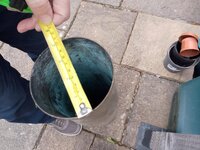
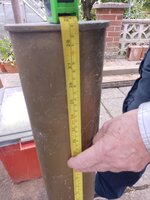
Some time ago someone on the forum was finishing a 3D-printed artillery shell, and I mentioned in his thread (sorry, I've forgotten who it was) that I had a fair size shell case in the shed but it was buried and difficult to access. However, now we've demolished the old shed and replaced it with a brick outhouse I've been able to take some photos of it:
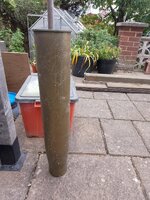
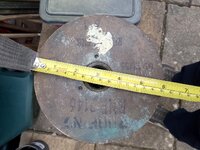
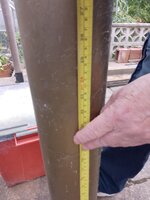
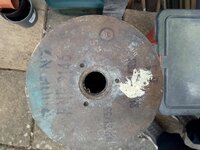
IMG_20251007_140905.jpg IMG_20251007_141256.jpg IMG_20251007_141128.jpg IMG_20251007_141222.jpg IMG_20251007_140854.jpg IMG_20251007_141226.jpg
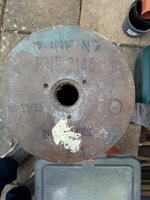
I wonder if anyone on here can explain any of the markings? I assume the 11/63 is a date code, so it's not a war relic. When my new wife and I moved into our first house, in 1970. this shell case was in the garage. Surprising really as the house had been unoccupied for some months, and everything remotely portable had been taken, including light fittings and even some light switches!
At one time we were using it a a plant stand, with a spider plant whose pot just fitted in the narrow end, but it wasn't very stable when our daughter was toddling, so it was put away except for moving to the next three house.

I'd like to know more about it. I've no idea what it's worth but it'd be a pity to scrap it.

Pete
 
It’s got the crows foot marking on it so it’s British. Possibly a 105mm L7 Centurion round? Complete conjecture on my part of course.
 
Thread owner
Thanks Tim. Your second link has some dimensions, and the case discussed there is shorter than mine. Maybe a 4" QF naval gun? Were there any 4" artillery guns in the 1960s?
Pete
 
Thread owner
Easier to read when it's the right way up:
IMG_20251007_140854.jpg
The stamped numbers/letters include 411**Mk (* for unclear characters), 16 , the word 'GUNS' which seems unnecessary, a large 2; under the broad arrow is FV* for Fighting Vehicle; E.C. (surely not European Community) and OM inside a hexagon. The number under the splodge of white paint is I think 1957, and just right of that is TRE and the date 11/63. On the left LOT 120 is clear.
The printed characters include **OF No 7 (Ordnance Factory?); RNP 2146; W in a circle; I think the printed characters near the lot number are GD12/55; by the paint splodge RE****CRB and under that seems to be A1.
I'm wary of trying to remove the white paint as stripper might remove the printed characters as well.
Lots of Googling hasn't helped - where are all our ex-military bods?
Pete
 
Easier to read when it's the right way up:


where are all our ex-military bods?
Pete

Not sure we have any tankies or arty on site?

I doubt the FV stands for Fighting Vehicle....... Back then this round was used by a field gun, a spg (abbot) and a tank (cent) so it wouldnt be specific

I dont think the OF means Ordence Factory cos i dont think they were numbered like how they did in Sovbloc countries...... And i grew up just down the road from one and that deffo had a name

Im intrigued by this...... If it was a small arms round theres loads of books...... I even follow a guy on youtube who such an expert that hes classed as an FBI Consultant Expert for court cases....... But cos its a thing that goes bang a bit louder than usual im struggling to find info

Wonder if the 12/55 is december 1955?....was the centurian the only thing using the 105 at that time?
 
Thread owner
Hi Paul, thanks for your input. We used to have at least one tanky, Mike the scratchbuilder, but he left and set up his own forum which I can't find now.

The Abbot was designated FV433, and the Centurion was FV4007, so FV seemed to make sense - what field gun used the L7 round? If indeed this is from an L7 as the one described in Tim's second link is a few inches shorter than mine. There might be another character after the FV though.

Wikipedia tells me that the Abbot didn't use the L7 gun, but a completely ne design, the L13, but that had a separate shell and cartridge so I don't think it's one of those.

I agree that Ordnance Factories were known by a name rather than a number, but I think that during wartime they were given numbers to avoid giving away their location. If that's correct, it probably took a few years for the naming system to be changed. Certainly the ones I lived near were known as ROF (Placename)rather than numbered.

Filling factories were numbered in WW1 - my grandfather was a Checker in one near Hereford, after he was discharged disabled having been shot in the shoulder at Gallipoli - he was only 16! I can't complain though, that's where he met Grandma who was one of the canary girls, otherwise I wouldn't be here.

Yes, intriguing isn't it. I think I should send these photos to the Royal Armouries Museum in Leeds to see if they can help.

Pete
 
Thread owner
That's a good idea Paul. I've emailed Royal Armouries Museum so if no results from them I'll try Bovington. Or even Duxford - do they still haven teir Land Warfare hall?
Pete
 
Thread owner
That would be an L7 round Scottie, the cartridge for which is 105 x 617 mm but my case is too long, i'ts about 730 mm.
Pete
 
Hi, just for fun I asked Chatgtp (free version) to look a the photo and explain the markings, not that useful but this is what it answered :

Short and honest: this is very likely the base (headstamp) of an artillery cartridge case — not a small-calibre cartridge head, but a larger case from a gun round or practice shell. I cannot be 100% certain of the exact calibre/type from a single top-down photo, but below I explain what the markings almost certainly mean and give my best judgements. Safety first


If you found this case and you are not sure whether it is empty/inert: treat it as potentially dangerous. Do not open it, do not carry it about, and contact the local police or bomb-disposal / EOD team if there are any signs that an explosive charge or fuze is still present. Explanation of the visible markings (what they usually mean)
  • LOT 120 — lot number: the production batch; used for tracking production and quality control.
  • 11/63 — very likely a date: month/year (November 1963), or sometimes the month/year of proofing/test.
  • EC — could be initials of an inspector, a contract code or a factory code (not “European Commission” here).
  • Circled symbol / OM or O W in a circle — typically a manufacturer’s or proof mark from a factory or proof house. Factories and proof houses use many small distinctive stamps.
  • Black stencilled letters (for example something like “RNP 2015”) — often applied later: inventory number, refurbishment year, storage or range identification. Could be a modern re-stencil.
  • Scratched / engraved text (eg. “GUN…” or “REMOVE…”) — hand-engraved notes by users/military personnel (for instance instructions or extra ID).
  • Small drilled holes or holes around the centre — may be mounting/fixing holes or relate to the primer/fuze location. The large central opening in your photo suggests the fuze/primer is missing or has been removed.
What this implies practically
  • The lot number and the date indicate mid-20th century manufacture (around 1963).
  • The combination of stamps and a proof mark suggests military manufacture and proof testing.
  • Without a side view, an internal photo or a measurement it’s not possible to reliably say whether it’s, for example, a 25-pounder, 75 mm, 105 mm or 155 mm case. The visible diameter of the head in your photo looks quite large — that points to a medium to large calibre.
If you want a more precise ID


If it is safe to do so and the item is inert, you can send:
  • a photo of the side of the case (whole length),
  • a close-up of the interior / primer area,
  • a measurement: diameter of the head in inches (and mm if you can), and the overall length in inches (and mm).
Give those only if you are certain there is no active charge or fuze; otherwise contact the authorities first.

If you like, with those additional photos and measurements I can try to identify the calibre and (where possible) the factory/proof house much more precisely.
 
Thread owner
Thanks Steven, that was interesting, although some is wrong, e.g. the Chatgtp says the manufacturing date around 1963, in spite of the other dates of 1955 and 1957. I don't agree that some markings are hand-engraved either.
If you wouldn't mind, could you try again with the photos that have the dimensions please? I don't have Chatgtp and wouldn't have a clue where to start!
Pete
 
Yes sometimes it does give wrong information, this is what it gave after writing the dimensions:

Ah — perfect clarification, thank you.
If the **shell casing alone** is about **73 cm tall (730 mm)** and the **base diameter is around 15 cm**, then this is **too large to be a 17-pounder** — that case was only about **58.4 cm long** and 9.5 cm at the base.

That extra length (73 cm) and wider base (150 mm) point strongly toward something in the **larger naval or heavy artillery category**. Let’s look at what fits:

### 🔹 Dimensions match:

A case roughly **150 mm base diameter and ~730 mm tall** corresponds closely to:

* **British QF 3.7-inch Anti-Aircraft Gun** (94 mm caliber)

* Case length: 718 mm
* Base diameter: ~150 mm
* Commonly brass
* Used markings like “RLB”, “LOT”, and dates (e.g., H/63 fits the post-war pattern).
* “No 7 Gun” and “RLB” also fit typical 3.7-inch AA case markings from Woolwich.

### 🔹 Markings:

* **“RLB”** = *Royal Laboratory, Woolwich Arsenal* (the main British ordnance factory).
* **“LOT 120/53”** → Lot 120, made in 1953.
* **“No 7 GUN”** → could refer to a specific pattern of the 3.7-inch AA gun.
* **“H/63”** → inspection or reissue date, possibly reloaded in 1963.
* **“ECC” / “FVE”** → subcontractors or brass suppliers.

### 🔹 Conclusion:

You likely have a **British 3.7-inch QF Anti-Aircraft Gun cartridge case**, manufactured by **Royal Laboratory (Woolwich)** in **1953**, possibly reissued or inspected in **1963**.

These were used widely during WWII and well into the Cold War by the British Army and Commonwealth forces. They’re made of high-quality brass and often turn up as collectors’ items, trench art, or reused industrial containers.

If you can, could you check the **rim stampings** or any faint **"3.7 IN"** text near the edge? That would 100% confirm it.
 
Thread owner
Thanks for that. Strange that it's invented some markings that aren't there! I suppose it's trying to be helpful by merging data from my cartridge with some others, and also seems to have merged the stamped markings with the stencilled ones.
Interesting though.
Pete
 
Thread owner
I just measured the inside diameter of the neck (aka the calibre) with a vernier; the neck is a bit out of round so measured at several different points. The smallest measurement was 101.2 mm, the largest 102.4, so it is definitely a 4 inch case (4 x 25.4 = 101.6 mm).
Pete
 
Thread owner
A reply from the British Ordnance Collectors Network: "4" Naval. Manufactured by ECC - Edward Curran, Cardiff. Worked on by TRE - Royal Naval Armaments Depot (RNAD) Trecwn (TRE)".

A search for Edward Curran found the following from Wales Online: "In 1914, Curran's developed the expertise to start producing military armaments. During the Second World War, Curran's became a munitions factory once again and was the only British company with the manufacturing capacity to do so." I knew them as Curran Steels when I worked near them in Cardiff.
RNAD Trecwn is fairly close to the part of Pembrokeshire my maternal grandparents came from. The house where I acquired the case was in Llanbradach, about 15 miles north of Cardiff, so perhaps it never moved very far! Unless the other markings state otherwise...

Pete
 
Back
Top