Theme editor

Scale Model Shop

Paint sanding

Defiant911

New member
Joined
Feb 25, 2020
Messages
640
Reaction score
0
Points
0
1/3
Thread owner
Hello,
i have just airbrush painted a model and the finish is Quite rough. It’s as if I sprayed in a very dusty room. I had this occur before when I spray a model in white.
can the surface be sanded down with something like 800 grit to get it back smooth without damaging the actual paint finish?l
any recommendations please.
carl
 
Hi Carl. Personally I wouls strip the paint off and start again but without knowing what caused the problem yjere is nothing stopping it happening again, sanding it down will lose any surface detailing on the model. Jim
 
Sounds like the paint dried In the air on the way to the model. Try a lower pressure or spray slightly closer To the model. As to repairing the finish, I’m afraid stripping As recommended by Jim is probably the best bet .
 
Thread owner
I’ve never tried stripping paint, how do you strip acrylic paint off.
 
I've heard oven cleaner, but done out side because of strong fumes Carl.

Peter Day often removes paint and I think a pm to him might help .
 
Carl,
It's going to be too high PSI, I'm new to airbrushing and have owned one for just over a week, I had the exact same problem, looked good, colour good but finish like sandpaper!

After a lot of research I turned my PSI down to 10 and started practising ... Now I'm at 15/20 PSI and the paint finish is smooth to touch (enamel).

PSI makes a big difference, it could be other issues and I can assure you I am a complete novice but the change in PSI made all the difference for me!!

Del
 
Should not be PSI . High PSI will just deliver more paint in as shorter time.

It would be a help Carl if we had the type of paint & if you have thinned.
Nozzle/needle size. Plus also what was the air temperature at the time of airbrushing.

On the what you can do front. You could try say on the underside, assuming it is an aircraft,
wet & drying with a 1000 to start with then go up to a 1200 gauge.

That will give an idea if you can carry on with out wrecking the detail. would not under any circumstances use an 800 grit.

Also using a wet & dry use pleanty of water & keep dabbing down with kitchen roll to see the result.

With a 1/48 1/32 you have a better chance with the above. 1/72 a little more difficult. All worth a try before going drastic.

If it is only recently & you have to remove the paint you may be lucky, if it is not totally cure, by using airbrush cleaner & kitchen roll.
Plus even airbrush cleaner with 1200 wet & dry.
 
Just add another bit of info needed. what distance are you airbrushing ie nozzle to plastic face.
 
Thread owner
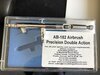
Hi all, this is where I may be a little vague and actually not really know my own kit. The airbrush I used seems to be non branded and I have no idea what Needle size it uses. Other than it is bottom feed from a bottle and gives a large spray area which attends to be more useful for painting larger areas. I have no idea where or how you measure to check what needle size the airbrush is using. See picture below of AB-182. I was using revell aqua colour mixed with Tamiya x-20a thinner , probably about 70% paint to 30% thinner which seemed to be thin enough. For most part I’m spraying about 3-5” from model surface at around 20 psi from my compressor.
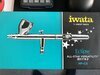
I also have another airbrush which I think has a 0.35mm needle, see Iwata HP-CS picture below.
as bad as this sounds I have no real idea of the air brushes but have just used them with mixed results, probably because I don’t really know how and where best to use them.
Hope this helps.
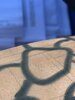
I’ve also added a photo of the sandy looking finish as discussed.

carl
 

Attachments

  • 713CBEEB-0827-4076-9197-7A22DBE8A4DB.jpeg
    713CBEEB-0827-4076-9197-7A22DBE8A4DB.jpeg
    3.4 KB · Views: 0
  • C1C2C6D6-0F10-4492-9BFD-E45B8BC52F3F.jpeg
    C1C2C6D6-0F10-4492-9BFD-E45B8BC52F3F.jpeg
    3.4 KB · Views: 0
  • EAF4393C-EB22-469F-A1AD-41E0BFFF10DB.jpeg
    EAF4393C-EB22-469F-A1AD-41E0BFFF10DB.jpeg
    2.9 KB · Views: 0
For stripping try Fairy Powerspray or Windex. I’ve not tried them on Revel Aqua, but they work on Tamiya and Vallejo. Don’t use commercial paint stripper unless it’s made for models Because it is likely to damage the plastic.
Sanding is probably not an option in this case because all of the panel lines and difficult to reach areas will also be affected, and sanding will not reach them.
I disagree with Laurie as well I’m afraid. More air pressure means finer atomisation which in turn means faster drying paint. Try 15psi. Remember that when airbrushing, the sequence should be press for air, then pull back for paint, and when finished stop paint flow before air flow. I would also test a few times until you are happy before committing to the model again.
The whole airbrush thing is a balance between paint thinning, air pressure, and distance from the model. Unfortunately the only way to really learn that is with practice.
 
AB-182 Suction Feed Hi-Flow Airbrush with 0.5mm Nozzle and the Iwata a 0.35mm needle, quite a difference.
 
I’ve never tried stripping paint, how do you strip acrylic paint off.
I have found that Mr. Hobby Mr. Color Thinners strips Humbrol and Ammo Mig acrylics very easily. Other similar thinners do not have the same effect. Good luck ...
 
Ummm ... Revell Aqua is water based acrylic, Tamiya is acrylic but not water based so I wouldn't be using that paint/thinner combination.
 
Thread owner
AB-182 Suction Feed Hi-Flow Airbrush with 0.5mm Nozzle and the Iwata a 0.35mm needle, quite a difference.
I’d be interested in an explanation of how the two needle sizes effect spraying and what they would be best used for from a model plane point of view which is my main focus.
 
Thread owner
AB-182 Suction Feed Hi-Flow Airbrush with 0.5mm Nozzle and the Iwata a 0.35mm needle, quite a difference.
Out of curiosity do you know what the AB-182 Is? Is it a budget air brush. It seems every bit as good as the Iwata.
 
This works with MRP paint and, I suspect other lacquers, perhaps some might want to experiment with other types of paint.

Do a mist spray of Mr Levelling Thinner over the finish, it reactivates the paint and it self levels to a perfect finish. Sometimes you might need to do it two or three times for the full effect and you should avoid flooding the model.

This can also be part of your airbrush cleaning routine.

Let us know if it works with other paint types.
 
I’d be interested in an explanation of how the two needle sizes effect spraying and what they would be best used for from a model plane point of view which is my main focus.
Hi Carl, I'm no expert, but the .5 would give a large covering and the .35 for finer work. looking at their web site the AB-182 price wise would be considered to be a budget type. Its all a matter of how good the machining is and to what tolerances they machine too.
As I only use A-mig and Vallejo acrylic paints I can't comment on the Tamiya or Revell. The .5 needle would allow quite thick paint through, how well do you mix?
Distance from the tip to the part to be painted is important along with with air pressure, I would make a note of several test sprays and see which is best, did you spray in this hot spell , that could well have caused the paint to dry before it landed, hence the finish. Just a thought.
 
Hmm, what thinners would you suggest?
As a rule learnt by results, I only use thinners mixed with the same type and brand of paint. As an aside, I have found Aqua to be a great paint for brushwork, but I wouldn't put it near my airbrush. But temper that comment with the fact I'm a relative newbie with airbrushing.
 
Back
Top