Theme editor

Scale Model Shop

Bailey Bridge part dimensions?

Dave Ward

New member
Joined
Apr 27, 2018
Messages
10,549
Reaction score
43
Points
0
1/3
Thread owner
I've been looking for parts for a Bailey bridge - for 3D printing, & found one on Thingiverse by user 'WindhamGraves' which looks very good, BUT, for some reason there's no scale quoted. It consists of the individual pieces like the top bracing frame
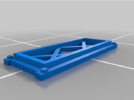
bracing_frame.png
If I can find actual dimensions for the full size parts, I can work out what scale the model is in ( I suspect 1/50 ), and work from there - I was looking at 1/35.
All this may come to nothing, I haven't looked closely at the files, and it could be that the parts may only be printable in resin, not FDM PLA - but the built up model looks pretty good
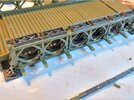
1016220736a_HDR.jpg
If it is possible, it will take a long time -- there are a lot of parts!
Dave
 
Should be ok for fdm Dave, as long as the parts are suitable for printing flat. If a piece has detail both sides and you want to avoid supports, you can always print it in two halves by sinking it halfway into the build plate in your slicing software.
 
web.mst.edu/~rodgersda/umcourses/ge342/Bailey%20Bridge-revised.pdf should get you all you need.
 
Thread owner
web.mst.edu/~rodgersda/umcourses/ge342/Bailey%20Bridge-revised.pdf should get you all you need.
`Paul,
WOW, thanks, that's exactly the info I needed. I've just analysed the models & the they are actually 1/96 , so I can scale the models up by 2.74, which will give 1/35. - Had a few moments of dithering, there - I had to remember about feet & inches! It's not the most intuitive of measures, when you think about it................
Dave
 
Unless you have feet & thumbs & have no need to be precise. Kinda like my deed in Cambridge Ohio that measured my plot, "...more or less...":smiling:
 
Thread owner
The printer is muttering away to itself - the parts are very much in the style of 'limited run kits' they need a bit of cleaning up, but the shape is there - I'll have to prime them before I can really tell how it's going - a job for tomorrow
Dave
 
Thread owner
Thanks to everybody for the references - I've managed to find a copy of TM5-277, the US technical manual for Bailey Bridges - very much overkill - but at least it does provide pictures with names of some of the more obscure parts!
I've printed out quite a few bridge parts & have just primed them - I'll put some pictures up tomorrow.
Dave
 
Oh, but careful: then you’ll be making American-sized parts, they won’t be interchangeable with British ones :) (This was an issue IRL. If you want to paint the bridge, use SCC 2 brown for British, but olive drab for American: the British parts were kept that way throughout the war so engineers could tell at a glance which was which.)
 
Thread owner
Oh, but careful: then you’ll be making American-sized parts, they won’t be interchangeable with British ones :smiling3: (This was an issue IRL. If you want to paint the bridge, use SCC 2 brown for British, but olive drab for American: the British parts were kept that way throughout the war so engineers could tell at a glance which was which.)
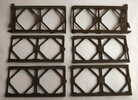
It's American at the moment - I've only got Olive Drab primer! Some of the parts look OK, but others won't stand close inspection - I've just looked at the Bronco Bailey Bridge - I reckon I print one for less than £5 - although the number of printer hours would run into days! I'm tempted to make up a couple of sections, to see how they fit before deciding on whether to a complete bridge - because it's modular, it could be pretty long..............
Dave
 
Thread owner
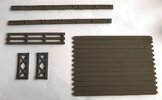
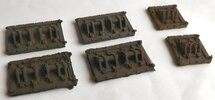
These are parts that I've printed so far - I've just given them a rough clean up & primed:
DSCF4179.JPGDSCF4180.JPGDSCF4181.JPG
All these are scaled to 1/35 ( nominally ), but I've used the same scaling factor for all parts, so they will be the correct size relatively.............
I've had difficulty in printing one part - the riband or curb ( road edging ), only a simple shape, but It just wouldn't stick - I've had to resort to printing it on a raft & using a glue pen - and now it seems to be printing happily. There are number of cross braces, the walkway & its' supports that I haven't printed yet, but these are smaller, simpler parts.
There a number of YouTube videos on the Bailey Bridge - the animated cartoons are the best for seeing what goes where!
Dave
 
I have it in 1/87. It takes a lot of components to go a short span w/any capy. Your pcs. look good in the pics.
 
Oh, but careful: then you’ll be making American-sized parts, they won’t be interchangeable with British ones :smiling3: (This was an issue IRL. If you want to paint the bridge, use SCC 2 brown for British, but olive drab for American: the British parts were kept that way throughout the war so engineers could tell at a glance which was which.)
What was the difference? We hadn't gone metric then.
Pete
 
Thread owner
Not sure off the top of my head, but IIRC it had to do with the differences in engineering standards.
Major differences were in threads - UK used BSW & BSF ( Whitworth & Fine ), US used UNC & UNF - Unified National Coarse & Fine. That's is why spares for a Packard Merlin, wouldn't fit a Rolls-Royce Merlin. There were other differences, mainly in tolerancing & drawing conventions................
Dave
 
Thread owner
Wasn't at all sure this was going to print, it is just about the maximum the build plate can hold. The slightest error in levelling could mean the print not sticking, or generally failing!
DSCF4182.JPG
It could also be affected by the build plate temperature varying at the corners. It looks like the bottom right quadrant is either a bit cooler, or a tad lower. Either way it worked & 10 minutes later
DSCF4183.JPG
The excess plastic just pulls away mostly, it needs going over with a scalpel to cut away any hairy bits & then a sanding stick to remove the rough edges
Dave
 
Now you're cooking ,Dave!
An observation- you might be able to eliminate the texture on the top surfaces if you have an 'ironing' option in your slicing software.
It's supposed to smooth out the build lines on the top surfaces. sometimes its good, sometimes not, but worth checking.
 
Back
Top