G
Guest
Guest
Hi I'm going to have a go at building a A12 Matilda II.
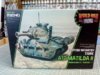
Box Art.
View attachment 341437
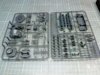
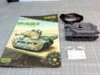
Parts.
View attachment 341438
View attachment 341439
The Infantry Tank Mark II, best known as the Matilda, was a British infantry tank of the Second World War.
The design began as the A12 specification in 1936, as a gun-armed counterpart to the first British infantry tank, the machine gun armed, two-man A11 Infantry Tank Mark I. The Mark I was also known as Matilda, and the larger A12 was initially known as the Matilda II, Matilda senior or Waltzing Matilda. The Mark I was abandoned in 1940, and from then on the A12 was almost always known simply as "the Matilda".
With its heavy armour, the Matilda II was an excellent infantry support tank but with somewhat limited speed and armament. It was the only British tank to serve from the start of the war to its end, although it is particularly associated with the North Africa Campaign. It was replaced in front-line service by the lighter and less costly Infantry Tank Mk III Valentine beginning in late 1941.
The split between the infantry tank and cruisers had its origins in the World War I division between the first British heavy tanks and the faster Whippet Medium Mark A and its successors the Medium Mark B and Medium Mark C. During the interbellum, British tank experiments generally followed these basic classifications, which were made part of the overall doctrine with the work of Major-General Percy Hobart and the influence of Captain B.H. Liddell Hart.
In 1934 Hobart, the then "Inspector, Royal Tank Corps", postulated in a paper two alternatives for a tank to support the infantry. One was a very small, heavily armoured, machine gun-armed model that would be fielded in large numbers to overwhelm the enemy defences. The other was a larger vehicle with a cannon as well as machine guns and heavier armour proof against enemy field artillery. Vickers designed a tank to a General Staff specification based on the first option as the A11 Matilda. Within the limitations of military finances, the Master-General of the Ordnance, Hugh Elles, went for the smaller machine gun tank and the larger cannon-armed version did not proceed.This requirement was passed to Vickers-Armstrongs which had a prototype (A11E1) but with armour proof against current anti-tanks guns ready by September 1936.
The first suggestion for a larger Infantry Tank was made in 1936, with specification A12. The design was produced by the Royal Arsenal, Woolwich, and Vulcan Foundry was selected as the manufacturer. A12 used a number of design elements of the A7, a medium tank that was built in limited numbers in the early 1930s whose mechanical layout was used for many following designs. With its greatly increased armour, a lack of power was seen as a problem. The solution was to use two AEC straight-six water-cooled diesel engines, used in London buses, providing up to 87 hp each. These were linked along a common shaft. Suspension was to use the 'Japanese Type' bell crank suspension used on the A7.
Vulcan received a contract for two wooden mock-ups and two mild-steel prototypes in November 1936. The first mock-up was delivered in April 1937 and the A12E1 prototype in April 1938. The prototypes proved excellent in a 1,000 miles (1,600 km) test, resulting in only a few changes to improve the gearbox, suspension and cooling. When war was recognised as imminent, production of the Matilda II was ordered and that of the Matilda I curtailed. The first order was placed shortly after trials were completed, with 140 ordered from Vulcan in June 1938
The Matilda Senior weighed around 27 long tons (27 t; 30 short tons), more than twice as much as its predecessor, and was armed with a Ordnance QF 2-pounder (40 mm) tank gun in a three-man turret.The turret traversed by hydraulic motor or by hand through 360 degrees; the gun could be elevated through an arc from −15 to +20 degrees. One of the most serious weaknesses of the Matilda II was the lack of a high-explosive round for its main gun. A high-explosive shell was designed for the 2-pounder but for reasons never explained, it was not issued and the main weapon against un-armoured targets was its machine gun.
Like many other British infantry tanks, it was heavily armoured. The front glacis was 78 mm (3.1 in) thick; the nose plates top and bottom were thinner but angled. The sides of the hull were 65 to 70 millimetres (2.6 to 2.8 in) and the rear armour, protecting the engine to sides and rear, was 55 millimetres (2.2 in). The turret armour was 75 mm (2.95 in) all round. The turret roof, hull roof and engine deck were 20 millimetres (0.79 in).
The armour of the Matilda was the heaviest of its era. Contemporary German Panzer III and Panzer IV tanks had 30 to 50 millimetres (1.2 to 2.0 in) hull armour, while the T-34 had 40 to 47 millimetres (1.6 to 1.9 in) (angled at 60 degrees). Matilda's side and rear armour was relatively heavy even at the end of the war, when tanks like the M4 Sherman carried about 40 mm, and late models of the Panther carried 50 mm. The shape of the nose armour was based on Christie's designs and came to a narrow point with storage lockers added on either side.The heavy armour of the Matilda's cast turret became legendary; for a time in 1940–1941, the Matilda earned the nickname Queen of the Desert.
While the Matilda possessed a degree of protection that was unmatched in the North African theatre, the sheer weight of the armour on the vehicle contributed to a very low average speed of about 6 mph (9.7 km/h) on desert terrain and 16 miles per hour (26 km/h) on roads. At the time, this was not thought to be a problem, since British infantry tank doctrine valued heavy armour and trench-crossing ability over speed and cross-country mobility (which was considered to be characteristic of cruiser tanks such as the Crusader). The slow speed of the Matilda was further exacerbated by a troublesome suspension and a comparatively weak power unit, which was created from two AEC 6-cylinder bus engines linked to a single shaft.This arrangement was complicated and time-consuming to maintain, as it required mechanics to work on each engine separately and subjected automotive components to uneven wear-and-tear. It did provide some mechanical redundancy, since failure in one engine would not prevent the Matilda from using the other. The combined power of the engines went through a six-speed Wilson epicyclicgearbox, operated by compressed air.
The tank's suspension system was that which had been developed by Vickers for their Medium C prototype in the mid-1920s. The tank was carried by five double wheel bogies on each side. Four of the bogies were on bellcranks in pairs, with a common horizontal coil spring. The fifth bogie at the rear was sprung against a hull bracket. Between the first bogie and the idler wheel, was a larger diameter vertically sprung "jockey wheel". The first Matildas had return rollers; these were replaced in later models by track skids, which were far easier to manufacture and to service in the field.
The turret carried the main armament, with the machine gun to the right in a rotating internal mantlet. Traverse was by a hydraulic system. As the gun was balanced for ease of movement by the gunner, much of the breech end was behind the trunnions. Two smoke grenade launchers were carried on the right side of the turret.The grenade launcher mechanisms were cut down Lee–Enfield rifles, each loaded with a smoke grenade. Its camouflage scheme was designed by Major Denys Pavitt of the Camouflage Development And Training Centre based on the dazzle patterns of first world war ships. The design incorporated block colours, visually breaking the tank in half.
The first Matilda was produced in 1937, but only two were in service when war broke out in September 1939. Following the initial order from Vulcan Foundry, a second order was placed shortly after with Ruston & Hornsby. Some 2,987 tanks were produced by the Vulcan Foundry, John Fowler & Co. of Leeds, Ruston & Hornsby, and later by the London, Midland and Scottish Railway at Horwich Works; Harland and Wolff, and the North British Locomotive Company Glasgow. The last were delivered in August 1943.
Peak production was 1,330 in 1942, the most common model being the Mark IV.
The Matilda was difficult to manufacture. For example, the pointed nose was a single casting that, upon initial release from the mould, was thicker than required in some areas. To avoid a needless addition to the tank's weight, the thick areas were ground away. This process required highly skilled workers and additional time. The complex suspension and multi-piece hull side coverings also added time to manufacturing
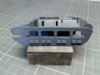
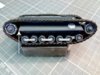
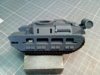
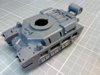
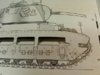
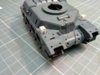
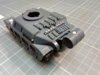
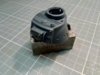
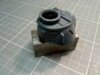
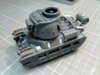
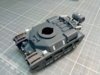
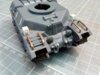
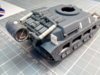
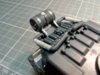
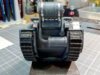
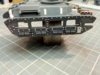
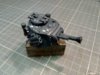
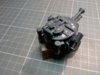
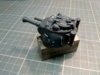
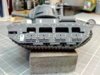
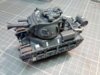
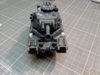
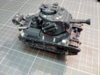
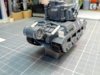
First job will be to re do the hull by adding missing rivets / holes/ hatches.
View attachment 341440
Thank you for looking in.
Pete.
Box Art.
View attachment 341437
Parts.
View attachment 341438
View attachment 341439
The Infantry Tank Mark II, best known as the Matilda, was a British infantry tank of the Second World War.
The design began as the A12 specification in 1936, as a gun-armed counterpart to the first British infantry tank, the machine gun armed, two-man A11 Infantry Tank Mark I. The Mark I was also known as Matilda, and the larger A12 was initially known as the Matilda II, Matilda senior or Waltzing Matilda. The Mark I was abandoned in 1940, and from then on the A12 was almost always known simply as "the Matilda".
With its heavy armour, the Matilda II was an excellent infantry support tank but with somewhat limited speed and armament. It was the only British tank to serve from the start of the war to its end, although it is particularly associated with the North Africa Campaign. It was replaced in front-line service by the lighter and less costly Infantry Tank Mk III Valentine beginning in late 1941.
The split between the infantry tank and cruisers had its origins in the World War I division between the first British heavy tanks and the faster Whippet Medium Mark A and its successors the Medium Mark B and Medium Mark C. During the interbellum, British tank experiments generally followed these basic classifications, which were made part of the overall doctrine with the work of Major-General Percy Hobart and the influence of Captain B.H. Liddell Hart.
In 1934 Hobart, the then "Inspector, Royal Tank Corps", postulated in a paper two alternatives for a tank to support the infantry. One was a very small, heavily armoured, machine gun-armed model that would be fielded in large numbers to overwhelm the enemy defences. The other was a larger vehicle with a cannon as well as machine guns and heavier armour proof against enemy field artillery. Vickers designed a tank to a General Staff specification based on the first option as the A11 Matilda. Within the limitations of military finances, the Master-General of the Ordnance, Hugh Elles, went for the smaller machine gun tank and the larger cannon-armed version did not proceed.This requirement was passed to Vickers-Armstrongs which had a prototype (A11E1) but with armour proof against current anti-tanks guns ready by September 1936.
The first suggestion for a larger Infantry Tank was made in 1936, with specification A12. The design was produced by the Royal Arsenal, Woolwich, and Vulcan Foundry was selected as the manufacturer. A12 used a number of design elements of the A7, a medium tank that was built in limited numbers in the early 1930s whose mechanical layout was used for many following designs. With its greatly increased armour, a lack of power was seen as a problem. The solution was to use two AEC straight-six water-cooled diesel engines, used in London buses, providing up to 87 hp each. These were linked along a common shaft. Suspension was to use the 'Japanese Type' bell crank suspension used on the A7.
Vulcan received a contract for two wooden mock-ups and two mild-steel prototypes in November 1936. The first mock-up was delivered in April 1937 and the A12E1 prototype in April 1938. The prototypes proved excellent in a 1,000 miles (1,600 km) test, resulting in only a few changes to improve the gearbox, suspension and cooling. When war was recognised as imminent, production of the Matilda II was ordered and that of the Matilda I curtailed. The first order was placed shortly after trials were completed, with 140 ordered from Vulcan in June 1938
The Matilda Senior weighed around 27 long tons (27 t; 30 short tons), more than twice as much as its predecessor, and was armed with a Ordnance QF 2-pounder (40 mm) tank gun in a three-man turret.The turret traversed by hydraulic motor or by hand through 360 degrees; the gun could be elevated through an arc from −15 to +20 degrees. One of the most serious weaknesses of the Matilda II was the lack of a high-explosive round for its main gun. A high-explosive shell was designed for the 2-pounder but for reasons never explained, it was not issued and the main weapon against un-armoured targets was its machine gun.
Like many other British infantry tanks, it was heavily armoured. The front glacis was 78 mm (3.1 in) thick; the nose plates top and bottom were thinner but angled. The sides of the hull were 65 to 70 millimetres (2.6 to 2.8 in) and the rear armour, protecting the engine to sides and rear, was 55 millimetres (2.2 in). The turret armour was 75 mm (2.95 in) all round. The turret roof, hull roof and engine deck were 20 millimetres (0.79 in).
The armour of the Matilda was the heaviest of its era. Contemporary German Panzer III and Panzer IV tanks had 30 to 50 millimetres (1.2 to 2.0 in) hull armour, while the T-34 had 40 to 47 millimetres (1.6 to 1.9 in) (angled at 60 degrees). Matilda's side and rear armour was relatively heavy even at the end of the war, when tanks like the M4 Sherman carried about 40 mm, and late models of the Panther carried 50 mm. The shape of the nose armour was based on Christie's designs and came to a narrow point with storage lockers added on either side.The heavy armour of the Matilda's cast turret became legendary; for a time in 1940–1941, the Matilda earned the nickname Queen of the Desert.
While the Matilda possessed a degree of protection that was unmatched in the North African theatre, the sheer weight of the armour on the vehicle contributed to a very low average speed of about 6 mph (9.7 km/h) on desert terrain and 16 miles per hour (26 km/h) on roads. At the time, this was not thought to be a problem, since British infantry tank doctrine valued heavy armour and trench-crossing ability over speed and cross-country mobility (which was considered to be characteristic of cruiser tanks such as the Crusader). The slow speed of the Matilda was further exacerbated by a troublesome suspension and a comparatively weak power unit, which was created from two AEC 6-cylinder bus engines linked to a single shaft.This arrangement was complicated and time-consuming to maintain, as it required mechanics to work on each engine separately and subjected automotive components to uneven wear-and-tear. It did provide some mechanical redundancy, since failure in one engine would not prevent the Matilda from using the other. The combined power of the engines went through a six-speed Wilson epicyclicgearbox, operated by compressed air.
The tank's suspension system was that which had been developed by Vickers for their Medium C prototype in the mid-1920s. The tank was carried by five double wheel bogies on each side. Four of the bogies were on bellcranks in pairs, with a common horizontal coil spring. The fifth bogie at the rear was sprung against a hull bracket. Between the first bogie and the idler wheel, was a larger diameter vertically sprung "jockey wheel". The first Matildas had return rollers; these were replaced in later models by track skids, which were far easier to manufacture and to service in the field.
The turret carried the main armament, with the machine gun to the right in a rotating internal mantlet. Traverse was by a hydraulic system. As the gun was balanced for ease of movement by the gunner, much of the breech end was behind the trunnions. Two smoke grenade launchers were carried on the right side of the turret.The grenade launcher mechanisms were cut down Lee–Enfield rifles, each loaded with a smoke grenade. Its camouflage scheme was designed by Major Denys Pavitt of the Camouflage Development And Training Centre based on the dazzle patterns of first world war ships. The design incorporated block colours, visually breaking the tank in half.
The first Matilda was produced in 1937, but only two were in service when war broke out in September 1939. Following the initial order from Vulcan Foundry, a second order was placed shortly after with Ruston & Hornsby. Some 2,987 tanks were produced by the Vulcan Foundry, John Fowler & Co. of Leeds, Ruston & Hornsby, and later by the London, Midland and Scottish Railway at Horwich Works; Harland and Wolff, and the North British Locomotive Company Glasgow. The last were delivered in August 1943.
Peak production was 1,330 in 1942, the most common model being the Mark IV.
The Matilda was difficult to manufacture. For example, the pointed nose was a single casting that, upon initial release from the mould, was thicker than required in some areas. To avoid a needless addition to the tank's weight, the thick areas were ground away. This process required highly skilled workers and additional time. The complex suspension and multi-piece hull side coverings also added time to manufacturing
First job will be to re do the hull by adding missing rivets / holes/ hatches.
View attachment 341440
Thank you for looking in.
Pete.