Theme editor

Scale Model Shop

Another can of worms................

The Whippet in Brussels definitely is not grey in (original) colour. Here is the interior of the door, which is painted the same as the outside:


Or the armour around the fuel tank:

And here we are with a prime example of selective personal perception. That looks grey to me. Hint of brown, maybe. Well, I am due vr a new pair of specs...
 
Part of the problem is that we’re viewing these online, which means we’re almost certainly not seeing the exact same colours, and in any case, the colours we do see won’t be exactly those of the real thing. The only way to get the proper colour would be to go to Brussels with a book of colour swatches …
 
The only way to get the proper colour would be to go to Brussels with a book of colour swatches …

While standing at a distance appropriate to the scale!

It gets to a point where it's more of a stress than it's worth sometimes and maybe we should ask ourselves is the 'exact' shade that super important?

Miko ( errrmmmm?)
 
Part of the problem is that we’re viewing these online, which means we’re almost certainly not seeing the exact same colours, and in any case, the colours we do see won’t be exactly those of the real thing. The only way to get the proper colour would be to go to Brussels with a book of colour swatches …
While standing at a distance appropriate to the scale!

It gets to a point where it's more of a stress than it's worth sometimes and maybe we should ask ourselves is the 'exact' shade that super important?

Miko ( errrmmmm?)
And even then it will depend on the lighting prevailing at the time and the pigments the swatch is made of. Different pigments give different colours under different lighting conditions. Two colours can look identical under daylight, but look markedly different under artificial light, for example, and daylight changes from morning, to mid day, to evening, and again according to the cloud cover.
The colours you see also depend on how analytical your colour perception is. As everything in life, some people see colours more accurately than others. They will see nuanced variation where others will see “the same colour”. Hell, in my case if I look at something with both eyes, my right eye, or my left eye, I see different colours. My right eye has a definite red cast that warms up colours that I see. It is also the dominant eye in my binary vision.
Of course, you don’t actually “see” colours, what you “see” is energy waves (or is it particles LOL) that are converted to electrical impulses by structures in your eye which are then in turn interpreted by your brain. This means your mood and upbringing can even effect the colours you see. To give two examples. Ancient Greeks couldn’t “see” the colour blue and determined colours by lightness and darkness rather than in terms of hue, hence the “wine dark sea” description. Himba people of northern namibia are able to easily determine different hues and shades of green compared to western peoples.
What this interminable rambling means in truth is that absolute colour fidelity is a myth. In terms of colour matching near enough really is good enough. Exact matching is influenced by so many factors it is impossible without sophisticated mechanical assistance, and even then external influences would bring some to argue that the results were wrong.
The only way you could exactly match an original colour is to use exactly the same paint, made at exactly the same time, and paint the item at exactly the same time that the original was painted. Even then, different storage and atmospheric conditions will create colour drift over time so the two will gradually become different colours. This is obviously impossible, so go with what seems right to you and tell any naysayer to boil his or her head……..
 
Had a check through my photos and only found one of the WWI gallery at the Brussels Military Museum and the colour is the same as that the one Dave Ward showed
 
And even then it will depend on the lighting prevailing at the time and the pigments the swatch is made of. Different pigments give different colours under different lighting conditions. Two colours can look identical under daylight, but look markedly different under artificial light, for example, and daylight changes from morning, to mid day, to evening, and again according to the cloud cover.
The colours you see also depend on how analytical your colour perception is. As everything in life, some people see colours more accurately than others. They will see nuanced variation where others will see “the same colour”. Hell, in my case if I look at something with both eyes, my right eye, or my left eye, I see different colours. My right eye has a definite red cast that warms up colours that I see. It is also the dominant eye in my binary vision.
Of course, you don’t actually “see” colours, what you “see” is energy waves (or is it particles LOL) that are converted to electrical impulses by structures in your eye which are then in turn interpreted by your brain. This means your mood and upbringing can even effect the colours you see. To give two examples. Ancient Greeks couldn’t “see” the colour blue and determined colours by lightness and darkness rather than in terms of hue, hence the “wine dark sea” description. Himba people of northern namibia are able to easily determine different hues and shades of green compared to western peoples.
What this interminable rambling means in truth is that absolute colour fidelity is a myth. In terms of colour matching near enough really is good enough. Exact matching is influenced by so many factors it is impossible without sophisticated mechanical assistance, and even then external influences would bring some to argue that the results were wrong.
The only way you could exactly match an original colour is to use exactly the same paint, made at exactly the same time, and paint the item at exactly the same time that the original was painted. Even then, different storage and atmospheric conditions will create colour drift over time so the two will gradually become different colours. This is obviously impossible, so go with what seems right to you and tell any naysayer to boil his or her head……..


Complicated stuff isn't it?

I wonder if Dave is beginning to regret asking? Ha!

Miko (if you mix blue and yellow pigment, you get green, but in light to get yellow, it's green and red???)
 
Complicated stuff isn't it?

I wonder if Dave is beginning to regret asking? Ha!

Miko (if you mix blue and yellow pigment, you get green, but in light to get yellow, it's green and red???)
Additive and subtractive in action there Miko. As we only see the light frequencies the object rejects, oranges are really blue…..honest.
 
Not at all! It just confirms that I'm not missing some vital clue ( or having a senior moment...............)
Dave

Yep, senior moments are a thing for some of us for sure!

Miko (more senior everyday)
 
oranges are really blue…..honest.
TBH, I prefer them a fluorescent greenish yellow-purple.

IMHO, if you want to paint your model of a military vehicle an accurate colour, the way to do it is to research what the real colour was supposed to be, and then pick (or mix) a model paint that you think comes close to that. It doesn’t matter if it’s 100% the same or not, as long as you’re aiming for the right kind of colour. This photo was posted on Missing-Lynx the other day:


This is a small part¹ of the vehicle dump at Deelen, in the Netherlands, in 1945 or ’46, and these are all vehicles used by the Canadian Army: British AEC armoured cars in the first row, British Daimler armoured cars in the second, American Staghound armoured cars in the third, British Daimler scout cars in the fourth, Canadian Otter scout cars in the fifth row, and large numbers of Canadian Military Pattern (CMP) trucks in the background. Except for the Staghounds, most will have been painted in SCC 15 olive drab by this time, though chances are that some are in SCC 2 brown; the Staghounds would all have been American olive drab No.9 or No. 22 (which was the same colour, just a different number). Even at first glance, though, the difference in shades is obvious: even the four AECs in the foreground all seem to be different colours.

For the modeller, this of course shows that it’s pointless to aim for an exact match of the official colour unless you’re building, say, a vehicle on the production line — and even then, depending on time and place, those might not all be the same, especially in different factories. But if you know what the colour was supposed to be, you can find or mix a paint that isn’t wrong.


¹ This is, what, a few hundred vehicles? There were 35,000 there by the spring of 1946.
 
This is a small part¹ of the vehicle dump at Deelen, in the Netherlands, in 1945 or ’46,...
Beautiful photo!

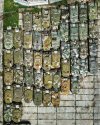
I've always had a weakness for "enemy vehicles" (vehicles of the Soviet Union & the Warsaw Pact from the 60s to 90s). And I have to laugh every time someone discusses what the right green color was for Soviet vehicles. I found a great photo of VDV BTR-Ds that were parked and dumped in the mid-90s. Which of the vehicles is wearing the “correct” green?
BTR-D's.jpg
 
IMG_0536.jpegIMG_0535.jpeg
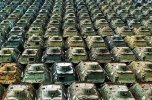
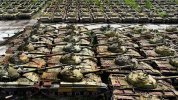
Here’s a couple more for you Andreas…….all painted using paint mixed with much more modern technology than the WW1 stuff we started with.
 
In my days when I used to be a military plane spotter, we used to get 'base tours, where we would be invited to join a group or go as the pair of us. This led to numerous flights in both large and fast jet flights.... As we often gave credit to the individual officers and men who we came to know (and drinking pals)...
We were invited to a base tour at RAF Waddington, where we were informed that a Vulcan had been parked on the maun ramp and we could go all over it and in it except that photos of the cockpit were a no!
So we arrived and joined the group of eight, and the big talk was of the release of the Airfix Vulcan B.2.... So there we were walking around and under the Vulcan and arrived at the tail end as did two others...
And the conversation between them went like this...
"I think this is wrong..."
"What is wrong?"
"The rivets in the tail cone.."
"Have you counted them?"
"Yes, and I do believe that Airfix has the correct amount, and this plane (Vulcan) has the wrong amount...."
We had to walk away trying to keep a straight face.... Nerds, who needs them.....
So when I paint a model I look at the paint and then the photos, allowing for changes in light, fading etc and mix up a colour as close to three photos, although I do read what others have used and make my choice....
 
We were invited to a base tour at RAF Waddington, where we were informed that a Vulcan had been parked on the maun ramp and we could go all over it and in it

XM607? the 'Black Buck' bomber?

Still there as for as I know?

Miko (once witnessed a four ship Vulcan scramble at RAF Waddington! the sky was black with them! 'Awesome' just doesn't cover it!)
 
XM607? the 'Black Buck' bomber?

Still there as for as I know?

Miko (once witnessed a four ship Vulcan scramble at RAF Waddington! the sky was black with them! 'Awesome' just doesn't cover it!)
No, these visits were when they were in service, and 607 was noted on several occasions doing circuits, as were Victor tankers, and an FGR.2 with a collapsed nosewheel with the crew taking to their chutes....
 
Back
Top