


- Joined
- Dec 28, 2023
- Messages
- 2,739
- Location
- Swale Kent UK
- First Name
- Peter
1/3
Just a slight warning tale, but I'm sure I'm teaching granny to suck eggs....!
On my latest build, a small Desert Diorama with a ATMP x6 wheeler and Scorpion tank, I wanted a desert type or arid base type scenario.
I also wanted tracks left in the base to show the vehicles use, etc.
Its now finished, took final photos yesterday and was having another look at them today and I noticed some small cracks to the surface of the base, Bah!
I have had issues with warping in the past, just using foam board, so this time I used ply board as the main base, with foam board pva'd on top. All good, no warping, so a good result.
But I then used fine modellers filler to "rough up" the base and give it some texture. I then also used some Ammo/Mig mud paste to add more texture, small sand ripples, etc as texture.
I then carved out two small trenches in the foam board where the vehicle tracks would be, so they are slightly lower than the surround base surface.
Finally I then applied a very thin layer of Milliput into the two trenches, and before it had fully dried, I then ran the x6 wheeler spare wheel over the Milliput to give the vehicle tyre texture to the tracks.
NB: I used Milliput for the tyre texture rather than the two fillers mentioned before as it is drier and less "messy" than the other two, so easier to nice clear and clean tyre marks.
All good so far.....
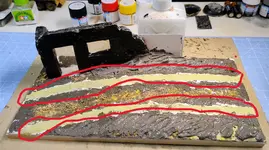
Once it was all dry, I then primed, painted and added washes and pigments to the base as required.
I assume what has happend is that because I've used multiple materials to surface the base, they have dried, and shrunk, at different rates thus causing those small fine cracks?
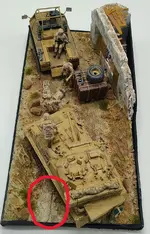
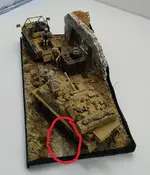
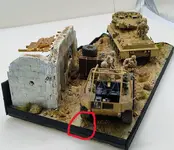
Looking back now, I either didn't leave it long enough between adding the layers so the one below fully dried before adding the next one, or I should have just stuck to using one main material, eg: fine modellers filler, or Ammo/Mig mud paste or Milliput and not really mixed them?
Theres no warping in the base, so its not that, sticking the foam board to the ply base seems to have solved that issue. It just appears to be the join between the Milliput and the fine filler/mud paste that has slightly separated.
As you can see from the photos its not a huge issue, and now that I have noticed them, they could easily be hidden with more paint, more filler, more fine sand, etc. Lesson learned for next time....
On my latest build, a small Desert Diorama with a ATMP x6 wheeler and Scorpion tank, I wanted a desert type or arid base type scenario.
I also wanted tracks left in the base to show the vehicles use, etc.
Its now finished, took final photos yesterday and was having another look at them today and I noticed some small cracks to the surface of the base, Bah!
I have had issues with warping in the past, just using foam board, so this time I used ply board as the main base, with foam board pva'd on top. All good, no warping, so a good result.
But I then used fine modellers filler to "rough up" the base and give it some texture. I then also used some Ammo/Mig mud paste to add more texture, small sand ripples, etc as texture.
I then carved out two small trenches in the foam board where the vehicle tracks would be, so they are slightly lower than the surround base surface.
Finally I then applied a very thin layer of Milliput into the two trenches, and before it had fully dried, I then ran the x6 wheeler spare wheel over the Milliput to give the vehicle tyre texture to the tracks.
NB: I used Milliput for the tyre texture rather than the two fillers mentioned before as it is drier and less "messy" than the other two, so easier to nice clear and clean tyre marks.
All good so far.....
Once it was all dry, I then primed, painted and added washes and pigments to the base as required.
I assume what has happend is that because I've used multiple materials to surface the base, they have dried, and shrunk, at different rates thus causing those small fine cracks?
Looking back now, I either didn't leave it long enough between adding the layers so the one below fully dried before adding the next one, or I should have just stuck to using one main material, eg: fine modellers filler, or Ammo/Mig mud paste or Milliput and not really mixed them?
Theres no warping in the base, so its not that, sticking the foam board to the ply base seems to have solved that issue. It just appears to be the join between the Milliput and the fine filler/mud paste that has slightly separated.
As you can see from the photos its not a huge issue, and now that I have noticed them, they could easily be hidden with more paint, more filler, more fine sand, etc. Lesson learned for next time....
Last edited:


