Theme editor

Scale Model Shop

NEW Airfix 1/24 Spitfire IX.

stona

New member
Joined
Jul 22, 2008
Messages
9,889
Reaction score
9
Points
0
1/3
Thread owner
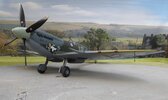
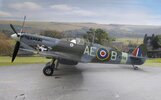
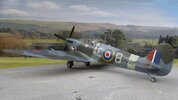
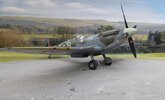
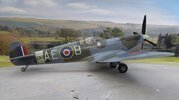
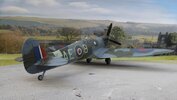
Superb build steve , flawlessly finished , perfectly photographed and if ever Airfix wanted a testimony to how nice the kit builds up then here it is . Top effort that man , cheers tony
 
Lovely model and nicely presented! Were the squadron codes really applied over the serial number though?
Pete
 
Thread owner
Lovely model and nicely presented! Were the squadron codes really applied over the serial number though?
Pete
Yep. The serial number was applied by the manufacturer, along with national markings etc. The codes were applied at the squadron. I wish they weren't. It was a b*gger slicing up the decal to fit as if under the letters I'd already sprayed :)

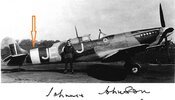
When this aircraft was re-coded as JE-J, when Johnson acquired it as his personal aircraft, the serial number was re-applied in much smaller letters and in the 'wrong' position. A Wing Commander could get away with it.

JEJ.jpg
 
A very nice Spit, Steve and a perfect photo shooting. :thumb2: :thumb2: :thumb2:
Glad Airfix improved their kits' quality.
 
The Committee here at Race Towers have awarded you
View attachment 476855

Congratulations. Steve.

Saw the Hornby tv programme last night . They showed this in the design stage and the first one to be built before production.
 

Attachments

  • download THE DOGS.jpg
    download THE DOGS.jpg
    5 KB · Views: 0
Wow, beautiful finish Steve and quick too!!! I bet it takes up some shelf space, doesn't it. Top work Sir!!!

As I'm no wingy expert, I do notice the landing gear are rather closely spaced together. I understand they needed structural rigidity of the fuselage, but wouldn't that make the plane tipsy and prone to accidents, when landing?

Prost
Allen
 
Thread owner
I do notice the landing gear are rather closely spaced together. I understand they needed structural rigidity of the fuselage, but wouldn't that make the plane tipsy and prone to accidents, when landing?
You are not wrong. The track of the landing gear of the Spitfire is actually slightly less than the infamous undercarriage of the Bf 109. It's geometry is, however, much better because it attached to the main spar of the wing rather than a fuselage truss, which is why the Bf 109's splays out and has horrible geometry at the axles. It's this geometry, the angle of the struts, the angle of the axles and the toe of the wheels that made the Bf 109s ground handling so problematic.

The undercarriage of the Spitfire was designed for grass aerodromes, where the aircraft could always land into the wind and make 'wheeler' landings, that is alighting on the main gear with the legs more or less vertical and decelerating across the field, lowering the tail. It was pretty good for this and the benign handling of the Spitfire at low speeds, thanks to its wonderful wing, made accidents relatively rare, at least until the massively overpowered later Marks. It's why Spitfires today land on grass whenever possible.

Of course when the Spitfire became a Seafire and was required to slam into a deck in a three point landing virtually stalled, the legs of the main gear were at an angle due to the forward rake, meaning the loads were no longer perpendicular to the spar but instead imparted a twisting moment which would rip the strut attachments from the spar, collapsing the undercarriage...not good!
 
You are not wrong. The track of the landing gear of the Spitfire is actually slightly less than the infamous undercarriage of the Bf 109. It's geometry is, however, much better because it attached to the main spar of the wing rather than a fuselage truss, which is why the Bf 109's splays out and has horrible geometry at the axles. It's this geometry, the angle of the struts, the angle of the axles and the toe of the wheels that made the Bf 109s ground handling so problematic.

The undercarriage of the Spitfire was designed for grass aerodromes, where the aircraft could always land into the wind and make 'wheeler' landings, that is alighting on the main gear with the legs more or less vertical and decelerating across the field, lowering the tail. It was pretty good for this and the benign handling of the Spitfire at low speeds, thanks to its wonderful wing, made accidents relatively rare, at least until the massively overpowered later Marks. It's why Spitfires today land on grass whenever possible.

Of course when the Spitfire became a Seafire and was required to slam into a deck in a three point landing virtually stalled, the legs of the main gear were at an angle due to the forward rake, meaning the loads were no longer perpendicular to the spar but instead imparted a twisting moment which would rip the strut attachments from the spar, collapsing the undercarriage...not good!
As ever, thanks for the interesting background Steve. Have you ever thought writing a book given your Encyclopedic knowledge? And I am being serious!
 
Lovely build and an interesting insight on the undercarriage
 
Thread owner
Steve,
That is a beautiful finish mate.
Thanks...trying to make plastic look like painted metal :)

It is also the first time I have used MRP paints and I was impressed with the results (after a bit of an initial struggle). I'll be using them again.
 
That's very impressive now I can see the pictures on a decent sized screen.

As a coincidence I was watching Hornby: A Model World last night and the episode featured the research & design that went into this kit. Interesting to see the lead designer drawing lines on a screen and measuring pipes in the engine bay one day, then be greated by a brilliantly finished model the next.
 
A beautiful build Steve, you've really made a cracker of a kit here, well done on the dogs,
 
Back
Top