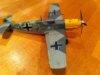
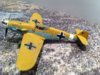
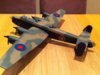
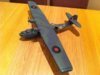
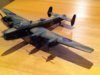
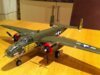
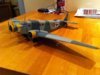
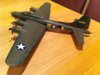
Hi again. You will be aware that weathering provokes more "debate" than just about any other aspect of modelling. It's far more art than science. I'm quite keen to make my models appear realistic and tend not to overdo the weathering. Some beautiful models look to me like patchwork quilts which I find over the top. Of course someone will always dig out a photo of a real aircraft looking a bit quilt like but I find that the exception.
I always try and find references,either for my intended victim or at least a similar aircraft.
Here's an over view of how I work,it's not right or wrong,just one method.
1 Painting.
I may pre-shade,I find it tricky to control exactly what the end product under various varnishes etc will look like. In my opinion it is very often way overdone.
I always post-shade. On larger scales I will lighten the centre of various panels with varying lighter shades of the camo colour. It's easy to control (or fix when it goes wrong!) and serves to break up the monotony of the blocks of single colours.You often hear people say "it makes a model look less toy like". A more than competent painter (and you've shown us your models) will have no difficulty doing this at all. On smaller scales I choose just to apply some streaks and mottles as spraying individual panels is soul destroying.
I also spray exhaust stains. You've got to have a reference as the stains rarely follow the track you'd expect. These stains were invariably cleaned off combat aircraft,I know there was a standing order to do this in the WW2 Luftwaffe but you still see them. My aircraft may just have returned from a mission. Don't spray black,I use a mixture of blue/greys,browns and black to match my reference.
2 Washes
I use mainly acrylic
paints nowadays so in wheel wells,engine bays and cockpits I apply an oil wash. I have a dilute mix of artists oils,mainly burnt umber and black, which gives a nice oily colour. I use a fine brush to run it around detail. Just touch a loaded brush to raised detail on,say,an undercarriage door and the wash will capillate around the detail. It dries slowly so any excess can easily be wiped away.
Many models have recessed panel lines and some people emphasise these in the same way. This is also a matter of opinion. On most German fighters the panels were let in to the frames and flush riveted leaving little room for this sort of accumulation,many were puttied and sanded to give a smooth surface. The British lagged behind,the front 20% of a Spitfire wing was flush riveted,filled and sanded smooth but if you look at the fuselage the skins actually over lap. No "trenches" and no black lines! Either way I choose not to overemphasise panel lines but it's each to their own.
I do give my models an all over sludge wash. I use the Promodeller ones which seem to be like Marmite,people love them or hate them.There are other brands available or you can,as I used to,make your own. The joy of this system is that you can remove as little or as much of the wash as you want.
Check your references,GENERALLY service aircraft,whilst often showing signs of wear and tear or repair,were not filthy.
3 Chipping
Wear and tear brings us to chipping. Wing walks could be so badly damaged that they were taken back to bare aluminium,more commonly some scuffing and chips occured. The edges of access panels were also often damaged. Cockpit entries and wind screen frames (often used as an aid to entering a fighter) also sustained wear. The front of airscrews,that's the surfaces facing the BACK of the aircraft, were subject to wear,particularly in a desert or sandy (coral) environment. Here again you really need to have some reference pictures.
There are many methods you can read up on, hairspray,salt,liquid mask are all used. I use some aluminium paint and a very fine brush and sometimes a silver artists pencil. For me the problem is scale. A large chip at 1:1,say the size of your thumb nail is very small at 1:48,smaller than I can achieve with salt or blobs of mask!
It's a massive subject and I've just given you a brief over view of how one person does it. Some will do much the same whereas in others it may provoke howls of derision. It's down to you,as an experienced modeller you'll know the only way to find the look that you are after is to have a go with some techniques and see which ones work for you.
If you're stuck for a picture of something you could do worse than ask here. There are several members with some decent "archives" who will always help if they can. Good luck with the Lanc,I'm mainly a Luftwaffe guy but I've got one of them in my cupboard which I've been eyeing up recently!
Cheers
Steve