Theme editor

Scale Model Shop

Scotties 25pdr.SP Bishop.

What's brass sheet like to work with Paul ? Pewter is great but so pliable and soon goes out of flat and can as you know bend easily.
Mud guard looks good and firm looking , that why I ask.
 
What's brass sheet like to work with Paul ? Pewter is great but so pliable and soon goes out of flat and can as you know bend easily.
Mud guard looks good and firm looking , that why I ask.
Half hard sheet is OK, takes bends well, and cuts and files easily. Also solder quite well, though not as well as nickel silver sheet. Not as soft as pewter though. Sheet that is annealed is too soft to work, even taking fingerprints if you are heavy handed. Brass pin wire is excellent for hand rails etc. nothing comes close.
 
Half hard sheet is OK, takes bends well, and cuts and files easily. Also solder quite well, though not as well as nickel silver sheet. Not as soft as pewter though. Sheet that is annealed is too soft to work, even taking fingerprints if you are heavy handed. Brass pin wire is excellent for hand rails etc. nothing comes close.
Cheers Tim .:thumb2:
 
Thread owner
What's brass sheet like to work with Paul ? Pewter is great but so pliable and soon goes out of flat and can as you know bend easily.
Mud guard looks good and firm looking , that why I ask.
John
Tim has just about summed it up. Pewter is good for flexible work straps etc and forming into complex shapes due to its softness. Brass sheet is better for angled shapes. It is harder to work, but annealing it helps especially on small items.
The mud guards were measured out then cut to allow the angles to be formed. Then soldered low temp paste is my go to. HTH
 
John
Tim has just about summed it up. Pewter is good for flexible work straps etc and forming into complex shapes due to its softness. Brass sheet is better for angled shapes. It is harder to work, but annealing it helps especially on small items.
The mud guards were measured out then cut to allow the angles to be formed. Then soldered low temp paste is my go to. HTH
Just for completeness……..Nickel silver sheet and strip has some advantages and some disadvantages over brass Scottie. It is just as east to cut and shape, though it slightly more springy in nature, which makes it structurally a bit stronger. It is much easier to solder, both taking solder better and nor spreading heat so rapidly, It takes paint better, making it more useful for anything likely to be handled. On the other hand, it is slightly harder to find, and is more expensive.
 
Lovely work on those mud guards!! What thickness of brass is that? And what thickness of pewter do you typically use? I noticed that you often use it as your go to metal.
 
Thread owner
Just for completeness……..Nickel silver sheet and strip has some advantages and some disadvantages over brass Scottie. It is just as east to cut and shape, though it slightly more springy in nature, which makes it structurally a bit stronger. It is much easier to solder, both taking solder better and nor spreading heat so rapidly, It takes paint better, making it more useful for anything likely to be handled. On the other hand, it is slightly harder to find, and is more expensive.
I will look it up next time I do an order for sheet.
 
Thread owner
Lovely work on those mud guards!! What thickness of brass is that? And what thickness of pewter do you typically use? I noticed that you often use it as your go to metal.
Hi Joe,

I have two main sheets of brass, 0.03mm/0.003" and 0.08mm/0.004". The pewter I have is 0.17mm/0.006" I do have some thicker stuff both in brass and ally but don't use a lot of that.
 
Thread owner
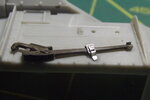
A little bit more done. The track tensioning tool was out of the spares box as it was slightly better detailed than the kit one. To this I added a strap and buckle and a stay for the handle.

DSCF3797.JPG

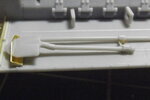
The shovel had the blade profiled from the back to give it a thinner look this was then added along with the crowbar.

DSCF3796.JPG

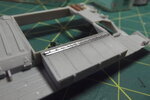
Finally for today the storage bin was added the hinge was removed and replaced with a scratched offering.

DSCF3794.JPG

cheers
Scottie
 
Excellently detailed additions Scottie. Interesting info about the pros and cons of different sheet metals. That solder paste you mentioned is good stuff.
 
Hi Joe,

I have two main sheets of brass, 0.03mm/0.003" and 0.08mm/0.004". The pewter I have is 0.17mm/0.006" I do have some thicker stuff both in brass and ally but don't use a lot of that.
Wow, that’s very thin brass. Most of my brass stuff in the railway days was made from ten or twenty thou. Five thou was used for fine detail, but I didn’t even know it came in three and four thou thicknesses.
 
That’s because Paul is using very short inches, whose exact length varies per sheet ;) 0.03 mm is 0.0012 inches, 0.08 mm is 0.0031 inches, and 0.17 mm is 0.0067 inches — so, I guess, 10, 30 and 65 thou?
 
That’s because Paul is using very short inches, whose exact length varies per sheet ;) 0.03 mm is 0.0012 inches, 0.08 mm is 0.0031 inches, and 0.17 mm is 0.0067 inches — so, I guess, 10, 30 and 65 thou?
Well Jakko, as I remember it, 40 thou is equivalent to about 1mm. That means ten thou is about 0.25 mm. ;) You’ve just shown 0.03 mm to be 1.2 thou (which it is pretty much)…….and then claimed it’s 10 thou (which it isn’t) ….. and I’ve been drinking Bordeaux all evening :tongue-out3:.
 
What I did was type “0,03 mm” (, instead of . because I’m not an English-speaker :tongue-out:) and the rest into my iPad’s search function, and got those results. My Mac says the same (as you would expect, of course) when I do that just now:

View attachment 481022

So where is the mistake, then? Maybe the thicknesses Paul quoted are off in millimetres too?

The inches-to-thou conversion mistake is mine, of course. Just measure in millimetres, all problems like this go away :)
 
Thread owner
The sheet which I suppose I should refer to as foil was measured with a digital vernier in mm then the inch mode was selected to give the imperial size.

But I think that this should now be put to bed.
 
What I did was type “0,03 mm” (, instead of . because I’m not an English-speaker :tongue-out:)

:smiling3:
Not just English speakers Jakko - the international IEC/ISO standard for the decimal separator is the comma.
Pete
 
No mistake in the maths Jakko……and I never even noticed the comma…..just that your last sentence says they are 10, 30, and 65 thou…..right after you’ve shown them to be 1.2, 3.1 and 6.7 thou……..
 
Back
Top