Theme editor

Scale Model Shop

SE5a CONSTRUCTION BEGINNING TO . . .

Status
Not open for further replies.
Beautiful Grahame it looks really businesslike' date='how do you manage to keep your workshop so clean and tidy ? there is not a speck of balsa dust anywhere ![/quote']Barry, while I work on the boat I have my vacuum cleaner on the floor next to me. As soon as I generate some dust/mess/shavings etc I vac it up. I hate having a dirty workbench and constantly having to get all the mess off the job I am doing.

Don't worry I know I'm abnormal!!
 
Thread owner
I’m not as organised as Richard but I always tidy the workshop in the evening; I’ve found that this has a couple of advantages. Firstly, if I leave the cleaning until the morning, I’m in too much of a rush to get on with the building so I don’t make a good job of it; and secondly, I earn a few “brownie points” with the better half every time I say “I’m just going down the shed to tidy up”, I might manage to do a spot of building before I start the tidying but I don’t tell her that!

I don’t mind covering up the construction, after all I build for my own enjoyment and all the detailing will still be visible if you look close enough, so that’s not gut wrenching. The first time you start the engine and let it go, now that is gut wrenching, not to say buttock clenching; I can understand the people who get another pilot to undertake the first flight, if something goes wrong it’s easier to blame yourself than another person, but on the contrary, if things go right you can’t beat the satisfaction of flying your own creation.
 
Thread owner
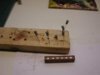
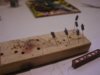
The flare box was an enjoyable little project; made mostly from 1/64th ply, just a 1/16th balsa base. No back to save weight, I know the saving is minimal but all these little bits add up!


View attachment 262652


The flares themselves are from plastic tube with a Plasticard top and a pin for the percussion cap. The clip, made from litho plate, should really be attached to the box but it was easier to cyano it to the flare.


View attachment 262653
 

Attachments

  • flare box1.jpg
    flare box1.jpg
    1.8 KB · Views: 0
  • flare box 2.jpg
    flare box 2.jpg
    2.2 KB · Views: 0
Thread owner
Iain

I’m no expert on the operation of full sized aircraft but reading through the “start up” procedure on the web site I’ve gleaned the following information, which I hope is correct:

The magneto produces the spark for the engine; the one I’ve just modelled is used to start the engine and is hand cranked by one of the ground crew while another one swings the prop. Once the engine is running the engine operated magnetos take over; one of the magneto switches selects between the two engine operated magnetos and the other is the on / off for the hand cranked magneto.

Grahame
 
Early WW1 engines had a manual advance and retard mechanism to start the engine you would first set this up,this then activated the solenoid,the prop would then be swung and the fuel ignited.

I once had an original WW1 manual solenoid,you wound it up thus storing the energy sufficent to create the spark,I sold it to a vintage aircraft restorer.
 
Thread owner
Below is the start up procedure for the SE5a, I hope the model will be a lot easier!

Like all water cooled engine, the SE is equipped with an expansion tank. It is situated in the cabane leading edge beside the emergency fuel tank. This emergency tank gives you about 20 min flying time at max RPM.

The carburator is fuel fed by pressurizing the main tank with an engine driven compressor or hand pump or both. The emergency works by gravity.

Now let's go and prepare your aircraft for the first flight of the day (Standard procedure)

  • Put the airplane in a level attitude using a trestle.
  • Fill up the fuel tank.
  • Check the oil level.
  • Check the coolant level and suck (no kidding) 2 lit.in the expansion tank (use the overflow pipe in the trailing edge, right side of the cabane, and pour the liquid in the radiator)
  • Get a stepladder and climb in the cockpit.
  • Check mags off and starting mag off.
  • Main tank valve off.
  • Air selector on hand pump.

  • Air release valve on the hand pump off.
  • Fuel selector on main to emergency.
  • Pressurize with the hand pump. (2.5 on the gauge)
  • Open the main tank valve. the fuel will flow into the emerg. tank. Maintain air pressure and don't fall asleep, it's gonna take few min.( 18 lit. )
  • You know the emerg. is full when you see fuel comming off the overflow pipe (Trailing edge left side).
  • Fuel selector off.
  • Main tank off.
  • Release air pressure and fill up main tank.
  • Pressurize the main tank again.
  • Fuel selector on main to carburator.
  • Air selector on engine pump.
  • Radiator shutters open.
  • Two guys on the wheels to do the injections while a third one turns the prop.
  • Two guys holdind the tail and a third with fire extinguisher.
  • Mixture rich.
  • Throttle closed.
  • Main tank on.
  • Stick fully back (with your knees).
  • When ready: starting mag switch on, running mags on 2
  • The mecanic bounces the prop,you turn the start mag and catch the engine with the throttle.
  • Check oil and air pressure.
  • Run the engine four min at 800 rpm.
  • Shut the engine down using the mags.(30 sec at 600 rpm).
  • Check for air in the coolant circuit (air pockets could dammage the water pipes or the radiator).
  • Start the engine again ( you don't need to prime, just open the fuel and turn the prop about 12 blades ) and so on until no air bubbles in the circuit.
  • When this is done, put the bird on its tail, start the engine; check all the pressures, water temp(around 60 deg.)mags at 1000 rpm, line up into the wind.
 
What a fiasco ! little wonder that flying old aeroplanes is more concerned with engine management,I cannot think of anything more precarious than starting an aircraft on a trestle ? having said that just check over starting a B-17 and you will see that if not done correctly you can do untold damage,indeed engine management especially with glycol cooled powerplants can be a tricky task,especially when the coolant is boiling over at the end of the runway as you wait for someone in the circuit to land.

Great checklist Grahame,now you can see how we all learn about the past from our models.
 
Thread owner
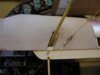
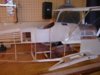
The final decking is just 1 layer of 1/64th ply and the stringers, except the centre one, have been removed to save weight. Small savings behind the CG really do make a difference; the further art the greater the effect.


View attachment 262655


With the decking finished I had the problem of filling around the cabane struts and bracing wires. It is only 1/32nd thick so the filler itself will have no strength and the rear face is a complex shape with the tubes etc. passing through the curved decking so any backing would be quite difficult to produce accurately. I then remembered a post by Barry about “Micropore” surgical tape and cyano; the tape is self-adhesive and followed the shapes easily, once in position a few drops of cyano turned it into a solid backing. With a couple of pieces of ply to form an edge it’s ready for the lightweight filler.


View attachment 262656


It took a few applications of filler to get to this state ready for covering; I’ll give it a few drops of cyano to harden the filler before I cover it.


View attachment 262657
 

Attachments

  • decking 17.jpg
    decking 17.jpg
    2.5 KB · Views: 0
  • decking 16.jpg
    decking 16.jpg
    2.3 KB · Views: 0
  • decking 15.jpg
    decking 15.jpg
    2.8 KB · Views: 0
Where struts vanish into the fuselage like this can be a real problem area,but you have tackled it just the way that I would have done,there is just no other option available,glad that you remembered that Micropore,it really locks up rock hard once the cyno touches it,and once more can be easily wound and stretched slightly,as you say Grahame a thin soaking in thin cyno will make the filler solid as it soaks in.
 
Thread owner
The top of the fuselage is covered in 2 pieces, first all the decking and then the stringers to just behind the cockpit, so the rear decking has 2 layers of Solatex. If I say that covering the decking was a challenge you’ll get the idea, I certainly envied the full size where the struts and bracing wires are removed before covering.


View attachment 262658


I’m now ready to start on the next section, the fin, skid and rudder but before I do I compare the actual model to the plan. This is for 2 reasons, firstly the plan is amended for those things that didn’t work out exactly as I’d envisaged and secondly it ensures that the next bit will fit what has already been made.
 

Attachments

  • fuselage 1.jpg
    fuselage 1.jpg
    1.7 KB · Views: 0
Grahame can you explain why you used two layers of Solartex on the rear decking ? no doubt you have good reasons to do so knowing your precise and well planned approach to building.

Thank you.
 
Thread owner
Barry

The decking is in 3 sections with one of the joints just aft of the cockpit at the “break” point; this would seem to be the place to end the decking covering but it would create an obvious weak point so the covering is taken back to the end of the decking. The “stringer” covering is taken forward over the decking because the decking is a different length on either side of the fuselage. Done this way there is a neat join between the coverings, which is further strengthened by a frayed tape.

A little extra weight but I wouldn’t want the decking to “spring” open on a less than perfect landing; where strength isn’t an issue I save every gram I can but there’s no point building so light that you’re for ever having to repair the model.
 
That makes good sense Grahame to do what you have done,a weak spot can wreak havoc into a structure like that,any cockpit opening is a weak point as well,it is a difficult decision especially as the aft centre of gravity build up of weight can be a real issue.

The S.E.5A has such appeal as a model subject and I can see now why you picked it as your current model subject.
 
may sound stupid but what is aft centre of gravity

is it just the centre of gravity of the plane?
 
Thread owner
Iain

Firstly there is no such thing as a stupid question, only a question you don't know the answer to.

The centre of gravity (CG) is the point at which the aeroplane physically balances, it is always marked on the plan and it is very important to get the model to balance correctly. A model that is nose heavy will usually fly reasonably well but a tail-heavy model can be literally unflyable. The CG is always some distance in front of the aerodynamic balance point to ensure stability.

On all the planes I know there is more model behind (or aft) of the CG than in front, in the case of the SE5a there is 10" from the CG to the nose and 34” from the CG to the tail so it needs 3.5 times the weight in the nose to balance weight at the tail. The length of the nose is calculated to allow the weight of the engine to balance the plane but as our engines tend to be light compared with the full size counterpart it is important to build as light as possible behind the CG to minimise the “dead” weight required in the nose.

So to actually answer your question, to read it correctly “aft centre of gravity” needs that next four words added to make sense which are “build up of weight”.

Hope that all makes sense!!

Grahame
 
Thread owner
Before I start on the construction of the fin itself I want to be sure that the tail plane incidence adjuster will work so I’ve made that first.


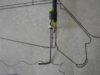
The fin post is a carbon fibre tube through which the adjuster rod, a snake inner, slides; the 2 attachments for the bracing wires are made from closed loop adapters and brass wire.


View attachment 262659


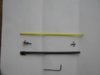
The lower attachment has a 2mm cap head bolt that will do the actual adjustment by screwing in or out of a length of snake inner firmly fixed to the fin post; I used snake inner for this as it acts like a large “Nyloc” nut so won’t alter the incidence as a result of engine vibration.


Any adjustment required will be made using an Allen key through a small hole in the base of the tailskid fairing.


View attachment 262660


This is the position it will be fitted in, at this setting the adjustment is about central and can be altered approximately 7mm either way.


View attachment 262661
 

Attachments

  • fin 2.jpg
    fin 2.jpg
    1.6 KB · Views: 0
  • fin 3.jpg
    fin 3.jpg
    1.8 KB · Views: 0
  • fin 1.jpg
    fin 1.jpg
    1.2 KB · Views: 0
Grahame this little feature is so important,and it surprises me that more modellers do not use it,no matter how well calculated the tailplane incidence nearly always needs adjustment to enable the model to fly properly.

I really like the idea of the snake inner put to use in this way,by the way this material also makes ideal cowling screw fastener inserts,you just push a flared piece through the wood and attach with a dab of cyno,the flare can be made with a hot metal butchers skewer quickly pushed into the snake inner,another flare on the outside takes care that it is not pushed through the wood,the job is best done during construction of the model.

Full sized aircraft utilise a screw jack arrangement for ground adjustment by the engineer.
 
Thread owner
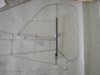
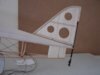
The fin is made using “core and half ribs”; for those not familiar with the method it is a simple way to make strong but light structures, especially if the outline is “curvy”. It is my preferred method even for simple shapes such as the SE5a fin, rudder and elevators; the tail plane may have to be a fully built up construction because of the cable and pulley elevator linkage, I’m not decided as yet.


View attachment 262662


To start the core is cut to the shape of the finished item, the usual material is 1/16th balsa but I’ve heard of the use of thin ply for extra strength or even Depron if weight is an issue. The positions for ribs etc. are marked then one side constructed whilst the core is pinned to the building board, thus ensuring a straight structure. After leaving plenty of time for the glue to fully dry the process is repeated for the other side.
 

Attachments

  • fin 4.jpg
    fin 4.jpg
    1.9 KB · Views: 0
Status
Not open for further replies.
Back
Top