Theme editor

Scale Model Shop

Special Hobby 1/32 Fiat G.50-II 'Freccia'.

Thread owner
Success!

I combined Plan A and Plan B to fit the engine. I'm certain that others will find their own way, but here's what I did.

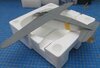
I fitted the resin adaptor to the fuselage having opened up the key to give some wiggle room. I shimmed the bottom and top pairs of rear cylinders with what I think is 0.3 mm card (don't quote me) to give a loose interference fit it the cowling, meaning it doesn't jam the engine into place but there's not much movement possible. Slide the engine into the cowling (it has to go from the back) and loop the exhaust 'ring' over the back of the engine. Having applied some CA glue to the fuselage adaptor slide the engine cowling assembly in to place. The cowling is one of the few parts of the models that can only locate one way with no play. Gently slide the engine back into the adaptor, rotating to vertical and fitting the key. Only the lower part will be glued because of the angles involved, but it is enough. You can then glue the cowling into place. As of now I have not glued the exhausts in any way because they don't seem to move and can't go anywhere. You can see the one on the side of the model nearest the viewer sticking out below the cowling.
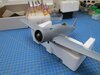
IMG_2513.JPG
 
Thread owner
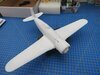
I've now got the model primed, in white.

IMG_2516.JPG


I've used white because I shall mask of the various white markings, and some white discs under the wings where the fasces in the white roundels go. White decals can be b*ggers otherwise, even on the underside grey (Grigio Mimetico).

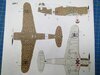
I'm going to attempt to approximate something like this with the camouflage.

IMG_2515.JPG

I don't know how it was done originally, but I'm intending to paint the entire upper surface in the green colour (Verde Mimetico 3) before applying the mottle of the yellow (Giallo Mimetico 3) and then red/brown (Marrone Mimetico 3) and don't want the whole thing to become too dark.

I have also found a reference to the 'back' of the propeller blades (facing forward on the aircraft) being painted in a blue colour whereas the 'front' (facing the pilot) was painted black. I quite like that idea.

That's it for today as I will leave the primer until tomorrow before I give it a polish.
 
Lovely choice in camo Steve. These schemes look superb, but must be terrifying to paint up.
 
Thread owner
Lovely choice in camo Steve. These schemes look superb, but must be terrifying to paint up.

All these Italian schemes were a bit weird. I know the amount of research, comparative trials etc. that we put into our camouflage schemes and I sometimes wonder if the Italians were making it up as they went along! I would assume not.
 
You’re talking of a country that exists purely for aesthetics there Steve. I’ve been to Italy a few times (absolutely love it) and I really think they spend more money on sunglasses than they do on their houses. They probably just picked these schemes because they looked really cool....and they were right!
 
This might help: Regia Aeronautica and ANR Colors and Camouflage Schemes.
The new camouflage scheme, the so-called "Honeycomb Camouflage Scheme" used existing colors, however, were now applied in a more complex, soft-edged mottling scheme (…). It is important to note, at this time only the camouflage scheme was standardized and not the colors. The standardization of colors would only come later with the appearance of the Tavola X colors. This of course led to interpretations of the three primary upper surface colors stipulated by the directive
and
The basic application of the "Honeycomb Camouflage Scheme" varied with each of the aircraft manufacturers, the unit and in some cases with the individual aircraft.
 
I found the article very enlightening when I came across it some years ago, concerning why model paints of Italian aircraft colours often have numbers after the name: Giallo Mimetico 1, 2, 3 and 4, for example. Turns out that these are modern terms for the different versions of what was supposed to be exactly the same colour, because the paint manufacturers were just giving it a shot instead of working to actual specs …
 
Thread owner
Quite a contrast to British practice, where chips and/or samples had to be matched, in terms of formula, colour and finish. Or German practice, where all the manufacturers were making paints to Warnecke and Bohm formulae under licence.
 
Looking very good Steve, rather you than me with that camo scheme. But I'm sure you can do it.
 
Thread owner
I sprayed the Grigio Mimetico on the underside.

The effect is underwhelming to say the least. There's not much to see on the underside, or in the currently masked wheel wells, and a coat of grey paint does little to afford anything of interest!

IMG_2517.JPG

I'll do a bit of post shading on this anyway and then hopefully make a start on the upper surfaces tomorrow.
 
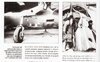
So, got my copy of the Bancarella Aeronautica G.50 book today, and there are more close-up photos, that, by this stage, aren't so useful to you
But have these anyway!
G.50 details 001.jpg

Have to say, all those little drop down doors by the wheel are new to me, and intriguing. What was that you were saying bout little of interest on the underside?
The other picture is the gun housing and the lubricant tank, right in front of the cockpit. No-one's done an Am set for that
yet.
 
Oh yeah, the 'Mimetici' colours.
Pre-1941 there were supposed to be four colours used on frontline, land-based Regia Aeronautica aircraft; lower surfaces Grigio Mimetico (grey), upper surfaces Giallo Mimetico, Verde Mimetico and Bruno/Marrone Mimetico, or yellow, green, and brown, or combinations thereof. In theory
In practice, each manufacturer sourced their own colours from different suppliers, so that Fiat aircraft are different shades to Breda or Macchi planes. Usually. AND they have different STYLES of camo too
Nominally, Fiat planes were in what's now known as Giallo Mimetico 1, which is quite a pale sand colour. Most G.50s are depicted in what's closer to Giallo Mimetico 3
which is a much darker shade. But that's interpretations from usually sparse colour evidence.
Nobody ever says there're more than one type of Grigio Mimetico (but that was replaced by Grigio Azzuro Chiaro in the Tavoli 10 colours in 1941... Officially...)

What this does mean is you can get away with a heck of a lot in Italian colours. I mean, the paint fades and discolours quite a bit in the Mediterranean sun!
Here's a couple of relevant quotes from the Italian Colori et Insigne' series that will either make you go 'I can get away with anything' or, for too many people 'NO! I demand to know the exact FS number of this colour!'
"...we would now consider absolutely meaningless trying establishing exactly which shade of colour was used for field paint-jobs at unit or maintenance shop level. Incase of repainted aircraft, each speculation about exact hues would result quite useless, as far as nobody could tell the origin of paints used."

Now, if I really wanted to upset people I'd point out that Luftwaffe aircraft in North Africa, Sandgelb or Sandbrun, looks remarkably like the Italian colour Nocciola Chiaro
 
Thread owner
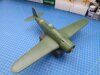
I've sprayed the Verde Mimetico 3 or as I like to call it, green.

To be honest this is not terribly exciting either! We'll see what a mess I can make of the mottled camouflage next :)

IMG_2518.JPG
 
Thread owner
Have to say, all those little drop down doors by the wheel are new to me, and intriguing.

It's unusual to see all those access panels open, and to see that they were hinged.

The photo of the undercarriage confirms that there was not much going on in the wheel wells!
 
It's unusual to see all those access panels open, and to see that they were hinged.

The photo of the undercarriage confirms that there was not much going on in the wheel wells!

Not much, sure, excepting the blinking great hole for rhe wheel hub! Don't think I've ever noticed that before.
 
VM3 or 'Green'. Yeah, that works. Then we can stick with 'Sand', 'Brown' and 'Grey'. MUCH simpler!

Y'know, most modellers seem to do these schemes with 'Green' first. What if, what IF, the green was lines painted on the 'Sand' base...
I'll just leave that nightmare scenario with you...
 
Thread owner
What if, what IF, the green was lines painted on the 'Sand' base...
I'll just leave that nightmare scenario with you...

I thought of that. I considered it as a way of doing this scheme. In the end I decided to go with the mottle over a green base because that's what the only photograph I've seen of this scheme looks like.
Also, whilst painting the green over the yellow would not be difficult using an airbrush on a model it would be much more difficult to paint coherently on a full size aircraft with a spray gun.
I do a lot of Luftwaffe camouflage schemes and it is important to think how they might have been applied originally. Applying something like a 'wellenmuster', it is important to understand that the guy standing on a ladder with a spray gun did not have arms eight feet long!
That limitation is clearly seen in this picture of original paintwork uncovered during restoration of the Smithsonian's (NASM) He 219.

9947h.jpg
 
Y'know, most modellers seem to do these schemes with 'Green' first. What if, what IF, the green was lines painted on the 'Sand' base...
From the article I linked to earlier:
As far as the "Honeycomb Camouflage Scheme" goes there were two basic types:

  • continuous mottling, usually Dark Green over a Yellow
  • sparse mottling, Yellow or Light Green over a Dark Green base and vice versa with, sometimes, a light mottling of Marrone or Bruno
So both would apparently be possible. But I agree with Steve that painting yellow lines over a green base is more likely, given that those lines are of relatively equal width, which would be difficult to do by painting green over yellow.
 
Back
Top