After my Colombian fix ( Coffee!! ) I actually laid hands on this - I charged it up from my computer _ don't know how long it took, but it was already partly charged, but less than 2 hours.The instruction book says you can leave it on charge, but I don't think that's good practice!
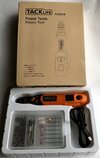
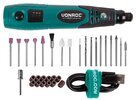
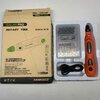
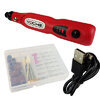
This is what you get:
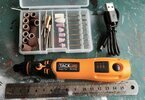
The cable is a standard usb to usb(c) of which I have one permanently attached to my computer to charge my phone & Kindle etc.
This thing come swith a CE rating
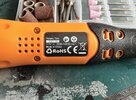
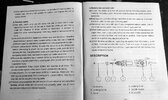
and for a Chinese product, an instruction book, which is in correct English! It also gives safety tips as well.
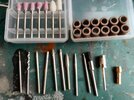
Tools are basic, but with the spare collet, you should be able to use Dremel accessories ( shaft sizes 2.3mm & 3.2 mm dia.
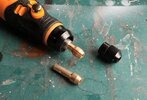
Collets are easily changed - all these parts are metal, as is the spindle locking button ( top left ).
The tool is turned on with the large button on the handle - it's sequential. 5000, 10000, 15000, free rpm. Hold the button down for a couple of seconds to turn off.
One of the things I want to do with this is waterline my full hull ship models. To do this I will use a HSS saw set that I bought for the Dremel. It has a mandrel with a 3.2mm shaft, so the collets were changed & the 25mm dia saw chosen.
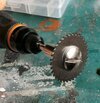
I reckon I might be able to use up to 35mm dia, but anything above that is dodgy!
From the stash, I retrieved the Dragon 1/700 USS Buchanan - this has a one piece hull. Normally I would add the deck to stiffen things up, but I wanted to see how I went without.
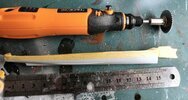
Masking tape added along the waterline as a guide. I used 15000 rpm at first, but I could also use 10000 rpm. When using this type of saw you should wear eye protection, as bits fly everywhere. It took about 4-5 minutes to cut the hull - the tool got hand warm, but nothing worse.
This was worst possible case, a small flexible model & first time using this thing. It felt good in the hand, nothing rattles when you shake it. No sharp edges ,there are fixing screws open to view ( and check for tightness ). It vibrates when using the saw, but you'd expect that from a light tool at quite a high speed. With sanding drums & engraving bits not a lot of vibration.
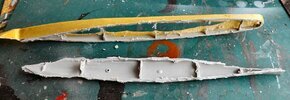
Initially a bit wobbly, but as I got used to it, and improved - if I had added the deck it would have been easier!
Next, change collets & try a sanding drum to smooth down the waterline & remove burrs
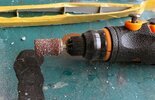
This time, I could use 5000 rpm & the results were good

Final flattening will be on a sheet of emery on a board................
Conclusions.
It has already proved it can do what I wanted! I dare say if you tried to use it on metal, or perhaps hard wood, then it may not work too well, but on plastic - very good. The collet sizes are OK for sawing sanding & engraving ( loads of cheap accessories around ). I don't intend to drill with it, as my record with little drill bits & power tools is disastrous.
How long does the battery last? - I have no idea - I ran it for about 12-13 minutes in total, and the speed seemed to be as normal. Running it for a long time isn't what I intend it for - it's intended to be on the bench ready for instant short burst of use. My computer is always on when I'm at the bench ( Spotify! ), so charging isn't a problem.
I can say that this satisfies my particular needs, and at the price I got it for, it was very much worth it.
The unknowns are, how long it holds a charge & how many times you can recharge it? Time will tell. Maybe the more expensive models have better & longer lasting batteries.
If you're after a
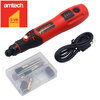
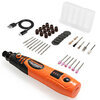
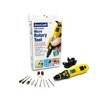
light-duty rotary tool then this 'Tacklife' fits the bill - I assume that the clones are similar, so it's a matter of looking around for the best price, some come with minimal tools - others with 100+ bits. If you already have Dremel bits then all these should fit!
Thanks for dropping by, - comments & questions appreciated
Dave