


You are using an out of date browser. It may not display this or other websites correctly.
You should upgrade or use an alternative browser.
You should upgrade or use an alternative browser.
Tamiya paint and mr surfacer issues
- Thread starter kacitgirl
- Start date


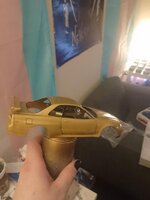
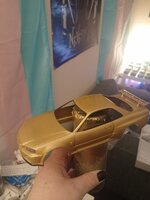

1/3
Not quite sure what I’m looking for here? Has the clear coat not given you the gloss you expect? Just for more diagnostic info, how are you diluting the clear coat, or is it a spray? I know the Mr Color stuff is cellulose (laquer) based, so wondered what you are using. Could be you are just over diluting the clear coat, or using too hot an thinner, or putting it on a bit heavy, so softening the undercoat and pulling it up through the top coat before it dries. I’ve only used TS colours a couple of times, and decant them off to use through an airbrush, thinning with Mr Color levelling thinner (MLT). Didn’t have this issue using Zero paints high gloss over it. However, when I used Tamiya gloss over very dry Alclad metallics I did get this problem, pulling the gloss black undercoat up through the silver finish. In that instance I had run out of MLT, so used basic cellulose thinners for the gloss and put it on too thickly. It was a poor choice of materials and bad technique on my part. Not saying that’s what you’ve done, just that when I got this that was how I did it. Just my thoughts.
There is a guy, Andy T, on here that sprays (or did) real cars for a living, and who is fantastic at this stuff. Be interesting to see his views because what he doesn’t know probably isn’t worth knowing.
There is a guy, Andy T, on here that sprays (or did) real cars for a living, and who is fantastic at this stuff. Be interesting to see his views because what he doesn’t know probably isn’t worth knowing.

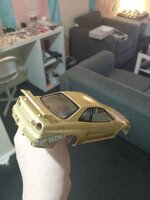
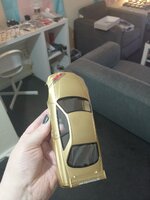
The photos are not very clear at showing your concerns but, in my experience as an ex car painter over 30 years, if you are seeing a sort of crazy praving effect in the clearcoat it points to the clear being either too quickly applied between coats or the thinners being too strong and eating into substrate.
You could try to flat down the offending areas but run the risk of losing details and it would be very difficult around the spoilers etc.
Best bet would be to strip all the paint off to bare plastic and start again with sufficient curing time between various coats which is going to take alot longer in the present temperatures and humidity levels.
What primer, gold metallic and clearcoat did you use and did you thin any of them?
You could try to flat down the offending areas but run the risk of losing details and it would be very difficult around the spoilers etc.
Best bet would be to strip all the paint off to bare plastic and start again with sufficient curing time between various coats which is going to take alot longer in the present temperatures and humidity levels.
What primer, gold metallic and clearcoat did you use and did you thin any of them?
Sorry for the poor picture the top coat has caused the surfacer to bleed through the colour coat and shows up as patches only seems to happen with certain colours ie. Silver or gold. It probably will get a bath unless I can hide it
1/3
So the paint regime was Surfacer, Gold paint, and clear finish? If so, that’s exactly what I got with the paint job I described. I got away with it on the aircraft I was making, as it just looked like wear and grime, but on a car I think you need a strip and respray. Possibly try an acrylic gloss coat (I know they aren’t great, but you can polish them afterwards) ?

Kaci I don't know anything about spraying cars, but out of curiosity I described the problem to chatgpt, perhaps it can help, here's what it sad:
ChatGpt said:Yes — this is a very common paint compatibility issue in scale modeling, and the clue is already in what she said: it mainly happens with metallic colors like silver or gold.
What is most likely happening
The top coat (clear coat) is partially re-dissolving the layers underneath.
As a result, the pigments or the surfacer “bleed through” the color coat, creating patchy or cloudy areas.
This usually comes down to a combination of the following factors:
1. The solvent is too “hot”
If the clear coat contains stronger solvents than the surfacer or color coat (for example, a lacquer clear over acrylic or enamel paint):
-The clear coat bites into the color layer
-It locally reactivates the surfacer underneath
-The surfacer shows through as patches or shadows
Metallic paints are especially sensitive to this.
2. Metallic colors have poor hiding power
Silver and gold paints:
-Are thin and semi-transparent
-Contain metal flakes that reflect light
-Show any disturbance in the undercoat very clearly
With solid colors (red, blue, black), the same issue might still occur but would be far less visible.
3. The color coat was not fully cured
If the color coat:
-Was not allowed enough drying/curing time
-Was still soft beneath the surface
Then the clear coat can:
-Reactivate the paint
-Allow pigments to migrate
-Cause metallic flakes to shift or “float”
This leads to blotches, clouding, or uneven areas.
4. The first clear coat layer was applied too wet
A wet first coat of clear is often the main trigger:
-Too much solvent at once
-Prolonged contact with the color coat
-Higher chance of solvent penetration
How to prevent it
Best practice, especially for metallic finishes:
1. Let the color coat fully cure
– ideally 24–48 hours (longer for enamels)
2. Apply very light mist coats first
– 1–2 dry, light coats
– This “locks in” the color layer
3. Only then apply wet coats
4. Use compatible paint systems
-Acrylic over acrylic
-Lacquer over lacquer
-Or use a safe intermediate sealer (e.g. an acrylic gloss)
5. Always test on a spare piece
Metallic + clear = always test first
In short
The issue occurs because the clear coat chemically reacts with the layers below, and metallic colors make the problem much more visible. It’s not really a spraying technique error, but a material compatibility and layering issue.

ChatGPT came to the same conclusion as me, the clear coat was too ”hot" and has damaged the layers underneath.
I use Mr Color GX112 for cars. First very light tack coat is 50/50 MLT and 112, 2nd coat 60/40 slightly heavier, 3rd coat 70/30 quite heavy and final wet coat 80/20. 5 minutes interval between coats.
Never had an issue using this method, even over metallics.
I use Mr Color GX112 for cars. First very light tack coat is 50/50 MLT and 112, 2nd coat 60/40 slightly heavier, 3rd coat 70/30 quite heavy and final wet coat 80/20. 5 minutes interval between coats.
Never had an issue using this method, even over metallics.
1/3
Not necessarily helpful, but I have used Zero paints clearcoat over TS metallic paint put on by airbrush and the finish was superb.
I see what you mean, would a gentle flat with 3000 grit be possible? If so a patient recoating of colour might work then clearcoat.
may try that or i have jdm decals i could hide the offending area with
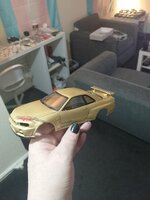
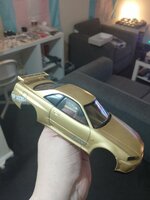

WELL Katy im like Steven 000 as dont know much about this sprayin paint lark on cars as im mainly into planes an warships an all i do is just spray a undercoat primer an then the main top colour over top on the model an i always practice with these paints on a spare bit of plastic as ive like you have found some paints or such will attack each other an if they dont attack then i know its ok to use the paints on the model
chrisb
chrisb
Legal Notice
scalemodelling.co.uk is a privately operated online discussion forum. All content posted by members reflects their own views and opinions and does not necessarily represent those of the forum owners or administrators. While reasonable efforts are made to moderate content, no responsibility is accepted for user-generated material. By using this site, you agree to comply with UK law and the forum rules.