Theme editor

Scale Model Shop

Trumpy 1/35 Faun SLT 56

nickedw

New member
Joined
May 31, 2023
Messages
94
Reaction score
0
Points
0
1/3
Thread owner
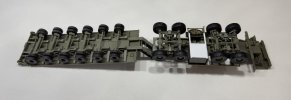
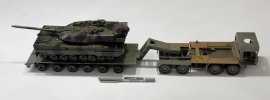
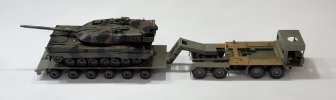
Here’s my first build thread with you guys, its a big old tank transporter.

Never built a truck before so here goes.

kit isn’t bad in a normal trumpy kind of way - quite a lot going on and some of it may even be right. It’s made from ‘old school’ brittle green plastic like the old Tamiya tanks were.

Lots of ejector pin marks, seam lines and fairly heavy sprue to deal with, I’ve been building a lot of very new kit’s lately, so I’m a bit spoiled I guess.

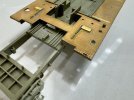
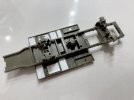
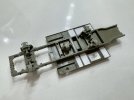
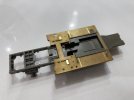
anyway, first job is to hack away a load of stuff and get some Eduard tin involved.
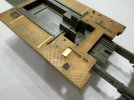
IMG_4752.jpegIMG_4751.jpegIMG_4750.jpegIMG_4749.jpegIMG_4748.jpeg
 
Great, I was hoping you would post a build thread of this one :) I’ll be following to see if I might finally pick up the courage to start mine :)
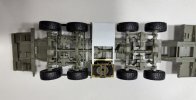
 
Thread owner
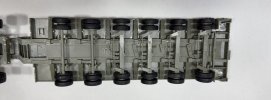
I hope you like wheels lol.
It's an older kit but builds well.
21 years old it turns out!

I’m trying to resist the temptation to correct everything at the moment, I’ve just been CNC machining Bentley leaf springs and there’s loads of em on this thing crying out for the same treatment, but it’s a slippery slope, and this is supposed to be a fairly quick build just to go with the RFM Leopard.
 
Thread owner
OK a little progress. I do like this kit, it’s a bit crude by modern standards, but there’s a lot going on with it in fairness

IMG_4792.jpegIMG_4791.jpegIMG_4790.jpegIMG_4789.jpegIMG_4793.jpegIMG_4794.jpeg
 
Looking good Nick, the front wheels are they glued? as they look a bit toe out. the etch work on the fender is excellent.
 
Thread owner
No the steering is all still floating - all 6 axles of it! a bit naff TBH but the hubs aren’t connected to each other at all, ie the steering arms are dummy and not attached to the hubs so you can have as much toe in/out as you like per wheel. Haven’t decided how I’m going to pose them yet do still free.

Also I hadn’t realised that it’s ‘most wheel drive’ as well which seems a bit odd, 6 of the 8 tractor wheels are driven only so the 2nd axle isn’t. I assume an additional ’centre’ diff would be needed if both sets of steerable front axles were driven as they look they turn at different rates, ie the front axle looks like it turns harder than the second. The rear two axles don’t have a diff between them as they both run at the same speed (near enough anyway as they aren't steering) I assume.

I don’t know anything about trucks as you can see so this is all a little adventure for me
 
The Fuan was indeed a 6x8 that's 8 wheeled but only 6 powered.
All three powered axels have a diff. It's the fat bit in the centre of the axels.

I had a lot of issues with wayward wheels on my one the last time I moved it I spent an hour putting wheels back on!
 
Thread owner
All three powered axels have a diff. It's the fat bit in the centre of the axels.
I’m talking about centre diffs. A 4x4 car has 3 diffs typically, one per axle and a 3rd centre diff because when you steer, the front wheels travel in an arc which means the front axle is turning faster than the rear axle, so you need a third centre diff. This thing has 4 diffs, one per driven axle plus an additional centre diff. Both rear axles run at the same speed as each other so don't need a diff between them. I think if the 2nd steering axle was driven, it would have its own diff obviously, but I think would require yet another diff between it and the other driven, steering axle because they would be travelling at different speeds relative to each other and the rear axles.
 
Also I hadn’t realised that it’s ‘most wheel drive’ as well which seems a bit odd, 6 of the 8 tractor wheels are driven only so the 2nd axle isn’t.
That’s the principal technical difference between the SLT 56 Franziska and the SLT 50-3 Elefant: the latter has all four axles driven.
 
Thread owner
Ah OK. I assumed that was a ‘lesser’ vehicle, maybe not then?
Did it have 6 differentials though
 
The SLT 56 has three differentials, and the SLT 50-3 has four: one in each driven axle. A differential is only needed in a drive axle, because it will allow the left and right wheels to rotate at different speeds, which is necessary in situations like when turning — the inner wheel will want to rotate more slowly than the outer (because it’s following a shorter path around the curve), but without a differential, it can’t, and that leads to difficulty steering as well as much greater wear on tyres and mechanical components. In a non-driven axle, this is much simpler to solve: just don’t connect the left and right wheels and they will naturally rotate at the right speed.

I think, but am not sure, that the 56 was intended as a slightly less expensive vehicle with greater towing capability (the 50 and 56 are the basic tonnage it can haul, IIRC) but slightly lower cross-country capability as the 50-3. So they saved on the fourth driven axle and all the complications that adds.
 
That is coming on a treat. Now if you need modern vehicle securing chains etc have a look at Accurate Armour, so much better than a bit of hairy string with ten knots in it.
A153 - A155.
 
Thread owner
The SLT 56 has three differentials, and the SLT 50-3 has four: one in each driven axle. A differential is only needed in a drive axle, because it will allow the left and right wheels to rotate at different speeds, which is necessary in situations like when turning
I don’t know how many diffs an SLT 56 has but with respect, your explanation is correct but incomplete. When a vehicle turns, the front steering AXLE (not just individual wheels) has to travel further than the rear axle because the front wheels are now travelling on a large radius curve not a straight line. All curves are longer than straight lines, so this means the front axle pair of wheels are turning faster than the rear pair, yes each wheel on the axle is also travelling at different speeds and as you say, the axle differential does that, but there is a speed difference between the aggregated front pair of wheels and the rear pair of wheels, as they are attached to each other via the chassis. So the situation you described for the wheels, also exists for the axles, it’s just the same only turned through 90° - A centre differential allows this to happen. On loose surfaces, without a centre diff, one set of wheels will just slip a bit. On tarmac it’s a problem and eventually a tyre will wind up so much it will just skip, which feels like you hit a bollard. A know this for a fact because Nissan Navaras (one of which I owned for a while) don’t have a centre diff. This means 4wd can only be used on loose surfaces. Anything with ‘full-time’ AWD has a centre diff, so unless these vehicles don’t have full time AWD, which may be the case?, they would need additional diffs.
So I assume if they do have 3 diffs as you say (can’t tell from model as it doesn’t even attempt the engine drive shaft on the transfer box and who knows if it contains a diff or not) then they can’t be full-time 6 wheel drive. this may well be the case?
 
You’re right, of course — but I was only talking about the differentials in the axles, not those elsewhere in the driveline. I’ve just been browsing through my copy of this book:


to see if it might have an answer to the question of the total number of differentials, but it doesn’t seem to. It does have diagrams (probably from a vehicle manual) that show the driveline, and in the SLT 50-2 and -3, the engine drives the gearbox, from where one shaft runs forward to the differential in axle 2, and from there to axle 1; and one shaft goes back from the gearbox to differential 3, and from there to axle 4. The SLT 56* is similar for axles 3 and 4, but forward, there is just a drive shaft from the gearbox to axle 1 (of course). No information on what’s inside the gearbox, however. For all I know, the differentials compensate for front-to-back differences in rotation speed as well as left-to-right?


* It turns out it’s not actually called that :smiling3: The real designation is Sattelzugmaschine, schwer, mil FS 42.75/42 8×6 but everybody calls it SLT 56 in imitation of the SLT 50, which is called that.
 
Thread owner
For all I know, the differentials compensate for front-to-back differences in rotation speed as well as left-to-right?
Good info, the axles diffs physically (well mechanically anyway) can’t do that.

They split all of input rotation from the drive flange left and right. It’s the input to these diffs drive that further needs splitting front to rear, so in effect, they need to receive different input speeds (when turning) front/rear to further distribute left/right. So when turning you might send 500 rpm to the front and 490 to the rear, and 100% of both those inputs then gets subdivided left/right via the final drive ratios etc. so the diff can’t lose or gain anything, all it can do is apportion all of the received energy left to right, if it’s receiving either too much (or nor enough) a. It doesn’t know, b. It couldn’t do anything about it. The centre diff is doing the same thing at 90° so 100% of the engine power just gets divided up front to rear, mostly it does nothing much as front/rear rotational speed is matched when travelling straight, it’s when turning it kicks in.
 
Many gearboxes/transfer cases have liquid couplings to reduce the effects you're discussing, also different ratios front & rear.
 
Thread owner
I’m still making slow headway with this kit, theres a lot of cleanup, ejector pin marks, and removal of stuff for Eduard PE to do, so some more photos later.

in the meantime looking at my references, it’s time for my next stupid non-model question - why would you put a radiator (so you are trying to cool something down) next to the exhaust (the hottest part of the engine) am I missing something? It looks like it’s a cooler for the hydraulic oil that drives the winch motors etc

IMG_1820.jpeg
 
Thread owner
Many gearboxes/transfer cases have liquid couplings to reduce the effects you're discussing, also different ratios front & rear.
Interesting been reading up on that, makes perfect sense.

I’ve come across this technology for LSD stuff in the past, but hadn’t realised it was used like this too. I think the Ferguson system (as in Massey-Ferguson Tractors and Jenson FF) worked liked this. Now I've looked it up the Celica GT 4 Rally car had a viscous coupling centre diff too. Good stuff!
 
Back
Top