
Theme editor

Scale Model Shop

Trying to get paint onto an Atlas

Flip

SMF Supporters
Joined
Jul 21, 2022
Messages
260
Reaction score
16
Points
18
1/3
Thread owner
Hello to all the more experienced sprayers.

I am currently building the Revell 1:72 A400M Atlas and I am experiencing airbrushing issues (big time). I have had little problem with smaller parts and smaller kits but this is my first large kit and I don't know if some of that is related to it.

I posted before (general chit-chat, I think) and was steered to spraying closer to avoid a powdery finish. Part of the previous problem was also that the ambient temp was too high.
So, I bought some VMS enamel retarder from John's shop, added 10% to the Revell Color Mix and then made up a 1:1 with this combo and Revell No.57 Enamel.

First step was to lay some of it on a spoon and see how it came out...Spoon Test.JPG
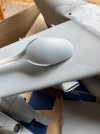
There did not seem to be any issues.

Next step - put it on the aircraft...IMG_3613.JPG
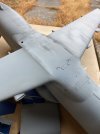
Can I cry now? It just looks terrible.

I paid close attention to my distance from the model - only about 2 inches away (desperately trying to avoid powder)
The ambient is only 18.6C
I noticed the other day that the powder forms around the edge of the cone of deposition so, today, I dialled my pressure down to 10psi to stop it being blasted.

I am out of ideas regarding how to stop this.

Any further suggestions guys from those who have gone through the pain barrier ahead of me?

Yours tearfully,
John :disappointed:
 
maybe add a little more thinner, to me it looks like its 'going on dry' which is causing the powdery effect..
Even though most paints will spray perfectly at a cheeky 50/50 mix, sometimes you might need to up the ratio of thinners to get it to work better, say maybe a even cheekier 60/40 ratio, which will help give you a slightly wetter finish..
 
It's very hard John to decide where the problem lies. The only things I can think of is firstly the dilution of the paint. Because the viscosity of paint varies so much it is impossible to give a standard thinning ratio. An old tin of paint will be thicker and require much more thinning than a newly opened tin. So maybe you 1:1 ratio was out. You should aim for paint to be 'like milk' - that would be slightly thicker than water. I mix my paint in a plastic shot glass with a coffee stirrer. Apart from visually checking the dilution I drag some up the side of the glass and it should run quickly back down leaving just a thin, transparent patch.
When spraying you should aim to get a just wet finish. Spray an area, say a wing, until the surface is wet. Not so wet that it runs though, and then move on to the next area. Your spoon was a small area whereas your model is much larger so maybe you laid down a wet coat on the spoon but on the larger area of the model you were moving before you had put on enough paint to be wet.
I know it is b****y frustrating but stick with it. We have all had similar issues.
Jim
 
I mix enamel paints after the old "same thickness as milk" trick. regardless of how thick or thin the un thinned paint is always have a 'taget' thickness, or thinness in this case.
The size of the subject could be could be factor. I would as Jim suggests break it into sections. I would go as far as even suggesting paint a few panels at a time. say ten or so at the front then some at the back and carry one until you meet up in the middle.
 
Thread owner
Thanks chaps for the input. I am always very nervous about over-thinning but it would appear that I am may not be near that point yet.
I have no option but to let it completely dry overnight.
I'll try to buff it out a bit in the morning and re-visit it with the airbrush.

BTW: I have a H&S Evolution CR Plus airbrush, currently with the 0.4mm needle fitted. Can I safely assume that, once I have gone up the learning curve, this AB will handle a model of that size? Or am I pushing it too far?

Regards,
John
 
Your airbrush is fine, It will do anything you need it to do. Many people will tell you that for very fine work a 0.2mm nozzle/needle is best. However I personally think that the skill you get by practice, practice, practice is more important than the nozzle size. A very skilled person with a 0.2mm nozzle will do amazing work but most of us will simple get more tip drying and clogging. I have a H&S and I have a 0.2mm and 0.4mm nozzles/ needles for it - I can't remember the last time I used the 0.2mm.
 
Thread owner
Your airbrush is fine, It will do anything you need it to do. Many people will tell you that for very fine work a 0.2mm nozzle/needle is best. However I personally think that the skill you get by practice, practice, practice is more important than the nozzle size. A very skilled person with a 0.2mm nozzle will do amazing work but most of us will simple get more tip drying and clogging. I have a H&S and I have a 0.2mm and 0.4mm nozzles/ needles for it - I can't remember the last time I used the 0.2mm.
Thanks Jim.
That simplifies the equation - the only thing that needs sorting is me :tears-of-joy:
Try again tomorrow when it's dry.
I really appreciate the input.
Regards,
John
 
Back
Top