

You are using an out of date browser. It may not display this or other websites correctly.
You should upgrade or use an alternative browser.
You should upgrade or use an alternative browser.
What is the most hard wearing paint in scale modelling?
- Thread starter pjgtech
- Start date


- Joined
- Dec 28, 2023
- Messages
- 2,934
- Location
- Swale Kent UK
- First Name
- Peter
1/3
I just bought an aftermarket part for one of my target air rifles, (its called a bag rider, as it rests the rear of the gun on a bean bag or soft rest), but its not in the colour that I really wanted, so I was considering spraying it with my AB and maybe using one of the paints that I already have.
Its a part that will not see much wear, so does not need to be very hard wearing, and it is made from anodised aluminium.
Its a part that will not see much wear, so does not need to be very hard wearing, and it is made from anodised aluminium.


- Joined
- Jan 26, 2017
- Messages
- 2,821
1/3
I’d say enamel followed by lacquer, both are very durable.
I think enamels only went out of favour compared to acrylic and lacquer paint because they take quite a bit longer to dry.
Geoff.
I think enamels only went out of favour compared to acrylic and lacquer paint because they take quite a bit longer to dry.
Geoff.

Having used all types, I would say lacquers to directly answer the question.
But this is an interesting subject and we can look back at how modelling paints have developed over the years. The best paint for you is also not just a matter of how hard wearing a paint is.
Enamels have nothing to offer that lacquers don’t have, while lacquers offer more for instance they dry and cure much more quickly.
That said all three have their place on our shelves and, for some people, there are good reasons to spray water based acrylics rather than lacquers.
Let’s look at my memory and experience over the decades of how we have got to where we are now.
I remember modelling in the ‘60’s when all that was on offer were enamels, Humbrol tinlets for me.
Then acrylics came along, also then Humbrol, I liked them as I found them easy to clean up and I used them alongside the enamels. Remember back then in the 60’s and ‘70’s I was only using a handbrush.
On returning to the hobby in about 2009 I discovered a dazzling range of brands and paint formulas. That said back then acrylics had come to dominate with enamels clearly having declined from their top spot. I started airbrushing immediately I decided to get back into the hobby. After research I started off using Vallejo acrylics and found Model Air to be an improvement over the Humbrols I had started with on my first build or two. I accepted their shortcomings and worked out how to get the best of them. I was then faintly aware initially of the Mr Color line of lacquer paints and used some of their metallics, likewise Alclad. Over the years that followed I became aware of more and more companies releasing lacquer based paints, clearly as a result of their gaining popularity over water based acrylics. Having tried out MRP early on when they called themselves Mr Paint, I bought a couple of basic colours, at a cost as I had to get them in from Uschi in Germany and I was blown away with how they sprayed. I stayed with Model Air for a couple more years until the MRP range had expanded and gained distributors in the U.K. immediately I then gave away my Model Air and bought nearly 100 MRP never looking back.
Why am I saying all this?
Well to demonstrate my experience of how paints have developed over the years. Enamels have been overtaken by acrylics and now, for airbrushing, the dominance of acrylic is now being challenged by lacquers.
There will still be plenty who love their enamels though they are less available now than other types. As I see it they don’t excel over the alternatives in any respect but are good all rounders.
Acrylics are great for hand painting but their real advantage being their lack of smell and for those in confined spaces of have certain health issues may well always be the better choice.
Lacquers are without a doubt the best for airbrushing. They have the robust finish of enamels but dry in minutes needing at most 30 minutes to cure and that’s playing safe. Now because of their increased popularity over the last 10 years or so, the range of brands offering them is now huge and the range of colours is massive. They are easier to handle than acrylics, not having the acrylic foibles, but they don’t hand brush and you do need a well ventilated space and, ideally, a spray booth.
I would suggest the optimum use of the various types is, as follows.
Airbrushing: lacquers
Handbrushing: acrylics
Pin washes: enamels
For some though acrylics may be the better airbrushing option for reasons mentioned.
I have not said anything about the alcohol based acrylics. These are a better airbrushing products than water based acrylics, which is why they have gained such a huge following. But note that Tamiya who are the primary producer of these have now also joined the lacquer camp with their own line to benefit from the growing popularity of lacquers.
My own take on this, as someone who has a dedicated room and a high quality spray booth to use and also like to try thing out and experiment.
MRP lacquers for all spraying and that means priming, painting and clears.
Vallejo Model Colour Acrylics of which I have a small range of mostly basic colours, for hand brushing over the lacquers. I have now started using AKI paint pens for this as well. These won’t totally replace the Model Colour and certainly not the airbrush.
AKI enamel washes for pin washes
Flory clay washes for sludge washes
Well, that was a much longer and more complicated post than I originally intended and I hope I didn’t bore anyone.
Last edited:

1/3
A huge amount of durability comes from the initial primer. After all, that is the paint to object layer that will need to bond strongest to keep the paint in place.
In my experience the best primer for adhesion and handling resistance is that produced for the automotive industry. In this case you are looking for bonding to a metal part, and automotive primers are designed to resist wear and handling in pretty adverse and challenging conditions for the lifetime of a vehicle. I have metal wargames figures and well handled model railway stock primed with Halfords cellulose primer that have resisted handling for over forty years, and I’m sure modern primers are even better at this job.
For the top coat, I would say that, again, the best handling resistance comes from automotive paint, for the same reasons as the primer.
However, if you are talking about model paints, the handling resistance goes Cellulose (laquer), Enamel, Tamiya type acrylics, water based acrylics. Within those ranges, for maximum durability, gloss is more wear resistant than matt.
Water based acrylics are better in one respect. On flexible surfaces, being more rubbery in the dried state, they are able to bend with the surface as it moves. Enamels are not flexible and crack off, as anyone that painted Airfix polythene figures back in the day will testify.
I have not included Artist oil paint, as the drying time alone will preclude it from this use. When properly dried though it’s as tough as old boots
- Joined
- Dec 28, 2023
- Messages
- 2,934
- Location
- Swale Kent UK
- First Name
- Peter
1/3
Wow, lots of great info, thank you. As it turns out I'm now not painting the part mentioned, as it seems to match the rest of the target airgun ok, so this question was ultimately moot, but I learned a lot anyway....
The part in question, (not painted in the end doh!) I was gonna paint it a brighter red, but the muted Crimson colur actually goes ok with the red laminate stock, so....
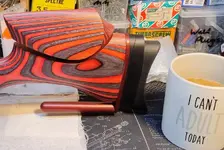
The part in question, (not painted in the end doh!) I was gonna paint it a brighter red, but the muted Crimson colur actually goes ok with the red laminate stock, so....
Legal Notice
scalemodelling.co.uk is a privately operated online discussion forum. All content posted by members reflects their own views and opinions and does not necessarily represent those of the forum owners or administrators. While reasonable efforts are made to moderate content, no responsibility is accepted for user-generated material. By using this site, you agree to comply with UK law and the forum rules.