Oh ere my brain hurts, need to read this and a lot lol
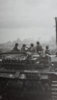
Let me illustrate the method using your photo :smiling3: The photo handily also shows a jerrycan leaning against the rack, meaning it’s under the same angle (or as close to that as makes no different), so we can measure both the rack and the jerrycan diagonally, as well as a 1:35 scale jerrycan to obtain the height of the rack.
In the screenshot below, in the big red ellipse, you can see a little line (with a + at either end). This is the measurement tool in Photoshop; the length of the line is 3.05 units — shown near the top, after L1:
Next, I’ll measure the jerrycan:
As you can see at the top, the length of this is 4.17 units.
Now all I need to do is measure up a model jerrycan. Please excuse me while I run to my hobby room to do so :smiling3:
(…)
Back. According to my callipers, a Bronco German jerrycan is 13.4 mm tall. So for the height of the rack, we get:
3.05 ÷ 4.17 × 13.4 mm = 9.80 mm
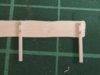
Rounded to a value you can actually measure and cut on a length of plastic strip, that's 10 mm.
You can work out things like the width of the rack, the thickness of the planks and posts, etc. the same way. You don’t need to do this in software like Photoshop, either — a ruler on a printed photo works just as well. Like I said before, the main thing is to get the relevant area as big as you can (this is not an option if you’re measuring in a photo in a book, of course) because smaller lengths are harder to measure accurately.
The main thing to remember is to try and measure things that are under the same angle and nearby, else your measurements will be thrown way off — if I had tried to measure the hull rear top plate, for example, we’d have gotten nowhere because it slopes forward while the rack slopes backwards. However, here the jerrycan leans against the rack, so it provides a very good reference point. Similarly, had the jerrycan been up against the rear wall of the superstructure, it would have been quite a way away from the rack and therefore been almost useless as a reference point, because it would look smaller in the photo.





 :thumb2: