Theme editor

Scale Model Shop

1/72 HMS Victory Cross Section

Thread owner
Hi all
Once again I'm truly blown away with such great support.
To answer Tim's very valid point about calking the deck planks. The instructions do say to show this. Their method is to run a black felt tip along the plank edges before fitting. That doesn't work because the wood is porous and the black spreads/soaks into the wood and the calk line becomes blurry. As each plank is different the unwanted effect was worse on some than on others. I tried various pens with similar disappointing results. I tried spirit based pens but they were worse. Enamel paint worked OK but that tended to seal the wood and so the PVA wood glue didn't stick well and the planks didn't lay flat to each other. To be honest I gave up and thought the buggers in the upper gun deck would just have to put up with a bit of wet!! :smiling5:

I've had a pretty good couple of days on this.
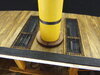
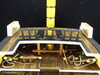
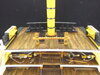
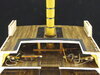
First job was to complete the quarter deck planking around the deck openings. Those openings were just frames but on the actual ship they have a grid covering them. I found some suitable mesh in the spares box. I then planked the small bulwark and framed the cockpit. I also fitted the mast collar.
P1060783.JPG

P1060784.JPG

Rails fit around the cockpit.
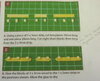
As you can see the instructions want 4mm lengths from 3mm square wood. Oh yer!!? The wood just splits along the grain so I have used 3mm square styrene tube. It will all be painted black anyway
P1060779.JPG

P1060781.JPG

P1060782.JPG


Thanks again guys :thumb2:
Jim
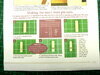
 
Working well mate! To replicate caulking I used to laminate black card (of appropriate thickness) between the planking and then trim flush with a brand-new blade; a coat of sealant and then a gentle sanding with a very fine grade abrasive paper, If you can find it a very dark grey art paper works even better visually.
Steve
 
Thread owner
Thanks guys.
Steve - what a clever idea. Wish I'd thought of that :thumb2:

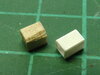
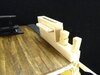
Stage 29 is virtually finished. First job was to complete the bulwarks with the pinrail for the belaying pins. Also carve and fit the timber heads.
P1060785.JPG

I also completed and fitted the cockpit rail.
P1060786.JPG

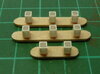
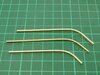
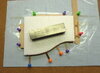
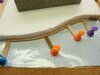
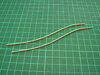
Mouldings fit on the inside of the bulwarks. A 1mm square rod needed bending. I soaked it and clamped it. I only needed two but made three to have a spare for any cock ups.
P1060787.JPG

P1060788.JPG

P1060791.JPG

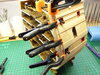
The instructions say that there should be 3 slots in each pinrail post but they suggest only attempting two. I decided to try for three and actually got it done :smiling:
P1060789.JPG

P1060790.JPG

Finally the bent mouldings, the kevels and the pinrail were fitted and painted. Apart from a couple of small jobs that's the stage done.
P1060792.JPG

P1060793.JPG

P1060794.JPG

Next up is Stage 30 - the LAST stage !! :tongue-out3:

Jim
 
Very nice work indeed Jim, look forward to seeing the finished article. :thumb2:
 
Thanks guys.
Steve - what a clever idea. Wish I'd thought of that :thumb2:

Stage 29 is virtually finished. First job was to complete the bulwarks with the pinrail for the belaying pins. Also carve and fit the timber heads.


I also completed and fitted the cockpit rail.


Mouldings fit on the inside of the bulwarks. A 1mm square rod needed bending. I soaked it and clamped it. I only needed two but made three to have a spare for any cock ups.


The instructions say that there should be 3 slots in each pinrail post but they suggest only attempting two. I decided to try for three and actually got it done :smiling:


Finally the bent mouldings, the kevels and the pinrail were fitted and painted. Apart from a couple of small jobs that's the stage done.


Next up is Stage 30 - the LAST stage !! :tongue-out3:

Jim
Jim.
Don't forget the upper sections of knights heads and other timber head. plus sheaves and blocks etc are ultimately shaped by the passage of ropes in the natural course of their work - therefore you may wish to use a cord to create that 'groove' ... to a greater or lesser degree of course! A case of 'form and function'! Forgive my arrogance in suggesting this!
Steve
 
Thread owner
Hi all
So nice to see so many of you still hanging on with this build.
Steve - wear and tear, weathering. Right at the beginning I had to decide how much weathering I was going to include. I decided to do very little for two reasons. Firstly there was no mention of weathering in the instructions and secondly all my references are from the restored ship in Portsmouth which show no weathering. No problem in you mentioning it, a valid point :thumb2:

First job in this update was to fit the fenders. Short sections were fitted between the wales. I also used two part epoxy to fit the wriggles above the gun ports. I don't know what job these wriggles did - any ideas?
P1060795.JPG

P1060796.JPG

The main fenders fit vertically over these short sections. That meant a strip of wood which followed the curve of the hull. I traced the curve and transferred it to a block of fairly hard polystyrene. I soaked the strips in hot water, bent them along the curve and left them to dry for 24hrs.
P1060797.JPG

P1060798.JPG

P1060799.JPG

That gave a close enough curve so it could be clamped.
P1060801.JPG

No photo but I'm pleased it all looked fine when the clamps were removed.
The white metal castings for around the entry ports were cleaned up (2 roof sections and 4 sides) and sprayed black. The gold on the mouldings will need to be picked out. I'm going to buy one of those gold paint pens to see how that will work.
P1060802.JPG

P1060803.JPG

Next were the chainwales and the deadeyes. Very fiddly. You start with this ...
P1060804.JPG

and end up some time later with this .....
P1060805.JPG

The kit provides brass wire which was impossibly stiff so I used some black copper wire.

This last stage is about ten times the work of the other stages.
Thanks again guys.
Jim
 
Jim,
The 'wriggles' are a form of gutter serving to deviate (to a greater or lesser degree) water from entering the gun ports. Under normal circumstances the ports are closed and may have had a temporary caulking to reduce the amount of water entering the decks - nothing worse than water slopping about your seaboots me hearties!
Steve
 
Hi all
So nice to see so many of you still hanging on with this build.
Steve - wear and tear, weathering. Right at the beginning I had to decide how much weathering I was going to include. I decided to do very little for two reasons. Firstly there was no mention of weathering in the instructions and secondly all my references are from the restored ship in Portsmouth which show no weathering. No problem in you mentioning it, a valid point :thumb2:

First job in this update was to fit the fenders. Short sections were fitted between the wales. I also used two part epoxy to fit the wriggles above the gun ports. I don't know what job these wriggles did - any ideas?


The main fenders fit vertically over these short sections. That meant a strip of wood which followed the curve of the hull. I traced the curve and transferred it to a block of fairly hard polystyrene. I soaked the strips in hot water, bent them along the curve and left them to dry for 24hrs.


That gave a close enough curve so it could be clamped.


No photo but I'm pleased it all looked fine when the clamps were removed.
The white metal castings for around the entry ports were cleaned up (2 roof sections and 4 sides) and sprayed black. The gold on the mouldings will need to be picked out. I'm going to buy one of those gold paint pens to see how that will work.


Next were the chainwales and the deadeyes. Very fiddly. You start with this ...


and end up some time later with this .....


The kit provides brass wire which was impossibly stiff so I used some black copper wire.

This last stage is about ten times the work of the other stages.
Thanks again guys.
Jim
Chain wales are more commonly referred to as 'channels' - I agree with you, making up standing rigging is a real pain in the back plate! Wait until you get to the running rigging though!
 
Thread owner
Thanks guys. You won't have to put up with this much longer. I'm well into the final stage :tongue-out3:

The instructions say to fit the entry port mouldings before the hull is completed and painted. Presumably so that the side steps/ladders can be positioned correctly around them. I made a quick template of the mouldings position and I'll fit things around that and fit the mouldings themselves much later.
P1060806.JPG

These side steps took ages.
P1060807.JPG

Yellow ochre stripes next.
P1060808.JPG

... then the black. I actually used a mix of black and black grey to stop it looking too stark.
P1060809.JPG

Touch up is needed in places and the final row of copper plates.

The chains under the channels - (thanks Steve :thumb2:). They were really difficult. For the centre links I resorted to 0.5mm lead wire. It's very fragile but it is easy to bend without stressing everything else - including me!!
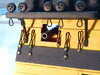
Before the joining links
P1060810.JPG

Top and bottom links bent out and the lead joining links fitted and painted up.
P1060811.JPG

P1060812.JPG

The other complication were the pins. I cut them down by half and drilled holes for them. The official YouTube video shows a bloke hammering them in. My model would have simply fallen to pieces!

I made up the shutters for the lower gun ports
P1060814.JPG

P1060815.JPG

The area for glue is small and even with 5min epoxy they will need support while the glue cures. I made little card supports - I think they will work.
P1060813.JPG

As I say it's nearly there. To be honest I will be glad when it's done. It has been different and enjoyable and something that I'm glad I've done but I would not do another wooden ship. Compared to styrene kits it's limiting and there are too many compromises.

Thanks again guys.
Jim
 
Lovely, lovely, lovely……just great Jim. Really brings home the complexity of these big wooden walls…..
 
Back
Top