Theme editor

Scale Model Shop

Steve's 1/72 Italeri Horsa Glider

stona

New member
Joined
Jul 22, 2008
Messages
9,889
Reaction score
9
Points
0
1/3
Thread owner
So, after a bit of to and fro, I’ve decided to go for this one.

My subject will be a Horsa glider PF800, glider No.1, but chalk number ‘91’, which delivered Major Howard (commander of the coup de main force) and the members of No.25 Platoon (designated as No.1 Platoon for the duration of the operation) of D Company, 2nd Battalion, Oxfordshire and Buckinghamshire Light Infantry, commanded by Lt. Brotheridge, to assault and capture the bridge at Benouville.

You can’t get more D-Day than that.

PF800 was towed by a Halifax V, LL355, code letter G, flown by Wing Commander Duder. I had thought to do some kind of vignette showing the two aircraft, but discretion, and no easy option for the Halifax, got the better part of valour.

The extraordinary feat of Howard and his men is well known, as is the tragic loss of Brotheridge. I wanted to throw some light on incredible flying of the men of the Glider Pilot Regiment, particularly Staff-Sergeants Jim Wallwork and John Ainsworth, who flew Howard, Brotheridge and their men to within about fifty metres of their objective.

Traditional picture of box and bits:
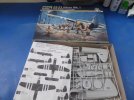
P1010921.JPG

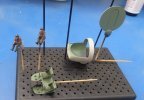
I've made a start on the cockpit. I won't be using the paratroopers, as I've an idea to pose this in flight. That means converting a couple of what I think might be US pilots to glider pilots, and doing something with the flaps, which are moulded shut on this kit. One bridge at a time :)
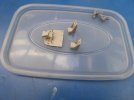
P1010922.JPG
 
Ohh this is cool! I'll look forward to seeing this come along, good pick!
 
So, after a bit of to and fro, I’ve decided to go for this one.

My subject will be a Horsa glider PF800, glider No.1, but chalk number ‘91’, which delivered Major Howard (commander of the coup de main force) and the members of No.25 Platoon (designated as No.1 Platoon for the duration of the operation) of D Company, 2nd Battalion, Oxfordshire and Buckinghamshire Light Infantry, commanded by Lt. Brotheridge, to assault and capture the bridge at Benouville.

You can’t get more D-Day than that.

PF800 was towed by a Halifax V, LL355, code letter G, flown by Wing Commander Duder. I had thought to do some kind of vignette showing the two aircraft, but discretion, and no easy option for the Halifax, got the better part of valour.

The extraordinary feat of Howard and his men is well known, as is the tragic loss of Brotheridge. I wanted to throw some light on incredible flying of the men of the Glider Pilot Regiment, particularly Staff-Sergeants Jim Wallwork and John Ainsworth, who flew Howard, Brotheridge and their men to within about fifty metres of their objective.

Traditional picture of box and bits:


One bridge at a time :smiling3:


Don't get going 'A Bridge Too Far' Steve. That's a whole different movie!
 
Looking forward to watching you build this Steve, intrigued to see what you’re planning :thinking:

Good luck with the build :thumb2:

Geoff.
 
Horsa, now that's different. Be watching this un that's for sure. :thumb2:
 
Thread owner
I'm posting today's progress, as I'm going to be covering an old mate at work for the next few days, while he's a bit poorly and therefore dragging me out of my semi-retirement the b*stard.

I've made a start on converting the Americans into Jim and John, the glider pilots, and have pretty much built the fairly minimal cockpit. I'm crap at figures, and 1/72 are a bit small for me. All I really want is to represent someone flying the glider. I'm not sure how much will be visible anyway.

prog_1.jpg

So, hitting 'pause' for a few days. Back soon.
 
Thread owner
I forgot tp post that yesterday ^^^^.

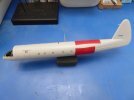
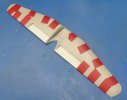
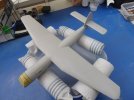
More progress. I've stuck the wing together, cut out the flaps and 'boxed in' the upper wing. I had a devil of a job finding any flap details until I found some plans for a full size Horsa. It turns out that area of upper wing was a seperate panel, hung from a secondary or auxiliary spar, to which the ailerons and flaps were also attached.

wing.jpg

I'll have to build the flaps from scratch, the cut out bits won't work, and I'd like to add some of the detail that I've discovered.

I did take the opportunity to offer the wing to the fuselage, as I've heard that this is a nasty fit.

wing fit.jpg

It isn't, it's fine, and will require only minor fettling.
 
I don’t recall any obvious fit problems from when I built this kit a decade ago, so whoever said it was a poor fit probably had one with defects :)
 
An interesting introduction Steve. All involved with the glider assault showed great courage. A great choice for a D-day GB. You're off to a great start.
 
An interesting build Steve.
I always thought gliders were a bit of an oddity. However, then I read a glider can get the men on the ground with good accuracy, as you point out. There's lots of stories around of Paras' landing well off target, or dispersed over a big area. That problem is greatly reduced using a glider. Also, all these 'passengers' didn't require hours of specialized training, unlike paratroopers. Then I read gliders weren't actually disposable, but could be recovered (assuming they survived the landing) everything started to make sense.
 
Thread owner
Then I read gliders weren't actually disposable, but could be recovered (assuming they survived the landing) everything started to make sense.
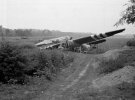
This is true, but at least of the gliders that landed to take the Benouville and Ranville bridges, all were heavily damaged if not destroyed. Sgt. Jim Wallwork, the pilot of Howard's glider and my subject described his landing:

"The final approach was a little fast and I landed probably at about 95[mph] instead of at 85, and 10 miles per hour in the dark looks rather quick. I hit the field and caught the first bit of wire and so I called "Stream," and by golly, it [the parachute] lifted the tail and forced the nose down. It drew us back and knocked the speed down tremendously. It was only on for two seconds, and "jettison," and Ainsworth pressed the tit and jettisoned the parachute. Then we were going along only about 60, which was ample to take me right into the corner. We got right into the corner of the field, the nose wheel had gone. The cockpit collapsed, and Ainsworth and I went right through the cockpit. I went over head first and landed flat on my stomach. I was stunned, as was Ainsworth; I came around and he seemed to be in bad shape. I said, "Can you crawl?" and he said, "No," and then I asked if I lifted, could he crawl out and he said, "I'll try". I lifted the thing and I felt that I lifted the whole bloody glider when probably all I lifted was a small spar, but I felt like 30 men when I picked this thing up and he did manage to crawl out."

The front of Wallwork's glider was destroyed and it's amazing that both pilots got out alive.

100760.jpg

That fence and gate was the boundary between the landing zone and the bridge, which was about 50m along the track in the foreground. They couldn't have landed any closer. It was a remarkable piece of flying. The other two gliders for this assault are visible in the background, and not far behind.
 
Now that is a great reference for a dio. Steve! At least Wallwork had the good manners to leave the field gate intact!

As usual with all your presentations, you just quietly get on with posting some great pictures and info. :thumb2:

Ron
 
Thread owner
Now that is a great reference for a dio. Steve! At least Wallwork had the good manners to leave the field gate intact!
I did contemplate doing the first glider (Wallwork/Ainsworth) as seen there - but discretion got the better part of valour.

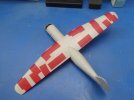
If someone did a dio with all three gliders in it, and there are quite a few photographs of these aircraft taken shortly after D-Day for reference, it would be magnificent, but huge! Even a 1/72 scale Horsa is a large model, as I have recently dicovered.

Glider.jpg
 
Back
Top