I'm not sure where I'd put a model with a wingspan not far short of three feet!:fearful: I've got the Bronco 1-35 one in the stash.....


You are using an out of date browser. It may not display this or other websites correctly.
You should upgrade or use an alternative browser.
You should upgrade or use an alternative browser.
Steve's 1/72 Italeri Horsa Glider
- Thread starter stona
- Start date
Neil Merryweather
Active member
1/3
Um...me too :tired:I'm not sure where I'd put a model with a wingspan not far short of three feet!

A_J_Rimmer
New member
1/3
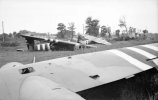
This is true, but at least of the gliders that landed to take the Benouville and Ranville bridges, all were heavily damaged if not destroyed. Sgt. Jim Wallwork, the pilot of Howard's glider and my subject described his landing:
"The final approach was a little fast and I landed probably at about 95[mph] instead of at 85, and 10 miles per hour in the dark looks rather quick. I hit the field and caught the first bit of wire and so I called "Stream," and by golly, it [the parachute] lifted the tail and forced the nose down. It drew us back and knocked the speed down tremendously. It was only on for two seconds, and "jettison," and Ainsworth pressed the tit and jettisoned the parachute. Then we were going along only about 60, which was ample to take me right into the corner. We got right into the corner of the field, the nose wheel had gone. The cockpit collapsed, and Ainsworth and I went right through the cockpit. I went over head first and landed flat on my stomach. I was stunned, as was Ainsworth; I came around and he seemed to be in bad shape. I said, "Can you crawl?" and he said, "No," and then I asked if I lifted, could he crawl out and he said, "I'll try". I lifted the thing and I felt that I lifted the whole bloody glider when probably all I lifted was a small spar, but I felt like 30 men when I picked this thing up and he did manage to crawl out."
The front of Wallwork's glider was destroyed and it's amazing that both pilots got out alive.
That fence and gate was the boundary between the landing zone and the bridge, which was about 50m along the track in the foreground. They couldn't have landed any closer. It was a remarkable piece of flying. The other two gliders for this assault are visible in the background, and not far behind.
Brave men.
Superb work thus far Steve.

- Joined
- Apr 27, 2018
- Messages
- 15,226
1/3
Steve, looking good mate.
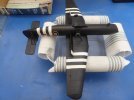
So, special markings, a.k.a. 'invasion stripes'.
First, the instructions get the ones on the wings much too far inboard, compared with the photographs of the actual gliders. Gliders were added to the list of aircraft to be marked with stripes after objections from the Commands that would operate them. They argued that since almost every other Allied aircraft except for night bombers would be marked, they should be too. They subsequently fell broadly under the same scheme as twin engine aircraft, though obviously thay had no engines, meaning the instruction for the stripes to begin outboard of the engines was rendered moot. They seem to have started inboard of the national marking (roundel) which was on no account to be obscured. Likewise, the fuselage stripes were applied starting at the base of the fin, not 18" from that position (as per instructions), and still ran right up to the fuselage roundel.
Second, if asked to paint black and white stripes on an aircraft would you really paint the black on areas that were already, to all intents and purposes, black? I find it unlikely that anyone on 4th of June, the eve of the original D-Day, would bother painting black over Night! There must be a good chance that the paint supplied was Night. The pictures don't tell the story, unfortunately.
Finally, these stripes were not expertly applied, something I have attempted to replicate. We'll see when I get the masking off
First, the instructions get the ones on the wings much too far inboard, compared with the photographs of the actual gliders. Gliders were added to the list of aircraft to be marked with stripes after objections from the Commands that would operate them. They argued that since almost every other Allied aircraft except for night bombers would be marked, they should be too. They subsequently fell broadly under the same scheme as twin engine aircraft, though obviously thay had no engines, meaning the instruction for the stripes to begin outboard of the engines was rendered moot. They seem to have started inboard of the national marking (roundel) which was on no account to be obscured. Likewise, the fuselage stripes were applied starting at the base of the fin, not 18" from that position (as per instructions), and still ran right up to the fuselage roundel.
Second, if asked to paint black and white stripes on an aircraft would you really paint the black on areas that were already, to all intents and purposes, black? I find it unlikely that anyone on 4th of June, the eve of the original D-Day, would bother painting black over Night! There must be a good chance that the paint supplied was Night. The pictures don't tell the story, unfortunately.
Finally, these stripes were not expertly applied, something I have attempted to replicate. We'll see when I get the masking off

rickoshea52
Active member
1/3
It’s been done. When the Airborne Forces Museum was at Browning barracks in Aldershot they had loads of dioramas including 1/72 scale recreations of not just the gliders and Pegasus Bridge but also the northern end of Arnhem Bridge from the Market Garden mission. As a boy I found it utterly fascinating and I’m sure it was a major factor in my taking up modelling.If someone did a dio with all three gliders in it, and there are quite a few photographs of these aircraft taken shortly after D-Day for reference, it would be magnificent, but huge! Even a 1/72 scale Horsa is a large model, as I have recently dicovered.

Looking forward to the big reveal Steve.So, special markings, a.k.a. 'invasion stripes'.
First, the instructions get the ones on the wings much too far inboard, compared with the photographs of the actual gliders. Gliders were added to the list of aircraft to be marked with stripes after objections from the Commands that would operate them. They argued that since almost every other Allied aircraft except for night bombers would be marked, they should be too. They subsequently fell broadly under the same scheme as twin engine aircraft, though obviously thay had no engines, meaning the instruction for the stripes to begin outboard of the engines was rendered moot. They seem to have started inboard of the national marking (roundel) which was on no account to be obscured. Likewise, the fuselage stripes were applied starting at the base of the fin, not 18" from that position (as per instructions), and still ran right up to the fuselage roundel.
Second, if asked to paint black and white stripes on an aircraft would you really paint the black on areas that were already, to all intents and purposes, black? I find it unlikely that anyone on 4th of June, the eve of the original D-Day, would bother painting black over Night! There must be a good chance that the paint supplied was Night. The pictures don't tell the story, unfortunately.
Finally, these stripes were not expertly applied, something I have attempted to replicate. We'll see when I get the masking off :smiling3:
Looking forward to the big reveal Steve.
I don't really have any references for the Horsa and strangely I can't find any drawings of the upper camouflage scheme. The instructions for this (and the Bronco kit) don't match what I can see in photographs, so I'm going to piece something together from the various images I do have.
I don't really have any references for the Horsa and strangely I can't find any drawings of the upper camouflage scheme. The instructions for this (and the Bronco kit) don't match what I can see in photographs, so I'm going to piece something together from the various images I do have.
In lack of concrete evidence Steve that sounds like a sensible plan.
ATB.
Andrew
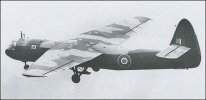
I'm starting to suspect that the scheme was more variable than would have been allowed on powered aircraft. The image I have which most broadly matches what I see in the Pegasus Bridge gliders is this one - though obviously this lacks the 'invasion stripes'.
I've got the model ready to start the camouflage, so I'll have to commit to something!
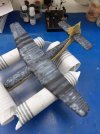
I've got the model ready to start the camouflage, so I'll have to commit to something!
I'm starting to suspect that the scheme was more variable than would have been allowed on powered aircraft. The image I have which most broadly matches what I see in the Pegasus Bridge gliders is this one - though obviously this lacks the 'invasion stripes'.
I've got the model ready to start the camouflage, so I'll have to commit to something!
Looking very good Steve. I assume the kitchen towel is wrapped around foam pipe industrial insulation 'tubes' with a cut down one side?
ATB
Andrew
Neil Merryweather
Active member
1/3
Wow. I thought for a minute you'd decided to paint it as a ME 410!I'm starting to suspect that the scheme was more variable than would have been allowed on powered aircraft. The image I have which most broadly matches what I see in the Pegasus Bridge gliders is this one - though obviously this lacks the 'invasion stripes'.
I've got the model ready to start the camouflage, so I'll have to commit to something!
Yep! It does a job.I assume the kitchen towel is wrapped around foam pipe industrial insulation 'tubes' with a cut down one side?
I've got my camouflage on, a sort of composite of various images. lso got slightly wobbly and ragged 'invasion stripes' applied.
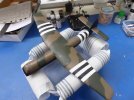
I'm now figuring out what kind of base to make in order to pose this thing coming into land at 00.15' 30" in the meadow between the canal and river. Wallwork must have skimmed the trees at the south-western edge of the field as he came in - maybe I need some trees

That looks really good Steve. I very much doubt if, at this stage of the war and on the run up to D-Day, personnel would be particularly concerned if the camo was a bit "off" and the stripes were a bit ragged :thumb2:

1/3
So looking forward to this one Steve!
Steve
Steve
- Joined
- Apr 27, 2018
- Messages
- 15,226
1/3
Steve, looking good the paint work looks great.
1/3
My training barracks ... :sad-face:It’s been done. When the Airborne Forces Museum was at Browning barracks in Aldershot they had loads of dioramas including 1/72 scale recreations of not just the gliders and Pegasus Bridge but also the northern end of Arnhem Bridge from the Market Garden mission. As a boy I found it utterly fascinating and I’m sure it was a major factor in my taking up modelling.
G
Guest
Guest
I like how even his kitchen roll has invasion stripes 

I've finally got the flaps on, so just a few aerials etc. to add in order to finish the glider.
The handbook notes that full flaps should be deployed "when sure of getting into the landing ground", and since I will be posing the glider within seconds of landing mine are fully deployed. The handbook also notes that, "the glide path with flaps fully down is steep" and I've seen a couple of pictures to show how steep.
Since I intend to make this part of a 'vignette', it's on with the base and yes, I have decided on a few trees
The handbook notes that full flaps should be deployed "when sure of getting into the landing ground", and since I will be posing the glider within seconds of landing mine are fully deployed. The handbook also notes that, "the glide path with flaps fully down is steep" and I've seen a couple of pictures to show how steep.
Since I intend to make this part of a 'vignette', it's on with the base and yes, I have decided on a few trees
Legal Notice
scalemodelling.co.uk is a privately operated online discussion forum. All content posted by members reflects their own views and opinions and does not necessarily represent those of the forum owners or administrators. While reasonable efforts are made to moderate content, no responsibility is accepted for user-generated material. By using this site, you agree to comply with UK law and the forum rules.