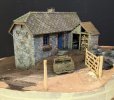
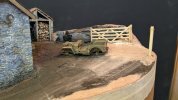
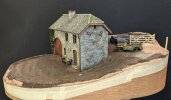
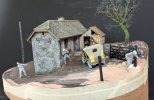
Theme editor

Scale Model Shop

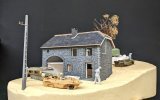
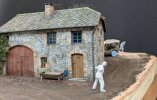
Not a Moment to Lose… Battle of the Bulge, Ardennes, December 1944

Now that is quite simply stunning Tim......I will now find a corner to crawl up in and consider the futility of my modelling existence. :crying:

Simply outstanding.

ATB

Andrew
Take a que number for that corner...;):tongue-out2:
 
Thread owner
Thanks so much for all the kind comments. I really do appreciate them.

Most of the time I am flying by the seat of my proverbial pants and I really don't know how a lot of this stuff is going to turn out. The acrylic paste was a good example - I thought I had ruined everything at first, but in the end it worked out.

Since the pictures above were taken I have added some washes, etc, but it's still work in progress until I get the groundwork down and see how the colour balance works overall.

Anyway, here is the next leap into the unknown...

Adding colour (and other stuff) to the roof

PXL_20240616_155144345.jpg


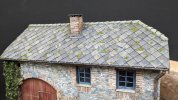
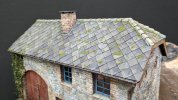
After spending so much time painting the stone and brickwork, I was a little wary of tackling the roof, but it was actually pretty quick, easy and a lot of fun.

I had already added some very basic pre-shading with an airbrush when I was giving the walls their first coat, but what the roof really needed was some variation to the individual tiles.

So I started with a grey black (these are all Vallejo paints) and mixed in various browns and blues to give me a palette of around five basic colours. These were then applied with a brush using the wet-blending technique to give some graduation within each tile with the darkest shade generally at the top (where the one above hangs over the one below).

This was done in a random manner and I didn’t even bother to paint every tile - so some remained in the original (pre-shaded) tone. Incidentally, the thick black card stock I had used to make the roof takes the paint very well and there was no sign of any warping (which was a relief).

Next I lightened these colours a little and went back over the tiles adding random spots, focussing generally on the lower edge of the tiles (but not all). None of this was scientific - I was just going for the right ‘look’.

To complete the illusion I then applied slightly lightened and diluted versions of the colours at the top of the roof planes and used a broad brush to drag them down vertically to give to look of rain stains.

The next step was to add speckling. I have always been slightly nervous of this technique because it seems a bit crazy and uncontrolled - and usually looks awful when first applied - but having tried it with rust colours on mufflers it really does add depth to most surfaces.

So, in essence, what you are doing is wetting a brush in paint, holding it a few centimetres from the surface and using something like a cocktail stick to bend the bristles back and spatter the paint. The trick is to keep the paint fairly diluted and use colours that are close to what to what you have already used to paint the surface on which you are speckling.

The great thing with Vallejo paints is that they dry pretty fast, so even if the effect looks to strong at first, they soon start to fade into the background and leave you with a subtle variation of the base colours. Anyway, it worked!

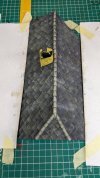
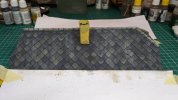
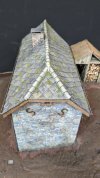
The final part of the painting process was to add speckles of Japanese Yellow to represent the typical blotches that you see on roof tiles (at least here in Europe). I believe this is lichen.

PXL_20240616_142915662.jpg

PXL_20240616_142900231.jpg

You can also see that I painted the ridge tiles a sort of concrete shade. These were originally terracota, but whilst that worked for my Italian diorama a few years ago, it would not have been appropriate for a farm building in NW Europe.

And then the final touch: moss! This is the green, fuzzy stuff that you also tend to see on rooves in rural areas and especially in damp climates.

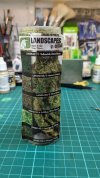
Some years ago I bought this lovely tower of mossy stuff from Landscapes in Detail at IPMS Scale Model World in Telford.

PXL_20240616_145628279.jpg

I’m not sure if they are still going (I hope so!), but they are a great Spanish father and son team who have also published some superb diorama books. Anyway, I had never used it - until now.

Of course, this could not be simpler: simply apply some PVA glue with a fine brush (slightly diluted with a drop of washing up liquid added to break the surface tension), sprinkle the stuff over and then tip off the excess. And voila!

PXL_20240616_154915832.jpg
PXL_20240616_155019688.jpg
PXL_20240616_155059969.jpg

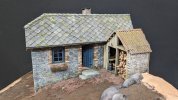
You can also see a few more additions in some of these shots, such as one of the downpipes, a creeper and the beginning of groundwork around the base of the building. I will cover these in future posts, but I’m pretty happy with the way this has turned out so far…
 
Thread owner
Building a farm or field gate

PXL_20240707_135104644 enhanced.jpg

Like most people, I’m sure, I like to take the easy route most of the time… but every now and then I am pleasantly surprised to find that there’s something I want for my diorama which I cannot find in pre-made or kit form.

PXL_20240707_141515512.jpg

Now I will be glad for someone to prove me wrong, but after extensive searching I could not find anyone who makes a 1/35 scale version what must be one of the most common sights in any rural setting: a farm or field gate.

Maybe I wasn’t using the right search terms (although I can tell you now that there’s no point looking up ‘Belgian gate’ because you come across something used to block roads from advancing forces…)

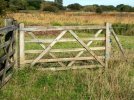
Anyway, after a bit of research, it seemed to me that farm gates in North West Europe (and probably many places elsewhere) tend to fall into two main types: wooden five-bar and galvenised metal.

I decided to go with the wooden version. Here are a few images:

wooden-farm-gate-small.jpg
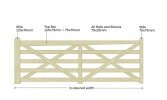
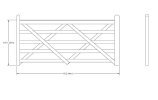
Farm gate dimensions.jpgFarm gate dimensions 2.jpg
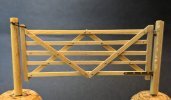
As you can see, the five-bar gate derives its strength from a simply construction using diagonal cross-braces. I worked out the rough dimensions, but I wasn’t too scientific about it. I used a figure to judge the height, based on the simple fact that an adult should be able to lean on any gate and the width (which can obviously vary quite a bit) was determined by the position on my diorama.

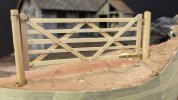
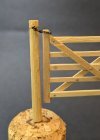
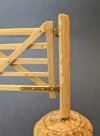
I then got to work. I decided to use various types of wood rather than plastic because I was worried that the latter would warp. The slats were mostly cut from the sort of stirring sticks you get in coffee shops and the uprights cut down from rectangular wooden rod that I had bought somewhere. The posts at either end are from bamboo chopsticks.

PXL_20240707_135115761.jpgPXL_20240707_135121067.jpg

Details were then added. The hinges are simply bent from copper strip and hung on lengths of bent brass wire. This means they actually pivot and can be easily removed for painting. I then added larger rivets from a Meng set (the ones you just shave off a plastic sheet) and smaller ones were punched out from pewter sheet. Finally I added a length of fine chain to the other pillar. Everything was then attacked with a craft knife to give it a well-used appearance.

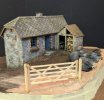
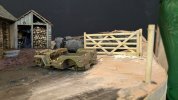
Here you can see how it fits into the diorama.

PXL_20240707_141504150.jpg

This is a view you won’t see when everything is finished, because the gate will actually be swung open. This all helps to tell the story, because it clearly shows the route that the jeep took into the farmyard. It also adds much-needed visual interest to the top right of the scene. In these pictures, the gate looks a little over-scale, but that’s because a) it’s far to light in colour and b) the jeep doesn’t have any wheels…

PXL_20240707_141324240.jpg
PXL_20240707_141311660.jpg
PXL_20240707_141300030.jpg
PXL_20240707_141254710.jpg
 
Lovely gate Tim, building a diorama of your own composition will always make finding suitable items a challenge like monkeys for instance...ask me why. :smiling6:

Cheers,
Wabble
 
Gee whiz, Tim, not a detail spared. Now that I can comment on this build, just the structure weathering and finish is nuts real, which means the rest is a given. Impressive work, Amigo, Ruck On!
 
Thread owner
Lovely gate Tim, building a diorama of your own composition will always make finding suitable items a challenge like monkeys for instance...ask me why. :smiling6:

Cheers,
Wabble
Thanks Richard. I'm almost afraid to ask about the monkeys... Did you try to make some?!
Gee whiz, Tim, not a detail spared. Now that I can comment on this build, just the structure weathering and finish is nuts real, which means the rest is a given. Impressive work, Amigo, Ruck On!
Ok, Steve has finally arrived! You are very welcome here my friend. And thanks for your kind words.

This blog is almost the same as my other one on Kitmaker / Armorama so you should not have missed anything...
WOW! Superb stuff!
Thanks Arnold. More to come...
Shaping up beautifully.
Thanks Paul.
Keep it coming Tim!
Thanks Neil. Only a few more months to go...
 
Thread owner
Telling the story, potential figures… and how to add a feeling of jeopardy

PXL_20240721_121145597.jpg

Here is the backstory as it now stands:

The early stages of the advance of the Kampfgruppe brings an SS recce unit into a Belgian farmyard (recently abandoned by the occupants who, for the last few weeks at least, had been living with the relief of Allied liberation). The Germans are confident - so far they have made rapid progress against little or no opposition - but the experienced panzer grenadiers are understandably wary.

Unknown to these (re)invaders, the farm is now occupied by some American GIs. Their recent experience is told by the broken-down jeep (perhaps shot up during a rapid retreat). They have taken refuge in the farmyard, but as they try to fix their vehicle, they hear the sound of approaching engines and tracks. Friend or foe? Looking out of an upstairs window, to their horror they realise that they are in a very dangerous position…

When I started this build I thought that I had a pretty clear idea of what tale I was trying to tell. I always conceived this diorama as an ‘encounter scenario’… hence the title. Yet I cannot claim that I had everything planned from the start. I have nothing but admiration for those modellers who can settle on everything at the outset of a project, but I suspect that for most of us ideas just evolve. How dramatic should it be? How many figures would I need? What exactly would they be doing?

The position of the building was always intended to create a natural division between the left / lower part of the scene and the right / higher area. But it was also designed to break the line of sight - that way the idea that both sides might find themselves surprised by the other made more sense.

PXL_20240303_150028456.jpg

In the early shot above I had started to work out the relative position of the vehicles and figures.

PXL_20240721_121327074.jpg

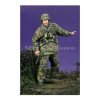
A pivotal figure in the composition is this SS panzer grenadier from Alpine.
12 SS HJ Grenadier Set AL35060.jpg
Not only a magnificent piece of sculpting and resin casting, but also a very great pose. Although I have seen this figure used in Normandy scenarios, he might just as easily fit into the Ardennes (I may add some gloves!)

He is also a useful focal point: his forward stoop and out-stretched left arm help to take the viewer’s attention around the corner where his looking, but also back to the vehicles and other troops who are dismounting and coming up behind him.

Because they have yet to find out what is lurking around the corner, I can probably go for some more relaxed poses for the rest. Obviously I still have much work to do here, because I’m working on the basis of two men in or around the Schwimmwagen (the photos from Kaiserbaracke Crossroads clearly show that each had a two-man crew) and another six from the 250 halftrack. So that’s a mere eight figures, almost all dressed in SS camo smocks… oh dear!

But what of the Americans? Well, at least here I am limited by the carrying capacity of the Jeep (four at the most). Looking around for potential figures, I couldn’t find many resin options in suitable action poses. In fact, in the world of Alpine, etc most GIs seem to spend all their time just lounging around!

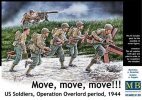
Luckily there are plenty of other options out there, especially from Master Box and Mini Art:

MAS35130.jpg

PXL_20240721_220650457.jpg

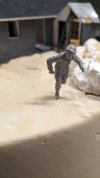
From the Master Box Move! Move! Move! set I have already started to cobble together a figure of a GI running away from the rapidly evolving situation. This is early days: he’s just white-tacked together with a Hornet head, but the pose is energetic and he looks like he’s running for his life… Those gaiters will probably have to go.

PXL_20240304_190132129.jpg

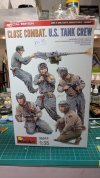
From the Miniart Close Combat US Tank Crew set there’s a great figure looking around a corner with his grease gun. By swapping the legs and adding an Alpine head I think I have found the guy who is about to face-off with the SS grenadier…

PXL_20240721_121133392.jpg

So why a tanker and a GI? Well I’m going to use the excuse that this is a mixed bag of soldiers who were driving somewhere when they ran into the German advance. Maybe the tank crewman (who is probably going to be an officer) was hitching a ride with some infantry.

Anyway, the takeaway from all of this is that sometimes you need to create the landscape before you can really begin to populate it. At least, that’s my excuse and I’m sticking to it!

PXL_20240721_121039416.jpg

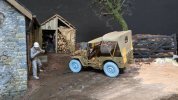
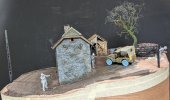
Hopefully, there’s quite a bit of other progress that you can see here: the Jeep, the tree, etc. I will be covering these in more detail very soon…
 
I'm loving your thinking Tim, and I love the logic for the tanker; anyway it's your model so why not?
And what a fantastic piece of diorama building already!
 
The scenario looks like it's working, Tim. Mixed units were all over, so that's not a stretch at all. This has come a long way and it's starting to mesh well.

Ruck On, and thanks for the warm welcome, Brother!

P.S. A little ad-lib never hurt nobody;)
 
Hi Tim, more precise page Malayan Emergency Monkeys showing the painted troop doing the macarena.

Your Dio is evolving as it goes as it's good you have found the right figures. Tweaking the plan and composition as little as possible is the norm in Dio making. Just like you I'm also in awe with those who have the picture and composition fixed from the very beginning.

Cheers,
Wabble
 
Back
Top