

You are using an out of date browser. It may not display this or other websites correctly.
You should upgrade or use an alternative browser.
You should upgrade or use an alternative browser.
54mm Charge of the Scots Greys
- Thread starter Neil Merryweather
- Start date

Neil Merryweather
Active member
1/3
Blimey thanks Ian!I’d be completely over the moon if I had half the skills you have. Fantastic work, loving watching this build Neil.
Neil Merryweather
Active member
1/3
Thanks Wouter.
I have always had a soft spot for these figures since they came out in the seventies, when I was a lad.
And this project is a long-held ambition, so I guess it's a labour of love....
There's just that bl88dy tartan to face now!
I have always had a soft spot for these figures since they came out in the seventies, when I was a lad.
And this project is a long-held ambition, so I guess it's a labour of love....
There's just that bl88dy tartan to face now!

- Joined
- Apr 27, 2018
- Messages
- 15,201
1/3
Neil,
Excellent work mate the hand looks great did you roll little sausages for individual fingers or did you form them from one block?
Excellent work mate the hand looks great did you roll little sausages for individual fingers or did you form them from one block?
Neil Merryweather
Active member
1/3
:smiling5:Neil,
Excellent work mate the hand looks great did you roll little sausages for individual fingers or did you form them from one block?
cheers Scottie.
Just a single blob, get it roughly to shape, let it cure for half an hour then finish off with a scalpel.
I use silicon Clay Shapers for most of the work because they don't stick too much to the Duro
I use those silocone shapers too, awesome stuff. I must say I find that green stuff to be quite sticky though, especially in comparison to other putties like Magic Sculp. I have a Mike Blank book somewhere where he mentions that you can mix green stuff and MS, looking forward to try that. Always impressed to see how people can get around working with green stuff.
Cheers
Cheers
Neil Merryweather
Active member
1/3
Well, I’ve bitten the bullet and had a go at the tartan- on a test piece, not the real thing.
So for the beginners or timid (i.e. those one step behind me) here is my blow-by-blow account of the misery, mostly stolen from Bill Horan’s Military Modelling Masterclass.
The difference is he uses Humbrol and I’ve used acrylics.
Please understand I am not setting myself up as any kind of expert-far from it- this is just what I did and how it turned out at first attempt, warts and all.
I used a wet palette, which I have only just discovered after over a year of struggling with acrylics, and it has revolutionised my painting experience. What’s annoying is that I had it about 9 months before I started to use it, because I thought it was only for serious painting, and I wasn’t really doing that. Doh!
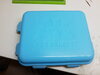
Now when I got it I was a bit shocked at how much I had paid for what is basically a Lock’n’Seal box with a bit of foam and a bit of felt and a sheet of greaseproof paper, and if I ever need another one I will certainly do it myself, but it’s done, put it down to experience…..
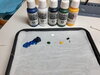
But it DOES work, in that it keeps your paint workable as long as you need it-even for a couple of days.
Anyway, I used the original kilt from the Highlander kit, which helpfully has lines scribed in it. I started with Prussian Blue, which needed 2 coats. I gave it basic shades and highlights, in the hope that they will ‘pre-shade’ the pattern as it builds up.
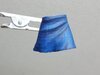
I then painted the main stripes with Black Green- slightly thinned in the hope that the shading will show through.
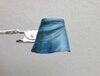
I mixed some yellow into the Black Green for the crossover squares
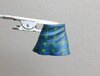
I tried a few variations of the mix.
Next came lines in a very thin filter of black, either side of the green lines.
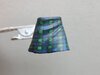
I thought the contrast was a bit strong, so I added a filter of Prussian Blue over half the kilt, to see if it helped.
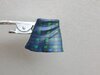
I think so. So far, so straightforward……..if a little bit intense.
Next came the yellow lines, again, quite thin so as to show the various colours underneath, And that’s when I developed the shakes………….
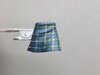
I added a stronger yellow dot at the crossovers, just for the hell of it, but the damage was done.
As I said- warts and all!
Not perfect by any stretch of the imagination, but I think it’s a reasonable first attempt- and it does look better with the naked eye rather than the optivisor or the digital screen! So I will have another couple of attempts and hopefully it will turn out ok.
I’ve just thought, if I varnish before I do the yellow stripes I can have several bites of the cherry if necessary. I’ve also definitely decided to remove the kilt from the model and work on it separately, both to avoid doing damage to the rest of him and in order to make access as easy as possible.
So there we are, one step nearer to slaying the demon!
Thanks for looking
Neil
So for the beginners or timid (i.e. those one step behind me) here is my blow-by-blow account of the misery, mostly stolen from Bill Horan’s Military Modelling Masterclass.
The difference is he uses Humbrol and I’ve used acrylics.
Please understand I am not setting myself up as any kind of expert-far from it- this is just what I did and how it turned out at first attempt, warts and all.
I used a wet palette, which I have only just discovered after over a year of struggling with acrylics, and it has revolutionised my painting experience. What’s annoying is that I had it about 9 months before I started to use it, because I thought it was only for serious painting, and I wasn’t really doing that. Doh!
Now when I got it I was a bit shocked at how much I had paid for what is basically a Lock’n’Seal box with a bit of foam and a bit of felt and a sheet of greaseproof paper, and if I ever need another one I will certainly do it myself, but it’s done, put it down to experience…..
But it DOES work, in that it keeps your paint workable as long as you need it-even for a couple of days.
Anyway, I used the original kilt from the Highlander kit, which helpfully has lines scribed in it. I started with Prussian Blue, which needed 2 coats. I gave it basic shades and highlights, in the hope that they will ‘pre-shade’ the pattern as it builds up.
I then painted the main stripes with Black Green- slightly thinned in the hope that the shading will show through.
I mixed some yellow into the Black Green for the crossover squares
I tried a few variations of the mix.
Next came lines in a very thin filter of black, either side of the green lines.
I thought the contrast was a bit strong, so I added a filter of Prussian Blue over half the kilt, to see if it helped.
I think so. So far, so straightforward……..if a little bit intense.
Next came the yellow lines, again, quite thin so as to show the various colours underneath, And that’s when I developed the shakes………….
I added a stronger yellow dot at the crossovers, just for the hell of it, but the damage was done.
As I said- warts and all!
Not perfect by any stretch of the imagination, but I think it’s a reasonable first attempt- and it does look better with the naked eye rather than the optivisor or the digital screen! So I will have another couple of attempts and hopefully it will turn out ok.
I’ve just thought, if I varnish before I do the yellow stripes I can have several bites of the cherry if necessary. I’ve also definitely decided to remove the kilt from the model and work on it separately, both to avoid doing damage to the rest of him and in order to make access as easy as possible.
So there we are, one step nearer to slaying the demon!
Thanks for looking
Neil

- Joined
- Apr 27, 2018
- Messages
- 15,201
1/3
Hi Neil,
For a first attempt that's not to shabby. I would have taken 10 attempts to get to that. Nice work
For a first attempt that's not to shabby. I would have taken 10 attempts to get to that. Nice work

1/3
Neil, very impressive.
I would try to follow the contours and folds in the kilt a bit more as I think it might look a bit more natural....it just appears a little stiff to my but I'm no expert.....not even a novice for that matter. Rick H.
Neil Merryweather
Active member
1/3
You're absolutely right, Rick, but for this exercise I was simply following the scribed lines on the model kilt, just to see if I could even do it! The lines are actually wrong in that thy fan out from the waist at the front, when they should be absolutely straight.the kilt only gets its shape from the pleating around the sides and back, which is going to be a considerable challenge, and mine has a great big fold in his lap, front and centre, which I will need to get spot on.I would try to follow the contours and folds in the kilt a bit more as I think it might look a bit more natural....it just appears a little stiff to my but I'm no expert.....not even a novice for that matter. Rick H.
Luckily no-one will be watching......
glad you are showing this mate. Those thin lines and shakes, I know all about the feeling. Don't understand how certain figure painting aces do those tidy lines. Looking forward to see you slay that demon though! Keep on going ^^
Cheers
Cheers

wotan
Active member
- Joined
- May 16, 2018
- Messages
- 1,311
- Location
- Brome Lake Quebec
- First Name
- John
1/3
Neil
very nice job so far. I got a tip once to paint thin stripes. paint in all the background stuff first then apply a gloss varnish over it. Then using an oil based paint, either an enamel or oil paints, paint in the thin stipes using a thinned version of the yellow in this case. Then since the surface is varnished and the paint will remain wet for a little while you can use a dry brush to refine the thin stripes to remove any blotches or shaky hand wiggles by running the brush carefully along the sides of the stripe. I can't say I have tried it but the technique sounds viable.
John
very nice job so far. I got a tip once to paint thin stripes. paint in all the background stuff first then apply a gloss varnish over it. Then using an oil based paint, either an enamel or oil paints, paint in the thin stipes using a thinned version of the yellow in this case. Then since the surface is varnished and the paint will remain wet for a little while you can use a dry brush to refine the thin stripes to remove any blotches or shaky hand wiggles by running the brush carefully along the sides of the stripe. I can't say I have tried it but the technique sounds viable.
John

A brilliant first attempt Neil. You certainly need to have a steady hand for this sort of work
Neil Merryweather
Active member
1/3
Cheers Steve, you certainly do.A brilliant first attempt Neil. You certainly need to have a steady hand for this sort of work
I 'll post my second attempt when I've matt laquered it- still shaky but a bit better
Legal Notice
scalemodelling.co.uk is a privately operated online discussion forum. All content posted by members reflects their own views and opinions and does not necessarily represent those of the forum owners or administrators. While reasonable efforts are made to moderate content, no responsibility is accepted for user-generated material. By using this site, you agree to comply with UK law and the forum rules.
Currently on our website
Threads
38,078
Messages
715,197
Members
2,734
Latest member
Filbys Fine Scale Models