Theme editor

Scale Model Shop

Another polishing question.....

PaulTRose

Active member
Joined
Jun 13, 2013
Messages
7,514
Reaction score
1,680
Points
113
Location
Tattoine
First Name
Paul
Location
Tattooine
1/3
Thread owner
....... Cos i really dont know

Ive never been one for polishing cos ive been happy with how things have turned out but i want to try it.... So i bought some tamiya fine compound and some lint free cloths......... But what the order of things?

Do i polish the paint to get it smooth then clear coat.... Then polish again?.......... Or clear coat and polish just once??..... Or what?

Muchos gracias for any help provided
 
Good question Paul, I was pondering something similar myself.
I saw a YouTuber earlier saying how he polished a primer coat before adding top coats 🤔.
I’ve never done that before, does anyone else here do it, have I been missing a trick 🤷‍♂️.

Geoff.
 
Good question Paul, I was pondering something similar myself.
I saw a YouTuber earlier saying how he polished a primer coat before adding top coats 🤔.
I’ve never done that before, does anyone else here do it, have I been missing a trick 🤷‍♂️.

Geoff.
I wouldn't mind seeing the video to hear his reasoning behind it but to me it's completely unnecessary, and even detrimental.

The main role of a primer is to promote adhesion between the substrate and the following coatings. The waters get muddied with primer surfacers or primer fillers as they also hide imperfections, but they are still helping adhesion.

By polishing their surface you are making them smooth at a micro level, giving the following coatings less surface area to grab onto for mechanical adhesion.

Sure, if you are using a solvent/lacquer primer followed by the same kind of paint, there will be chemical adhesion where the solvent reactivates the primers surface, allowing some migration between the layers (think about how solvent cements like TET etc work by dissolving the plastic on both parts a little to enable them to bond together), but not everyone uses lacquer products.

Even in cases like that though, some mechanical adhesion will likely provide a better bond, so smooth, but not shiny ("smooth" on a much finer level) is generally thought preferable.
 
Last edited:
I am no expert on this subject but from my own experience I have to agree with the advice Andy has given. I have just used these polishing compounds for the first time. I applied several coats of varnish onto a paint coat that wasnt perfect. When fully cured the varnish buffed up as smooth as glass. Just remember my bad experience with the dremel pad that I posted recently and buff up by hand only.
 
Andy did this for a living, so his advice is gold standard. I would follow that, only adding that allowing the paint to gas off properly and harden right through the layer is also necessary to get the best results. The only time I would polish between layers is if my spraying has been sub par and I have minor orange peeling to smooth out.

If you want to see how effective these compounds are, and to practice with them a bit, use some left over clear parts. You will see them turn from plastic to glass before your eyes.

Another tip is that if you are building something like a motorcycle that has a black vinyl saddle cover, then polishing the black plastic part can give it that vinyl appearance without using paint.
 
Andy did this for a living, so his advice is gold standard.
Thanks Tim, and I still do. No rest for the wicked 😂

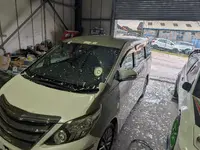
This Jap import love bus is a perfect example. It's a factory paint job but you can see how shiny the primer is, so the paint has just peeled away in big sheets from the roof, one wing & tailgate, only sticking in certain places where some debris must have been sanded out of the primer.

Can't wait to fix it 😩

1000004389.webp
 
Cheers Andy, that makes sense 👍.

He didn’t really give a reason he was talking about a new primer he had used which he said polished really smooth. I didn’t think this was a necessary step hence my question.

Cheers,

Geoff.
 
Back
Top