Theme editor

Scale Model Shop

AZ Models 1:72 Supermarine Attacker

  • Thread starter Thread starter Guest
  • Start date Start date
Thread owner
Chris,
the joys of short run models! I leave the glue well alone until I've dry fitted and adjusted things for 'best' fit. It can help to add plastic card strips to aid location in fuselages. I go back to the old method ( from making vacforms ) by having a sheet of wet & dry on a thick piece of flat board, and sanding component faces square ( use wet, less dust! ) - I even do this on mainstream models occasionally, if needed, removing location tabs/pins in the process.
Dave
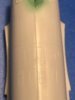
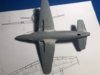
Hi Dave,

What you mentioned about dry fitting has been playing on my mind and I wanted to satisfy myself that I had done what I could, and I think I have.
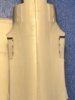
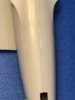
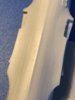
The two halves are fractionally different sizes, with all the step being created by the LHS half. Oddly, the LHS is 'taller' but the RHS is longer!

There is a good deal of very fine detail that is going to be lost during clean up.

IMG_1394.JPG
IMG_1395.JPG
IMG_1396.JPG
IMG_1397.JPG
IMG_1399.JPG
 
Chris,
you just have to bite the bullet, fill, sand, and rescribe. I apply tape on either side of the joint - damage limitation, and only do small areas at a time, letting things dry off before moving on.
Dave
 
Thread owner
I'm going to try to deepen the detail whilst it still exists before I put a file anywhere near it.
 
Thread owner
I decided that the step was too large and thought I’d look at it to see what could be done.
The old contacta I had used had not sufficiently bonded the very hard plastic that this model was molded from, so a steady hand and a sharp blade was all that was required to separate the two halves of the fuselage.

I cleaned them up again, had a torrid time fitting them back together (the tub put on weight) and ended up with this:

49024B87-5587-4826-8E79-484645B1B9F3.jpeg

I’ll let it set and see what I get.

Nothing to lose I guess...
 
Wow, this makes vintage Airfix look like a modern Tamiya. Well done for persevering.
 
Thread owner
It’s about the size of a twix. Makes you wonder if it’s worth all the effort!
 
Thread owner
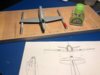
The problem I have had and which has stalled the build is the wings. There are no locating aids and the fit is terrible. I found a few minutes this evening at the bench and received the extra thin glue I was waiting for to execute my plan, so got on with it.

I decided that I'd probably mess the whole thing up if I tried to work on the joins and reasoned that filling would be better, since you can take away but you can't add. The only issue then was how to set the angle in both vertical and rotation relative to the fuselage, keeping the whole thing stable whilst the glue set.
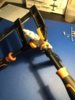
What I decided to do was to create a cradle on a piece of ply I use to hold my 'parts on sticks' while they dry and other cutting activities, then mount the wings and apply extra thin so I didn't have to handle the model.

I found a 1:72 drawing of the aircraft which I used to work out the wing angle. I then marked out a centreline and positioned two cotton buds on the lines, taping them down. This is the cradle for the fuselage.
Then I tacked the wings with CA and as luck would have it, my scalpel blades are the exact same diameter as the required rise, so these would support the wings.

IMG-1445.JPG

Once it's set overnight I'll lift it and apply glue to the underside to properly secure them.

I'm glad I got on with it. I have been scratching my head over this for a few weeks and have a habit of overthinking problems.

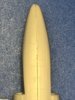
I also cleaned up the intake cowl's........eurgh.

IMG-1374.JPG

More to follow.
 
Chris,
with short run kits, and butt joined wings, I drill holes in the wing roots & fuselage <1mm dia, and use copper wire as the strength member - copper, so you can adjust the dihedral, etc before committing to cement!
Dave
 
Thread owner
Chris,
with short run kits, and butt joined wings, I drill holes in the wing roots & fuselage <1mm dia, and use copper wire as the strength member - copper, so you can adjust the dihedral, etc before committing to cement!
Dave
Good tip! Won’t be the last time I need this, so thanks!
 
Chris,
Another tip from the vacform days - I have a sheet of emery paper on a thick glass sheet, the wing halves can be ground flat on the mating faces - use wet to reduce dust - make fingerholds from folded masking tape. You can use this on any flat mating components. Before I sourced a thick glass sheet, I used a formica drawer front - as long as it is flat (ish), and doesn't flex, anything will do - you can get large sheets of extra fine ( crocus paper ) to coarse emery paper from your local hardware store - not that expensive.
As an aside, my local hardware store is also the undertakers! - I often wonder, looking at his stock of varnishes, glues & screws etc. , whether any of his products end up being used on coffins :smiling2:
Dave
 
Thread owner
haha!
my ply board doubles up as the flat sanding surface.
 
Thread owner
Definitely learning from this short run kit.
I’ll do it again, but will apply more effort to fit next time.
 
Thread owner
Another short update for those still with me.

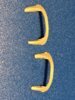
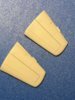
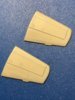
Can anyone tell me what is wrong with these elevators........
IMG-1451.JPG
IMG-1452.JPG

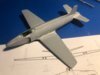
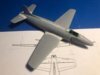
Thanks to Dave I was able to employ his technique for attaching wings void of locators to a fuselage and got the corrected elevators attached. It involved steel wire and not copper because it is 1/4 of the price and a pretty decent puncture to the tip of my index finger thanks to a sheared 0.6mm drill bit, but we got there.

IMG-1455.JPG
IMG-1456.JPG
IMG-1457.JPG

Part of the way through filling & sanding stage 1. There will be another round of this before scribing with my fresh Hasegawa TL-2 templates as there are some significant differences in the mating surfaces and then (hopefully) on to prime and paint!

I am reinvigorated with this now that the wings are on and I'm getting somewhere.
 
Chris,
copper is easier to cut than steel! I bought a whole load of different thickness copper wire, many years ago - still got a load of it remaining. I think I got it from a hippy jewelry making shop! ( you can get some really fine chain from these places., as well ) Broken drills? can't help you there ( serial drill snapper! )
Dave
 
Thread owner
It’s about 0.8mm, easy to cut. With 50m of it I don’t anticipate having to replace it!
 
Thread owner
Looking at the later pictures I'm guessing you corrected it :thumb2:
 
Top marks Chris. I'm sure many of these kits have ended up in the bin. But not yours.....
 
Back
Top