Theme editor

Scale Model Shop

Environment v Plastic modelling...

Status
Not open for further replies.

Ian M

Active member
Staff member
Admin
Joined
Dec 14, 2008
Messages
18,341
Reaction score
588
Points
113
Location
Falster, Denmark
1/3
Thread owner
Unless you are living on the moon or otherwise totally cut off from the outside world, you might have heard a thing or two about Plastic waste in the environment.
I try to be as good as I can with sorting our rubbish but these days it seams that people are just looking for a soft target.
I have started to place all my "leftovers" and empty sprues in a big box, the plan being to deposit it in the recycle bit at the rubbish tip.
The amount of "scraps" after building a kit these days weighs almost the same as the actual kit. This got me thinking. (it happens once in a while.
Would you buy a plastic kit in which the main parts have been 'cut from the sprue' and only the fine detail parts where still on the sprue. This could not only save a lot of trash ending up in the wrong place, but could also save the manufacturer a bit of money, the cut off sprues going direct into the chipper to be reused.
Is this a daft idea of could it be a step in the right direction to save our hobby. Oh and the planet.
 
HI Ian yes I think its a good idea as long as the parts have got the number's on them so you know whats what an the number of the part would be mouled inside so it wont be seen :thumb2:
chris
 
Not sure what the cost implications would be for the manufacturer to remove most parts from the sprue, but a particularly environmentally aware one could accept back the unused parts and sprues for recycling. Probably still not cost effective but that isn't the point. They could even add a small percentage to the purchase cost that is refunded on return, maybe in the form of vouchers for future products of theirs to keep customers brand loyal.
 
The 1/16 Hobbyboss Tiger I will be attempting for the animal GB doesn’t have much sprue - majority of parts already removed and in card boxes within the main outer box
 
The problem in my area is that my local council only recycles certain plastics, gets me angry as there are loads of stuff we bought that have the recycle symbol and they cannot be done.

As for models. I do the same, had a spare box with the sprues and then put them into the recycle bin-no idea if they do get recycled though. Yes, I would buy a model without sprues but, would that make it very difficult for the manufacturer and if they could would costings go up?
 
Thread owner
I was wondering about weighing the whole lot, then weigh the remains once the kit is built.
I bet Dragon win that one hands down... lol.
 
Recycling the sprues seems to be the answer, though perhaps we have to question how sustainable plastic modelling will be in the future. I do have guilt feelings every time I open an new kit when the rest of the family is trying to go plastic and packaging free. Can't see a way out of this one unless manufacturers at least start using recycled plastic or find an alternative, more environmentally friendly material.
 
ROCO has gone to just detail parts on sprue as they no longer assemble the major parts as a cost savings. Trident still assembles the major parts w/details on sprue for their plastic models. Well engineered model assembly (ie. round lugs left, square lugs right) with a good instruction set (separate bags of parts for each assembly step) could preclude numbered parts and sprues, but would elevate labor costs. PaulE
 
PLA used in 3d printers is made from fermented plant starch

I dare say they could turn that into some kind of replacement for oil based styrene if someone puts their mind to it
 
A problem indeed, just the other day I put half a dozen sprues in recycling bin, thinking I wonder what will happen to them.
on the web there seem to be several points raised, one sprue plastic can't be reused because of the heat in injection molding , yet on another site I have found this .

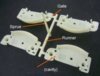
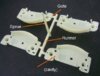
Plastic Scrap Recycling From Runners And Sprues

Posted on October 18, 2017 at 11:41 am
Please Recommend...facebook.pnggoogle.pngtwitter.pnglinkedin.pngpinterest.pngtumblr.pngstumbleupon.pngreddit.pngemail.png
Plastic scrap recycling often involves the use injection molding waste. These parts are referred to as runners and sprues. Sprues and runner comprise the conduit that connects the machine nozzle to the machine cavities. During the injection phase of the molding cycle, the molten material flows through the sprue and runner to the cavities. These parts can be reground and mixed with new materials, primarily virgin resin.
Creating what is referred to as ‘regrind’ is a major element of the plastic scrap recycling process. The proportion of regrind mixed with virgin material is generally based on the customer’s requirements. Regrind can have various characteristics different from the virgin pellets used. For instance, the melt flow could vary in small amounts from the resin. But these variations should have no impact on the final product as long as appropriate proportions are added.
The formula should be standardized in order to develop a repeatable process. The product mold design determines how much regrind will be available. Small parts with many runners and sprues can produce a lot of material

for reuse. start-2-300x227.jpg
There are different types of granulator machines to produce the regrind. High-speed granulators, for instance, are best used with polypropylene, while ultra-slow granulators are ideal for filled materials that non-plastic fibers that add strength to the original products.
The ultra-slow granulator produces relatively large, uniform pieces with much less dust residue. This helps maintain the characteristics of the original product, including the length of the strengthening fibers. Other safeguards include material tags on the machine to prevent contamination with other resins. Additionally, each granulator is thoroughly cleaned before taking on a new project with a different resin.
An added benefit to the cost-cutting effectiveness of plastic scrap recycling and the use of regrind is that it often reduces the weight of the recycled product, further making its use a practical solution for many manufacturing projects. The process in its entirety can also dramatically reduce the amount of excess that normally would be sent to a landfill.
With thanks to Cy Plastic Works

John.
 

Attachments

  • start-2.jpg
    start-2.jpg
    2.6 KB · Views: 0
Having worked in the injection moulding industry I know that a great deal of the waste can be re used. The issue would be getting this back to the manufactures. It would be good if some sort of free post return system could be set up but I think it might be impracticable.
 
there are loads of stuff we bought that have the recycle symbol and they cannot be done.
You mean the triangle of three arrows with a number in the middle?


The purpose of that is to indicate the type of plastic (shown by the number), so that anyone who does plastic recycling can use this to sort the plastics they take in by type. Chances are good that people taking in plastic for recycling don’t want every type, though.

Having worked in the injection moulding industry I know that a great deal of the waste can be re used. The issue would be getting this back to the manufactures. It would be good if some sort of free post return system could be set up but I think it might be impracticable.
It would drive manufacturers out of business, is my guess. Can you imagine the bill Tamiya would get from the Japanese post office if every modeller around the world were to mail them old sprues? :smiling3: As long as buying new raw plastic is cheaper than recycling, manufacturers will almost invariably buy new.

Here in the Netherlands, BTW, the situation is somewhat ludicrous — understandable once you know the reasoning, but still ludicrous. There is organised plastic recycling, with plastic collection bins etc. in towns and villages; I assume that the contents of these get sorted and go to plastic manufacturing plants and not into some power plant’s furnace with the miscellaneous trash. You can’t just put any plastic in, though — it’s only intended for packaging materials. Any other plastic, even if it’s the same type, is not allowed and should be put into the miscellaneous waste bin. Model sprues fall into this latter category, of course.

The reason for this is that manufacturers pay for this whole thing, in other words they pay to have their packaging recycled, so anything they didn’t make, they also don’t want to pay for. Understandable from their point of view, but very difficult to explain to people. When I found this out, I decided to put more plastic in the plastic waste bin, including things that I know are technically not allowed for the above reason, on the principle that as far as I’m concerned, these companies are welcome to pay for more than their own share :tongue-out:
 
Don't worry mate it will come back at us in the form of higher product prices...always does.:tired:.
Cheers, Rick H.
 
Hi guys

Just catching up after a week visiting my son at uni.

Sorry for the length of this post, but I have been closely involved in the development of our (Guernsey's) waste strategy over the last 10 years, so this is a subject close to my heart. Having said that, I think our strategy of sending non-recyclates to Sweden to be incinerated is madness - we should have our own on-Island incinerator, but I digress.

Back to modelling plastic.

The use of plastic is not in itself bad, somethings can only be made from plastic so the question is: what problem do you want to solve?

One concern is that oil is a finite resource. With modelling in mind, I think this irrelevant when you think of how much plastic is used for non-essential products - just consider the amount of plastic we use in models compared to Upvc windows being fitted rather than wood. Even this is 'small fry' compared to the amount of oil burnt is our power stations and cars etc. Arguably, using oil to make plastic which can be recycled is far better than burning it as fuel.

If the concerns are the environment or climate change the situation becomes more confusing and surprising. The Danish environmental agency published a report earlier this year (here is the link if anybody is really interested: https://www2.mst.dk/Udgiv/publications/2018/02/978-87-93614-73-4.pdf.

In the report they compare the climate change and environmental impact of different types of bags compared to the 'bog standard' supermarket plastic bag which used to be given away free. They included all of the. Costs and impact of producing and using the bags. Their findings were quite a surprise to me, and include:

"
Unbleached paper bags: Can be directly reused as waste bin bags for climate change, should be reused and up to 43 times considering all other indicators. Finally, reuse as waste bin bag if possible, otherwise incinerate.
 Bleached paper bags: Reuse for grocery shopping at least 1 time for climate change, and up to 43 times considering all indicators; reuse as waste bin bag if possible, otherwise incin- erate.
 Organic cotton bags: Reuse for grocery shopping at least 149 times for climate change, and up to 20000 times considering all indicators; reuse as waste bin bag if possible, other- wise incinerate.
 Conventional cotton bags: Reuse for grocery shopping at least 52 times for climate change, and up to 7100 times considering all indicators; reuse as waste bin bag if possible, otherwise incinerate.
 Composite bags: Reuse for grocery shopping at least 23 times for climate change, and up to 870 times considering all indicators; reuse as waste bin bag if possible, otherwise inciner- ate."

I see a few shops moving towards using paper bags, but since we are unlikely to use them 43 times the Danish report concludes that doing so actually increases the negative environmental impact!

Surprisingly, both Iceland and Morrisons have admitted that the volume of plastic they have used in their 'bags for life' is more than the volume of plastic they used when they gave away their free bags!


The conclusion I came to is that using plastic is not in itself bad if there is no practical alternative, for instance I do find the use of plastic cups and so much plastic packaging to be annoying and unnecessary.

The real issue is one of disposal. Ideally either recycled or incinerated. In Guernsey plastic bottles and containers are collected from home every fortnight. And hard plastics can be deposited at a central site - that is where I drop off my old sprues.

Although virtually all types of plastics are reclable the problem is when manufacturers mix different types of plastic into one product, for instance my toothbrush has 4 types of plastic in it which makes it impractical to recycle even though the plastic can be.

After all of this, the conclusions I came to are:

Where possible try to avoid plastic if there is an alternative or it is not necessary,
Re-use plastic products as many times as possible
Try to ensure they are recycles and not sent to landfill.

For anybody who read all of this post - welldone for keeping with me!

Peter
 
Thread owner
An interesting post Peter, Living In Denmark I can just add that as far as I know we have no more land fill sites. Most of the stuff going to the incinerator. The heat from which is used to provide heating and or power. (district heating).
Not quite sure why cotton bags should be burned after full use. Cotton can go in the compost. also our local recycle center collects fabrics for shredding and turning into something else.
One thing I can not understand is the local card and paper recycling. Recently they changed the "rules" so now only paper and single layer cardboard (as in cornflakes boxes and the like) can go in the wheelie bin. Corrugated card has to be taken to the recycling center... Great if you have a car.
The real problem is not the plastic in its self, rather the way in which it is disposed of. So the less plastic we, as model makers have to deal with the better.
 
Interesting read Peter
What I find annoying is the continued use of plastic film with the message saying Not Currently Recycled.
Well stop using it then, the only way I can see to make super markets stopping using this film is to stop buying the product, they would soon find a better alternative if profits were hit.
We recycle here in Lincs, even have food waste bins, started as a trial, so many used them our council is going to continue offering it .
Think the Danish method that Ian mentions is great, I think they do a similar thing in Sweden , why don't we use this, I have a feeling it was banned some time ago.
 
Excellent post Peter.
I think the 'bottom line' is that regardless of the material, we waste too much.
Interesting to hear the CEO of Terracycle on the radio the other day - they can recycle many things that others won't; for some materials the cost of collection is more than the value of the material, but Terracycle have a network of private individuals who collect things like crisp packets and pet food pouches until they have enough of them to justify a collection.
The son of a chap I used to work with has set up a company to recycle plastic waste from injection moulding companies - they waste huge quantities of polystyrene every time a mould is changed, often far more than is used in the moulded product. He regrinds it into pellets and sells it back to the moulding companies.
Pete
 
Status
Not open for further replies.
Back
Top