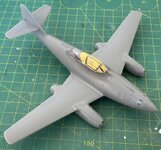
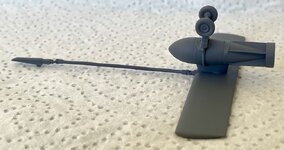
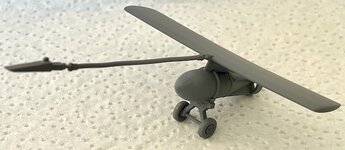
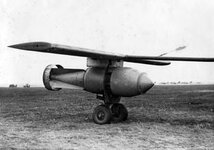
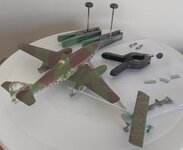
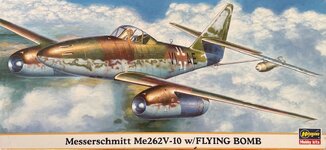
A very unusual combination, Hasegawa's 1/72 kit of Me262 V10 prototype V1+AE with a towed SC1000 glide bomb.
Some background information:
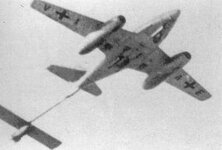
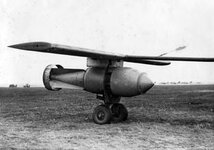
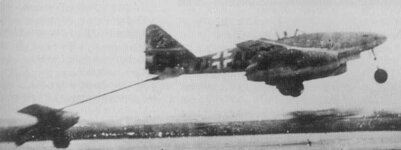
In October 1944, proposals were made for towing both extra fuel and ordnance behind a Me262 in the Deichselschlepp rigid tow arrangement. The bomb or drop tank had an auxiliary wing mounted above it and was fitted with a two-wheeled take-off dolly, attached to the aircraft by a 19ft 8in (6m) hollow pole. The pole had a double joint to allow both vertical and horizontal motion. After take-off the wheels were jettisoned by exploding bolts. On reaching a target, the aircraft was put into a shallow dive, the weapon being targeted using the normal Revi sight and launched via another exploding bolt. V1+AE W.Nr 130005 was repaired after damage during an air raid at Leipheim field on 12th September 1944, and the aircraft flew the first test with a towed 500Kg bomb on 22nd October. It later tested a 1,000Kg SC1000. Messerschmitt test pilot Gerd Lindner, who conducted trials with the Deichselschlepp arrangement found that the larger bomb tended to 'porpoise' disconcertingly. On one occasion the explosive bolts failed to jettison the bomb and Lindner had to land with the bomb still attached. During another test, turning the aircraft too tightly caused the towing swivel to break away, damaging the rear fuselage. Despite this Lindner considered that with an improved wing and the addition of a vertical fin, good results could have been obtained with towed bombs. It was never used operationally.
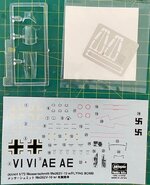
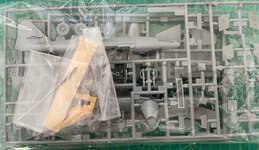
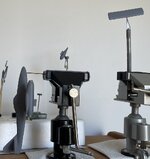
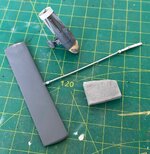
The kit is the basic Hasegawa Me262A-1a with extra parts. The SC1000 bomb and parasol wing structure is cast in resin, with a white metal tow bar and trolley components. There is a separate instruction sheet for the differences from the main kit:
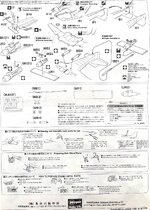
The main difference from the usual Me262, apart from the glide bomb, is the inclusion of RATO rockets on the underside. These are cast in metal.
Some background information:
In October 1944, proposals were made for towing both extra fuel and ordnance behind a Me262 in the Deichselschlepp rigid tow arrangement. The bomb or drop tank had an auxiliary wing mounted above it and was fitted with a two-wheeled take-off dolly, attached to the aircraft by a 19ft 8in (6m) hollow pole. The pole had a double joint to allow both vertical and horizontal motion. After take-off the wheels were jettisoned by exploding bolts. On reaching a target, the aircraft was put into a shallow dive, the weapon being targeted using the normal Revi sight and launched via another exploding bolt. V1+AE W.Nr 130005 was repaired after damage during an air raid at Leipheim field on 12th September 1944, and the aircraft flew the first test with a towed 500Kg bomb on 22nd October. It later tested a 1,000Kg SC1000. Messerschmitt test pilot Gerd Lindner, who conducted trials with the Deichselschlepp arrangement found that the larger bomb tended to 'porpoise' disconcertingly. On one occasion the explosive bolts failed to jettison the bomb and Lindner had to land with the bomb still attached. During another test, turning the aircraft too tightly caused the towing swivel to break away, damaging the rear fuselage. Despite this Lindner considered that with an improved wing and the addition of a vertical fin, good results could have been obtained with towed bombs. It was never used operationally.
The kit is the basic Hasegawa Me262A-1a with extra parts. The SC1000 bomb and parasol wing structure is cast in resin, with a white metal tow bar and trolley components. There is a separate instruction sheet for the differences from the main kit:
The main difference from the usual Me262, apart from the glide bomb, is the inclusion of RATO rockets on the underside. These are cast in metal.
Last edited: