Mark
The only show where I’ll display the model will be my club's annual air show, which is the Teesside Model Flying Club, near Stockton upon Tees. If any one's up this way in June I can thoroughly recommend it as an excellent day out.
Grahame
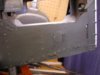
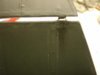
I’ve repainted and weathered the offending front section of the fuselage and am now happy with it.
The elevators are actually operated by a pair of pushrods but I want it to look as if the scale control cables and pulleys control them. To do this I will run a cable from the top control horn on one side to the bottom control horn on the other and vice versa; to take up any slack I will include springs in each cable run.
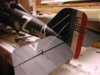
The first thing to do is to find out where any slack in the system may be by temporarily joining the elevators together and connecting the control horns with cotton. I did each cable separately to ensure there wasn't any interaction.
View attachment 263065
Moving the elevators from full up to full down showed that there is in fact no noticeable slackening or tightening of the cables; more by luck than judgement I’m sure! I’ll still incorporate the springs but with just enough tension to stop the cables flapping about
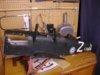
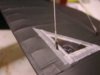
I made up the 2 cables complete with springs; as they won’t be seen I used the easy option of brass tube as crimps, with a drop of cyano just to be sure.
View attachment 263066
I fitted the cables through the fuselage before threading them through the tubes built into the tail plane, one spring each side.
View attachment 263068
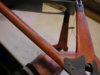
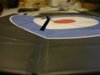
I then attached the cables to the control horns ensuring that there was equal tension in each cable by the simple measure of ensuring that each elevator was at the same relative angle. There is a little friction introduced by the pulleys and the springs running inside the tubes but definitely not excessive, as I’m using a separate servo for each elevator I’m certain there’ll be no problems.
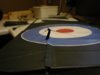
Just the acetate “windows” and frayed tapes to fit now.
View attachment 263067