

You are using an out of date browser. It may not display this or other websites correctly.
You should upgrade or use an alternative browser.
You should upgrade or use an alternative browser.
spanner's 1/72 Airfix Starter Kit Spitfire.....'Reach for the Sky' (1956)
- Thread starter spanner570
- Start date


- Joined
- Apr 27, 2018
- Messages
- 15,174
1/3
Ron, I love your build and wreck builds.

1/3
Very nice indeed Ron. Not easy to sculpt at that scale.
The man who is very likely to have shot down Bader is Lionel Harwood 'Buck' Casson (we had better names back then). He was a Sheffield man and experienced pilot, having joined No. 616 (South Yorkshire) Squadron, Auxiliary Air Force, at Doncaster on 6th April 1939.
Casson reported shooting the tail of a Bf 109 and watching the pilot abandon the aircraft at the base of the clouds, a description which matches Bader’s demise remarkably accurately.
As Ron says, only one Bf 109 was shot down in this action, and that was attributed to Philip ‘Nip’ Heppell (where did they get these names?). Heppell would later fly a Spitfire to Malta as part of Operation Spotter and claimed the Malta Spitfires’ first kill when he shot down a Bf 109 on 10 March 1942.
To be clear, such incidents were not as unusual as we would like to thing, and that Bader was surprised by an attack coming from behind and below may well have been the impetus for him concocting the collision story, first in a letter to his wife, but soon widely publicised and becoming 'fact' by repetition.
Casson reported shooting the tail of a Bf 109 and watching the pilot abandon the aircraft at the base of the clouds, a description which matches Bader’s demise remarkably accurately.
As Ron says, only one Bf 109 was shot down in this action, and that was attributed to Philip ‘Nip’ Heppell (where did they get these names?). Heppell would later fly a Spitfire to Malta as part of Operation Spotter and claimed the Malta Spitfires’ first kill when he shot down a Bf 109 on 10 March 1942.
To be clear, such incidents were not as unusual as we would like to thing, and that Bader was surprised by an attack coming from behind and below may well have been the impetus for him concocting the collision story, first in a letter to his wife, but soon widely publicised and becoming 'fact' by repetition.
Thanks for all your input chaps.
Thanks also to Steve for his historical add-ons.
All much appreciated.
Here's yer man seconds after finally freeing himself from his crippled Spitfire. His right 'leg' remained jammed behind the control pedals.

Next I'll make the fighter's prop. look like it's going around and around and......
Cheers.
Ron (Fully payed up for another 12 months)
Thanks also to Steve for his historical add-ons.
All much appreciated.
Here's yer man seconds after finally freeing himself from his crippled Spitfire. His right 'leg' remained jammed behind the control pedals.
Next I'll make the fighter's prop. look like it's going around and around and......
Cheers.
Ron (Fully payed up for another 12 months)
G
Guest
Guest
Oh I say 570 splendid work , nice to read of the true facts .
Would have look good to say it was due to friendly fire .
Feeling a lot better thank you .
453 no longer coughing!
Would have look good to say it was due to friendly fire .
Feeling a lot better thank you .
453 no longer coughing!

Superb storytelling as always matey ( and of course compliments to the chucker ) , poor old doug looks excellent in mid air ,trouser flapping , hoping his chute is going to deploy fully . Cheers tony
Thanks boys.
'No Longer Coughing'....Good to read you're a lot better.
'Mucker'. Thanks Matey. Compliments sent and I'll soon need her chucking arm too!
EEEEEOOOOOOWWWWW!
Prop. done. Made out of the clear plastic top of a food container and suitably messed with.
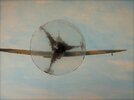
Nearly there.
Cheers.
Ron
'No Longer Coughing'....Good to read you're a lot better.
'Mucker'. Thanks Matey. Compliments sent and I'll soon need her chucking arm too!
EEEEEOOOOOOWWWWW!
Prop. done. Made out of the clear plastic top of a food container and suitably messed with.
Nearly there.
Cheers.
Ron

HI Ron yes that prop looks great an its goin at a heck of a rate an the spitty now looks powered very well DONE any chance of a little yellow goin round on the props tips ? but very good all the same or did the prop not have yellow tips ? 570
chrisb
chrisb
Hi Chris, Thanks for the nice comments.
As far as I know, Spitfires at the time didn't have yellow tips.
I never bothered looking it up to be honest. I just went by the box art. Easy fix if yellow was present........
Ron
As far as I know, Spitfires at the time didn't have yellow tips.
I never bothered looking it up to be honest. I just went by the box art. Easy fix if yellow was present........
Ron
Easy fix if yellow was present........
It was.
I don't have an exact date, but they are visible on RAF aircraft in the mid 1930s (unless orthochromatic film was used!).
We do have the painting instructions for the repair of Rotol blades, which gives an idea of how it was originally done.
PAINTING.
38. After repair of covering, except Emergency Repairs, the repaired
parts shall be painted.
(i) Spray or paint with Grey Surfacer and allow to dry.
(ii) Spray or paint two or three coats of Matt Night, DTD.751/4.
(iii) The four-inch yellow tip should be given two or three coats
of Identification, Yellow DTD.751/5
(iv) Paint a White line, 1/32 in. wide at 0.70 of the original
radius, across the thrust face of the blade.
This line indicates the blade pitch angle checking station
and should be at right angles to the longitudinal axis.
(v) Blade identification markings should be made good.
My bold.
Bear in mind that 4" at 1/72 scale is just under 1.5mm.

Steve and Jim.
Thanks for the input. :thumb2:
Steve. I was going to P.M. you about the yellow tips, but I just knew you would come to the rescue. Thanks.
What a long winded application it was for sure!
I'd best add the yellow to my round and round effort, toot sweet. Thanks again for taking the time to clear things up.
Jim, glad you approve of yer man and the prop.
Back soon......
Ron
Thanks for the input. :thumb2:
Steve. I was going to P.M. you about the yellow tips, but I just knew you would come to the rescue. Thanks.
What a long winded application it was for sure!
I'd best add the yellow to my round and round effort, toot sweet. Thanks again for taking the time to clear things up.
Jim, glad you approve of yer man and the prop.
Back soon......
Ron
- Joined
- Apr 27, 2018
- Messages
- 15,174
1/3
Ron,
It's good to know that there is always someone on here with the knowledge we need.
It's good to know that there is always someone on here with the knowledge we need.
"What a long winded application it was for sure!"
A lot of them were. Some of the finishing instructions for airframe repairs put a great emphasis on the final result, filling, rubbing down (often using guide coats to ensure an even and level surface), final painting and cleaning. Of course, an aircraft in the metropolitan air force might receive much more 'correct' treatment than one in the Burmese jungle
A lot of them were. Some of the finishing instructions for airframe repairs put a great emphasis on the final result, filling, rubbing down (often using guide coats to ensure an even and level surface), final painting and cleaning. Of course, an aircraft in the metropolitan air force might receive much more 'correct' treatment than one in the Burmese jungle
You are spot on there Paul. This little discussion and a positive outcome is just another example of what is so good about this forum.
Thanks again Steve. Your knowledgeable input is always most welcome.......even if it means even more farting about with a bit of circular plastic!
Here's my final attempt at a moving propeller. It's the best I can do, 'cos I'm starting to 'Fiddle' with the thing....... :upside:
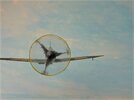
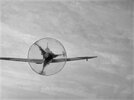
Cheers.
Ron
Thanks again Steve. Your knowledgeable input is always most welcome.......even if it means even more farting about with a bit of circular plastic!
Here's my final attempt at a moving propeller. It's the best I can do, 'cos I'm starting to 'Fiddle' with the thing....... :upside:
Cheers.
Ron
Legal Notice
scalemodelling.co.uk is a privately operated online discussion forum. All content posted by members reflects their own views and opinions and does not necessarily represent those of the forum owners or administrators. While reasonable efforts are made to moderate content, no responsibility is accepted for user-generated material. By using this site, you agree to comply with UK law and the forum rules.