Theme editor

Scale Model Shop

Stona's Bf 109/Ju 88 'Mistel'.

Status
Not open for further replies.

stona

New member
Joined
Jul 22, 2008
Messages
9,889
Reaction score
9
Points
0
1/3
Thread owner
I did a bit of a build thread here:


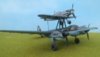
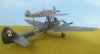
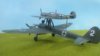
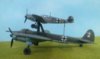
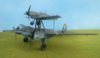
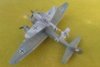
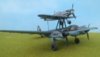
So this is a 'Mistel 1', 'White 2' of 2./KG 101 as seen at St Dizier, France in June 1944. A Mistel was a combination aircraft, in this case a Bf 109 F-4 and a Ju 88 A-4 from which the cockpit was removed and replaced with a warhead. This was the SHL (Schwere Holladung) 3500. It contained 1,700 Kg of explosive in a hollow charge. The electrical crush fuses for the explosive are at the end of a 2.75 m probe, a hollow chamber lined with soft metal (aluminium and copper were used), giving the device its nick name 'Elephantenrussel' or elephant's trunk. For those not familiar with hollow or shaped charges, when the explosive (70% Hexogen/30% Trinitrotoluol) at the back of the warhead was detonated it would focus its force on the soft metal liner which would liquefy and project forward at 20 times the speed of sound. Test showed that this jet could penetrate 8m of armoured steel or 20m of concrete.


History lesson over, here's some pictures of the completed model.


View attachment 263419


View attachment 263420


View attachment 263421


View attachment 263423


View attachment 263424


View attachment 263426


View attachment 263427


The kits are from the Italeri Mistel boxing. They were both fairly stress free. Paints are a mixture of Colourcoat and Humbrol enamels. Final varnish a mixture of Klear and Vallejo matt to give a satin(ish) finish.


Cheers


Steve


Edit: I've just noticed that the Bf 109 has shed its tail wheel! If I ever find it I'll stick it back on :)
 

Attachments

  • IMG_1787_web.jpg
    IMG_1787_web.jpg
    1.7 KB · Views: 0
  • IMG_1787_web.jpg
    IMG_1787_web.jpg
    1.7 KB · Views: 0
  • IMG_1789_web.jpg
    IMG_1789_web.jpg
    1.6 KB · Views: 0
  • IMG_1790_web.jpg
    IMG_1790_web.jpg
    1.6 KB · Views: 0
  • IMG_1791_web.jpg
    IMG_1791_web.jpg
    1.7 KB · Views: 0
  • IMG_1792_web.JPG
    IMG_1792_web.JPG
    1.6 KB · Views: 0
  • IMG_1793_web.jpg
    IMG_1793_web.jpg
    1.7 KB · Views: 0
WOW!


Great job Steve. A very impressive model with a very impressive paint job. 
 
 
Superb work steve , when you see  the mistels like this you realise how hard it must have been for the bf109 pilot to control the two aircraft . Once separated was the ju 88 just a free fall glide bomb or did the pilot still have some directional control over it?
 
Great job Steve love the paint job mate. The backdrop makes for a great display
 
Thread owner
Superb work steve , when you see  the mistels like this you realise how hard it must have been for the bf109 pilot to control the two aircraft . Once separated was the ju 88 just a free fall glide bomb or did the pilot still have some directional control over it?

The easy bit was flying the combination! Take off was a little tricky. All the pilots seem to agree that it was no more difficult than flying a single aircraft. There were no mechanical links between the control surfaces of the two aircraft.  'Open loop' control principles, governed by the Mistel's speed were employed. The control rods of the upper, controlling, aircraft were linked to potentiometers which regulated the power supply to electrically driven servo-actuators fitted to the carrier aircraft's flaps, ailerons, elevators and rudder. It was, for the time, a very advanced predecessor of the 'fly by wire' systems which are almost standard today.


The lower component, once released, flew to the target on an auto pilot. Aiming and acquiring the target was dependent on the Mistel's gyro stabilised gun sight which could calculate the lead required for the Mistel's lower component, allowing it to fly under auto pilot and in a straight line to the target, even if it was moving.


Fritz Haber wrote, about a moving target like a ship.


"Target acquisition is initially achieved by locking the gyro's axis, and thus the line of sight, and aiming the aircraft at the target. The pilot then frees the gyro and afterwards has nothing more to do than align and maintain the target in the reticle. He has then achieved the situation with the correct lead angle depicted in the sketch [which I can't reproduce] It is clear that in this situation, where the target is being continually tracked, the upper aircraft can be separated at any time, because the overall situation will not alter....The simplicity and certainty of hitting a target using the Mistel method was based on the premise that the carrier aircraft [the bomb] continued to fly in a straight line and did not have to rely on the calculations needed for ballistic flight."


For a stationary target, like a bridge or factory, the same method was used, but no lead was calculated. The important point is that the carrier aircraft's auto pilot simply had to keep it on a predetermined straight course, something it was quite capable of doing. There was no requirement for any maneuvering. Unfortunately the system was less than reliable. IF the Mistel's managed to get within range to separate then the lower components did sometimes get close to the target, but they also had a tendency to dive into the ground (or sea).


Cheers


Steve
 
Wonderful work Steve, as with all your models the quality and finish are top notch and the history you provide makes them come alive.
 
Another great build Steve and a good bit of knowledge and understanding of how these things worked top job all round
 
Looking Great


Surely in the air these things were hairy to fly even without the chance of Flak Blowing you out of the sky
 
Thread owner
Surely in the air these things were hairy to fly even without the chance of Flak Blowing you out of the sky

By all contemporary accounts they really were easy to fly. Flak and fighter could be deadly.


When P-51s of the 55th FG surprised three Mistel combinations on a transfer flight (they did not carry warheads, the Ju 88s carried a crew of 3), 3rd February 1945, they shot them all down in minutes.


As for ease of operation, I described the method used for aiming and target acquisition above. Here is an account, from Ofhr. Georg Gutsche of I./KG 30, describing an operation against the Oder bridges.


"Take off was set for 17.00 hours. The aircraft were lined up one behind the other with engines running. My Mistel was the second one in line. From my cockpit I could not see the horizon because the nose of my Fw 190 [he flew a Mistel 2 combination] was pointing up too high. The procedure was to move all three throttles in a synchronised manner so that the Mistel stayed on the runway. With sufficient air speed, the stick could be pulled back and the undercarriage and flaps retracted. You then throttled back, adjusted the airscrews and made a steady climb. After reaching our combat altitude of 2,000 metres, I could see the front, the fires and the impact of mortar explosions. The heavy haze made visual orientation very difficult, but the Oder was easy to make out as a silvery band. The bridge that I was looking for was a dark line across this band. I was 'welcomed' by heavy anti aircraft fire, but I put the Mistel into a dive, switched on the fully automatic control system, pulled down the cross hair sight and aimed at the bridge. When the target drifted out of the cross hair sight, I corrected and the automatic control system put the target squarely into the cross hair again. At about 1,000 metres distance, I squeezed the trigger that automatically armed the warhead [in fact there was a three second delay] and separated the Mistel. My Fw 190 climbed as it released itself from the heavy weight of the Ju 88. As I pulled away, I noticed a lightning flash in the river bed below me that quickly went out. Without much difficulty I returned to my home field." 


The system was not reliable. Gutsche's attack was copybook, but other accounts speak of the Mistels having fuel transfer problems,and after separation the Ju 88 not following the correct course, being randomly released or, worse, failing to release. Ofhr. Burkhardt Winkler-Hermaden, of  I./KG(J)30, suffered a failure to release on his first attack on a Warsaw railway bridge. Despite heavy flak he made a second attack, instigating the emergency release procedure which also failed. Finally he made a third attack at a steep angle, pulling up abruptly and literally breaking free of the Ju 88, which certainly missed the target, before deciding, in his words " Now, nothing else, but head West!"


Cheers


Steve
 
I know I have said it before but you should write a book "History for plastic bashers" or some thing like that. I always enjoy these little historical facts that you post on the forum with your builds.
 
Status
Not open for further replies.
Back
Top