Theme editor

Scale Model Shop

Which airbrush would you buy?

I'm poor..... I go to Lidl for mine :ROFLMAO: :ROFLMAO:
You might not if Waitrose was a five minute walk as opposed to a 7 mile drive each way to the nearest Lidl.
Do go there sometimes though, their Bratwurst are excellent and Gammon joints are nice too.
 
You might not if Waitrose was a five minute walk as opposed to a 7 mile drive each way to the nearest Lidl.
Do go there sometimes though, their Bratwurst are excellent and Gammon joints are nice too.


Out of interest I just looked where the closest Waitrose is to me..... 36 miles away
 
Thread owner
Nuther stupid begionner question, I assume you realease the pressure once finished using the compressor, and don't just leave it pressurised?

And another, I've read that some compressors. hoses, air brushes, etc can have o rings that are affected by thinner, so do I need to be careful? I have just bought some mr surfacer leveller 400 thinner, will that be ok in my chosen choice of AB and compressor?
 
I always drain the compressor at the end of a spraying session and leave the drain plug out just the same as a full size compressor in a spray shop.
Regarding lacquer thinners affecting rubber o rings and seals, this is a possibility but if you don't leave those parts soaking in thinners or leave thinners in the cup ( unless a suction feed model ) you shouldn't have a problem.
I would be very worried if thinners was in my compressor or hoses.
 
Thread owner
I'm all set up, but not going to use it today, been watching several "How to" vids on air brushing for beginners, eg: me!
Seems like I should start with a lowish pressure, around 15 to 20? and I should also start with thinned paint, either mix separately then pour in the AB bowl, or if adding straight to the bowl, add thinner/water first, then add the paint.
Can use gentle pressure on the AB to get backflow to mix the paint in the bowl as well.

Then forget about painting any models (for now) and just practice on paper/card.

Use appropriate trigger control, for a dual action AB...
Eg: trigger down for air, can vary downward pressure for air flow control (as well as compressor pressure control)
Trigger back for paint, can vary backward pressure for paint flow control.
Trigger forward to stop paint, but trigger still down.
Trigger up/off to stop air.
I am aware that keeping the air on helps to reduce/stop paint build up on the needle, etc.

Practice thin lines, thick lines, horizontal lines and vertical lines.
Try to avoid splatter and try to avoid spidering.
Practice dots, small dots, larger dots, etc. swirls, curves, moving the AB near the surface and further from the surface, etc.

Experiment with the AB to just try to get a "feel" for it.
One technique seemed to be to paint thin horizontal lines, then vertical lines to form a grid, quite small / thin, then try to get small dots into every grid section, and then again try to get small dots on the line intersections.

Make sure I know how the AB comes apart and goes back together, make sure I don't leave paint in the brush, clean it out after every use, etc.
Couple of YT vids have just suggested cleaning out with plain water, or is there better cleaners, I assume you can buy all manner of AB cleaning solutions, but I would imagine maybe they are just variations on Isopropol Alchohol?

Anything else I need to know for now?
Will probably be taking the plunge tomorrow, or if its really hot, (likely here 30+) may wait till Thursday....
 
Airbrushing is something that almost all modellers do slightly differently to the next guy. Despite this, we all get it to work.

The point of this comment is to say what a video tells you works for them may not work for you, so do not be scared to experiment.

From my perspective, I’ve never got on with water based acrylics through an airbrush. Tried dozens of times but just get frustrated. I therefore gave up and use Tamiya/Mr Color. However, others get really first class results using acrylic paint so it’s not the medium per se, just that it doesn’t work for me. Might be because I learned using enamels, so find organic solvent based paint more intuitive.

Practice, practice, practice, and when you experiment, only change one thing at a time. It’s the only approach that works 😉.
 
What Tim just said, Peter. Play with it and you will get a feel for what you need with regards to ratios and pressures etc. A good starting point is a 50/50 ration of MLT and paint, approx. 20 PSI (I use a 0.3 HP-CS with a common compressor like you have). Vary according to your needs around that. You will soon develop a sense of what is right for what you are trying to achieve with your airbrush and different paint types. All it takes is practice and lessons from errors.

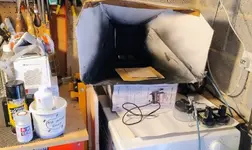
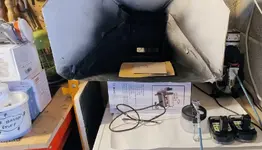
Respirator, booth extractor, compressor, airbrush, paint, thinner. You're all set, no one is watching or judging, so get airbrushing. The sooner you play, the sooner you start to learn.
 
That link you gave to the AB was interesting to watch .
When you get your first spatter, or nothing coming out don't panic when using acrylics. Tip dry is a term you will hear mentioned countless times.
Good luck and take your time, remember we all started with zero experience.
 
Every paint brand has its own ab cleaner
I like a rattle can ab cleaner that hobby craft sells.... Forget the brand..... I always keep a can on the bench cos I even use it to clean normal hairy brushes

One word of warning...... You see lots of people coming up with 'alternative' cleaning solutions...... In other words cheap...... Don't do it, use a proper cleaner...... One that gets touted a lot is car washer fluid....... Cept the ammonia in it will attack any coating on the metal...... I did it when I was learning and ruined a couple of cheapo ab before I realised

Same with thinning agents for paint..... Why mess about trying to find something cheap when the brand you are using have done all the r&d to come up with the right stuff?

Why spend a fortune on gear then try to save pennies by skimping on what you put through it?
 
A couple of things that I think are important, but haven't seen mentioned yet.

Start the paint flow away from the piece you are painting and do the same when stopping.
This avoids any wet spattering which usually happens at these times.
Also keep the airbrush moving, stopping mid spray can again cause unwanted effects.

Not so sure about the back flushing to mix or clean.
If the needle seal is in any way defective paint will go back up the body where you don't want it.
 
Thread owner
Not so sure about the back flushing to mix or clean.
If the needle seal is in any way defective paint will go back up the body where you don't want it.
I've seen the back flushing being used on a couple of vids now, I think as its only done with the air flow on, so in theory that stops any paint going any further back than the bowl? I do think its a more "advanced" technique anyway, so prolly will not be trying it for now.... :)
 
Thread owner
Start the paint flow away from the piece you are painting and do the same when stopping.
This avoids any wet spattering which usually happens at these times.
Also keep the airbrush moving, stopping mid spray can again cause unwanted effects.
Yep, good advice, I've seen that mentioned in a few of the vids that I've watched, theres a lot to learn, Lol! :)
 
I've seen the back flushing being used on a couple of vids now, I think as its only done with the air flow on, so in theory that stops any paint going any further back than the bowl? I do think its a more "advanced" technique anyway, so prolly will not be trying it for now.... :)
I use it occasionally, usually to clear blockages when using acrylics….
 
Yep, good advice, I've seen that mentioned in a few of the vids that I've watched, theres a lot to learn, Lol! :)
Air on first and off last should eliminate this. It’s useful if you are just using the device as a spray gun, but not if you are using it as a brush. Advanced techniques like Weathering streaks or WW2 German mottle camo etc require you to start on the workpiece so this isn’t feasible.
 
Back
Top