Theme editor

Scale Model Shop

Using CA accelerator

Thanks Paul. I have had a bit of a read around about CA accelerators and am going to try Tamiya X-20A thinners. Accelerator seems to be mostly water with acetone as a fast dryer and deacidifier. X-20A is Isopropyl alcohol in water so may well do the same job.....albeit slightly slower.

i bought a can in Boyes for about a fiver.......the way i use it i think it will still have some in by the time i shuffle off this mortal coil lol....seriously, cant see me buying another can for years!!
 
I’m sure you’re right Paul, but I haven’t got any, and have some x-20 on the shelf doing nothing. Might as well see if it works before shelling out :tongue-out3:
 
Ex-chemist here!

Anything alkaline will work as an accelerator. The easiest to make at home is a solution of baking soda/bicarbonate of soda (depending where you live) in water. A teaspoon of bicarbonate in 1/2 a cup of water is about right. You need a solution with a pH>7 and baking soda will give a pH of about 9, completely safe but sufficiently alkaline.

Some of the commercial accelerators are acetone based, the acetone evaporates to leave the accelerant to react with the CA. Many used to (maybe still do?) contain toluidine, which is not nice stuff at all.

Failing all else, water will work, as anyone who has ever got superglue on a moist part of their body or tried to wash it off themselves, the carpet or the neighbour's cat will testify. Even the moisture from your breath, blowing on the glue, will make it go off slightly faster. It's also why your superglue goes off once opened and exposed to moisture in the atmosphere. I keep mine in the 'drinks' fridge to slow the process down.
 
Trialled X-20A today, and it gave a bond after five seconds. Without it, the same materials bonded in about thirty seconds. I tried ABS plastic rod, styrene rod, and wood strip onto both plasticard and foam board. All stuck end on and were able to be left to fully cure without support after five seconds.
The technique used was to add a small drop of CA onto the main piece, then dip the rod/strip in X-20 and shake off the excess. Once the parts are introduced together the bond happened without further assistance.

This will not be as fast as commercial accelerators, but it seems to be a usefuel tool for the armoury......

The science bit....as far as I understand it, haven’t done much real chemistry since I got my degree twenty five years ago LOL....
X-20A is an alcohol solution so is weakly basic. CA polymerases badly in the presence of acid, but needs moisture. A basic (alkaline) solution is useful because the alcohol neutralises any acid species present and the moisture in the solution then starts the polymer reaction. The more basic the accelerant the faster the polymerisation.
 
I have put some spray directly in to a small aluminium container and used that way as Tim suggested.
As mentioned it does evaporate very quickly so only do a very light spray.
I've tried the Baking Soda mentioned by Stona.
Might have not had the mix right, did work but appeared to be slow. After washing it out I out it in one of those finger spray bottles that have beauty products in ( not for me :nerd::smiling3: ) the result being every time I used it there was the smell of the previous product, at least the cave smelt better than TET .
 
Trialled X-20A today, and it gave a bond after five seconds. Without it, the same materials bonded in about thirty seconds. I tried ABS plastic rod, styrene rod, and wood strip onto both plasticard and foam board. All stuck end on and were able to be left to fully cure without support after five seconds.
The technique used was to add a small drop of CA onto the main piece, then dip the rod/strip in X-20 and shake off the excess. Once the parts are introduced together the bond happened without further assistance.

This will not be as fast as commercial accelerators, but it seems to be a usefuel tool for the armoury......

The science bit....as far as I understand it, haven’t done much real chemistry since I got my degree twenty five years ago LOL....
X-20A is an alcohol solution so is weakly basic. CA polymerases badly in the presence of acid, but needs moisture. A basic (alkaline) solution is useful because the alcohol neutralises any acid species present and the moisture in the solution then starts the polymer reaction. The more basic the accelerant the faster the polymerisation.

Interesting Tim, ok if you use some Tamiya paints and have that as well .
Good to know these other uses .
 
To be honest, John, I’ve just huffed on it for many years. It is pretty much as effective....
 
Yes but if It did that I'd end up with the model stuck to my lip :smiling3:
 
Bob. You can get accelerator in pen form.... Just apply the CA to the kit and wipe the piece across the pen tip.

Much more efficient, cheaper and no spray to worry about.

ATB.

Andrew

View media item 9063
View media item 9064
Andrew where did you get that stick. Been using Cyberbond stick for years but they only sell in 50 lots. Mine is running out.

If it is the same as Cyberbond it is a great primer. No smell no reaction. No spray.

Think this is the centre of the matter a primer which you apply to one side & let dry. Cyberbond does not leave a mark. But remarkably acclerates the C/A.

Laurie
 
Andrew where did you get that stick. Been using Cyberbond stick for years but they only sell in 50 lots. Mine is running out.

If it is the same as Cyberbond it is a great primer. No smell no reaction. No spray.

Think this is the centre of the matter a primer which you apply to one side & let dry. Cyberbond does not leave a mark. But remarkably acclerates the C/A.

Laurie
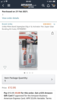
I bought this from Amazon for £12.95
D588FE93-C58F-415D-A58D-56DF1382CB6E.png
 
Thanks Andrew. Have you tested & used it on plastic etc.

Laurie
Hi Laurie, yes.

It's a clear slightly smelly liquid, with the tip working just like a felt tip pen. I normally don't the CA to the model and wipe the part over the pen tip. This is definitely NOT a primer. Just an accelerator.

Hope that helps. Drop me a PM of you want to know more.

Andrew
 
Hi Laurie, yes.

It's a clear slightly smelly liquid, with the tip working just like a felt tip pen. I normally don't the CA to the model and wipe the part over the pen tip. This is definitely NOT a primer. Just an accelerator.

Hope that helps. Drop me a PM of you want to know more.

Andrew

Thanks Andrew. Have you tried it as a primer ?

Laurie
 
Thanks Andrew. Have you tried it as a primer ?

Laurie
Hi Laurie

I don't think there's a way of getting it out of the pen and it certainly doesn't give the impression that it can be used as a primer.

ATB.

Andrew
 
Hi Laurie

I don't think there's a way of getting it out of the pen and it certainly doesn't give the impression that it can be used as a primer.

ATB.

Andrew
With the Cyberbond, Andrew, you apply the primer with felt tip on the end of the pen. Just wondered if you could perform the same trick.

Laurie
 
Back
Top