
Theme editor

Scale Model Shop

Using ca accelerator

BattleshipBob

SMF Supporters
Joined
Apr 28, 2018
Messages
6,894
Reaction score
259
Points
63
Age
65
1/3
Thread owner
Afternoon

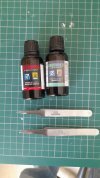
Just had these delivered
View attachment 514416

So used the accelerator for the first time. My god is evaporates immediately, the instructions say leave until dry, so I did but there was just a stain on the practice plastic!!. So my brain wave to put some into a empty tablet blister pack so I could apply with a small brush went down the pan lol.

Is this normal Chaps, found the brush in the bottle cap is quite big and had to get a lot off it first, or do you apply a lot!!

Bob
 

Attachments

  • 20240718_151501.jpg
    20240718_151501.jpg
    6.2 KB · Views: 0
I haven't used that exact accelerator Bob but as a rule they don't need to be wet to work, and most are better if they aren't

You apply to the surface, the solvent evaporates and leaves a (normally invisible) film of accelerator behind.
 
Thread owner
I haven't used that exact accelerator Bob but as a rule they don't need to be wet to work, and most are better if they aren't

You apply to the surface, the solvent evaporates and leaves a (normally invisible) film of accelerator behind.
Thanks Andy, more practice needed by the sound of it,!

I assume paint covers the residue? It does not need lightly sanding!
 
I've never had an issue painting over the residue. I'm not sure of the exact chemical that gets left behind, but as long as you don't use gallons of accelerator there's usually nothing noticeable left on the surface once the solvent (often acetone) has evaporated.
 
Thread owner
I've never had an issue painting over the residue. I'm not sure of the exact chemical that gets left behind, but as long as you don't use gallons of accelerator there's usually nothing noticeable left on the surface once the solvent (often acetone) has evaporated.
Thanks again Andy
 
HI Bob matey yes i use the acellerator in a big spray tin very soon sets the c/a off in seconds an then goes an yes you can paint over it an ive used it for a few yrs very good but wear a mask when usein as its not good to breathe in
chrisb
 
Just had a read up on accelerators and am quite surprised by how simple they are. Basically they are just a dilute baking soda solution dispersed in acetone. CA has traces of acid in the formula, which slows the glue setting reaction. The baking soda neutralises the traces of acid in the CA, which then causes the glue to set very quickly. If you are worried about residue then a quick rinse in water should remove it. More info here…

https://www.hotmelt.com/blogs/blog/...uper glue) is,trace of organic sulfonic acid.

The debonder is very useful, I can see this work flow in your future….. Accelerator on one surface. Glue on another. Bring them together, then spray with debonder when you find the part is in the wrong place ;)
 
Bring them together, then spray with debonder when you find the part is in the wrong place ;)
There lies the difficulty. CA has a very short time for adjustments normally but with accelerator positioning has to be perfect first time.
 
Thread owner
Just had a read up on accelerators and am quite surprised by how simple they are. Basically they are just a dilute baking soda solution dispersed in acetone. CA has traces of acid in the formula, which slows the glue setting reaction. The baking soda neutralises the traces of acid in the CA, which then causes the glue to set very quickly. If you are worried about residue then a quick rinse in water should remove it. More info here…

https://www.hotmelt.com/blogs/blog/...uper glue) is,trace of organic sulfonic acid.

The debonder is very useful, I can see this work flow in your future….. Accelerator on one surface. Glue on another. Bring them together, then spray with debonder when you find the part is in the wrong place ;)
Ah can see coming lol
 
Thread owner
There lies the difficulty. CA has a very short time for adjustments normally but with accelerator positioning has to be perfect first time.
Very true Jim, main use will be railings, especially the long runs. More practice needed
 
Best way to tackle railings is fix one end, then the other and then make the bit in the middle follow the path. Most often I would fit rails after painting making accelerator redundant. Any misplaced CA gets painted again.
 
Was great fun NOT trying to use this when doing coving on a kitchen . Standing on a stool with the short return sprayed with the accelerator and gluing it on to a long length already screwed . down .
 
Tried the accellerator once, and yes it worked, and no it did not... It worked in that it accelerates the bond, but oh! the joy of trying to debond, totally destroyed the part and left residue on the job.
So that was my first and last episode, it is just a fad to use the accelerator, if you use 5 sec c/a then in reality by the time you reach for and get ready to apply the acceleator the 5sec c/a is already dry.
I usually buy 5sec and 20sec c/a, then mix about a 50/50 mix of them to each bottle (remember I still have the empty one already in use, so three bottles) and I find this mix gives me time to apply the part and to alter its position before it settles.
 
Good luck with this one Bob ,to be honest I've yet to find a product that works as per tin or YouTube demo you have to sort your own best way so as you say practice practice practice ,like Mike I use a five and fifteen/twenty sec bonding ca the latter giving you a lifetime of wriggle room ,the best/good idea ca ive seen is the black stuff from mig at least you can clearly see where your putting it although not sure it warrants the price , question for thoes that will know night-shift (YouTube) uses the black stuff then cleans up excess with debonder how come what he's stuck doesn't come unstuck. As I said good luck Bob im sure your find your own little routine with the stuff. Dave
 
Good luck with this one Bob ,to be honest I've yet to find a product that works as per tin or YouTube demo you have to sort your own best way so as you say practice practice practice ,like Mike I use a five and fifteen/twenty sec bonding ca the latter giving you a lifetime of wriggle room ,the best/good idea ca ive seen is the black stuff from mig at least you can clearly see where your putting it although not sure it warrants the price , question for thoes that will know night-shift (YouTube) uses the black stuff then cleans up excess with debonder how come what he's stuck doesn't come unstuck. As I said good luck Bob im sure your find your own little routine with the stuff. Dave
Martin can cut the video and go back as many times as he wants :tears-of-joy:
Seriously he has a steadier hand than me, and I think he uses the VMS debonder which I have yet to try out. For a quick clean up I keep a bit of tiolet paper next to the job and run the edge of it next to the part, this sucks up any spare c/a.
 
Back
Top