Theme editor

Scale Model Shop

Does it take time or talent?

As more of a traditional artist/painter I tend to spend much of my time working in 2 dimensions. However I do enjoy sculpting and painting figures in small scale and have learned a lot about techniques along the way. I think there are a number of issues that make a successful paint job and they can all be learned (as Tim pointed out) by anyone who has the interest to persist at it. I also teach figure drawing and portraiture, two skills that most people would consider "hard", however I have seen many regular folks become very competent artists by a little technique and a lot of perseverance. Here are some areas that I would suggest that you concentrate on

1. Accuracy of paint application. Nothing detracts from the appearance of painted figures more than colours that "go outside the lines". If you are painting belts or strapping etc etc, be sure to make your lines straight, and with no paint spreading over the surrounding features. Some decent brushes will help to achieve this.

2. Learn a few basics about colour theory and the way in which your chosen paints mix. Don't just shade with black, look at how colours can be made more interesting by mixing their complementary colours into shadows. Also learn to identify warm and cool colours and how they work together. Colours have three properties, VALUE, CHROMA, and HUE. Hue is the most obvious being simply is it red, blue or green etc. Value is the darkness or lightness of a colour, in other words what would it look like if you photographed it in black and white only. Finally Chroma is the intensity of the colour, in other words is it a brilliant glaring colour or is it a greyed down version of the colour.

3. Finally look and look again at real people to see how many colours, nuances and lighting variations you can see. Remember the effect of scale. Most models are anything from 1/72 to 1/6 the size of real people so you will be obliged to exaggerate colours and shadows in a scale figure in order to give it any realism.

If you choose to use Acrylic, acrylic gouache, Gouache, Enamels, Oils or Alkyd Oils really doesn't matter. I use them all and, not my efforts, but I have seen great results with all of them. Having said that I would suggest you start with acrylics since they dry fast, are not expensive, and can be found anywhere (check out your local art stores as well as model suppliers). Finally make sure you find a good MATTE varnish (I suggest artist's matte spray varnish) since nothing looks more false on a figure model than shiny cloth trousers or jackets.

John
 
As more of a traditional artist/painter I tend to spend much of my time working in 2 dimensions. However I do enjoy sculpting and painting figures in small scale and have learned a lot about techniques along the way. I think there are a number of issues that make a successful paint job and they can all be learned (as Tim pointed out) by anyone who has the interest to persist at it. I also teach figure drawing and portraiture, two skills that most people would consider "hard", however I have seen many regular folks become very competent artists by a little technique and a lot of perseverance. Here are some areas that I would suggest that you concentrate on

1. Accuracy of paint application. Nothing detracts from the appearance of painted figures more than colours that "go outside the lines". If you are painting belts or strapping etc etc, be sure to make your lines straight, and with no paint spreading over the surrounding features. Some decent brushes will help to achieve this.

2. Learn a few basics about colour theory and the way in which your chosen paints mix. Don't just shade with black, look at how colours can be made more interesting by mixing their complementary colours into shadows. Also learn to identify warm and cool colours and how they work together. Colours have three properties, VALUE, CHROMA, and HUE. Hue is the most obvious being simply is it red, blue or green etc. Value is the darkness or lightness of a colour, in other words what would it look like if you photographed it in black and white only. Finally Chroma is the intensity of the colour, in other words is it a brilliant glaring colour or is it a greyed down version of the colour.

3. Finally look and look again at real people to see how many colours, nuances and lighting variations you can see. Remember the effect of scale. Most models are anything from 1/72 to 1/6 the size of real people so you will be obliged to exaggerate colours and shadows in a scale figure in order to give it any realism.

If you choose to use Acrylic, acrylic gouache, Gouache, Enamels, Oils or Alkyd Oils really doesn't matter. I use them all and, not my efforts, but I have seen great results with all of them. Having said that I would suggest you start with acrylics since they dry fast, are not expensive, and can be found anywhere (check out your local art stores as well as model suppliers). Finally make sure you find a good MATTE varnish (I suggest artist's matte spray varnish) since nothing looks more false on a figure model than shiny cloth trousers or jackets.

John
Regarding point one John, the other part is that there is no rule saying you can’t go back over a colour to tidy up a line…I do it all the time. Just use the colour you’ve gone over to cut the line back to size. That is one place where acrylics score over everything else. They dry very quickly , and when they are dry they are dry so there is no bleed through of the underlying colour. A wet palette helps as well, because you usually still have some of the original colour available for the touch in.
 
Thread owner
Cheers I will have a look.
Let us know what you think, Scottie.

Hi Steve, thanks for those links to the Bannerman content.

I've thought about switching to oils for a while now. I'm not ready to do that yet, as I am still learning and enjoying using acrylics, and find it hard to accept that my investment in acrylic paints, and all the stuff that goes with them, would be largely redundant. (Worth saying that the skills I've developed in using acrylics would certainly not become redundant!)

I've had a read through some of those Bannerman tutorials and, excellent as they are, can I say they're rather showing their age? I think if he was trying to impart the same knowledge today he'd probably use something like YouTube. That's certainly where I've learned most of my acrylic painting techniques.

I've just watched an excellent video on miniature painting with oils by Marco Frisoni, and I wondered what you would make of it - would you mind if I posted a link to it here on this thread?
No worries, Paul, this is for all of us, so please post any helpful links whether acrylic or oils. The key here is the info gets passed along to others. Ya, those articles are pretty dated, but the intel is still useful for someone starting out to get the basic jist of the process.

IMHO, keep at the acrylics and slowly work in the oils. You'll be able to parse the two whenever you need to. If you've learned both medium sets it should be no issue, but a plus. Your acrylic inventory would never become redundant, you'll always be using them and the beauty of oils, which I neglected to mention earlier, is a tube can last almost a life time, almost. Once you've got a decent basic set of colors you can make whatever tone is required on your palette.


As more of a traditional artist/painter I tend to spend much of my time working in 2 dimensions. However I do enjoy sculpting and painting figures in small scale and have learned a lot about techniques along the way. I think there are a number of issues that make a successful paint job and they can all be learned (as Tim pointed out) by anyone who has the interest to persist at it. I also teach figure drawing and portraiture, two skills that most people would consider "hard", however I have seen many regular folks become very competent artists by a little technique and a lot of perseverance. Here are some areas that I would suggest that you concentrate on

1. Accuracy of paint application. Nothing detracts from the appearance of painted figures more than colours that "go outside the lines". If you are painting belts or strapping etc etc, be sure to make your lines straight, and with no paint spreading over the surrounding features. Some decent brushes will help to achieve this.

2. Learn a few basics about colour theory and the way in which your chosen paints mix. Don't just shade with black, look at how colours can be made more interesting by mixing their complementary colours into shadows. Also learn to identify warm and cool colours and how they work together. Colours have three properties, VALUE, CHROMA, and HUE. Hue is the most obvious being simply is it red, blue or green etc. Value is the darkness or lightness of a colour, in other words what would it look like if you photographed it in black and white only. Finally Chroma is the intensity of the colour, in other words is it a brilliant glaring colour or is it a greyed down version of the colour.

3. Finally look and look again at real people to see how many colours, nuances and lighting variations you can see. Remember the effect of scale. Most models are anything from 1/72 to 1/6 the size of real people so you will be obliged to exaggerate colours and shadows in a scale figure in order to give it any realism.

If you choose to use Acrylic, acrylic gouache, Gouache, Enamels, Oils or Alkyd Oils really doesn't matter. I use them all and, not my efforts, but I have seen great results with all of them. Having said that I would suggest you start with acrylics since they dry fast, are not expensive, and can be found anywhere (check out your local art stores as well as model suppliers). Finally make sure you find a good MATTE varnish (I suggest artist's matte spray varnish) since nothing looks more false on a figure model than shiny cloth trousers or jackets.

John
Well said, John. Painting figures takes time, practice, and a willingness to learn, excellent points. Your comments are spot on, imho.

Not having your experience or background I would respectfully disagree on one point, however, that everyone should start with acrylics. I've never considered the drying time of oils to be an issue personally, and have always expected it, and worked with it. It's the nature of the beast. It should not be a limiting factor for anyone. If you understand the properties of each medium up front you will learn to work with each limitation from the start, acrylics or oils. The frustrations with each medium are equally present and we've heard issues arising from both. Presenting the issues of both leaves it open to whomever it is to make the decision which medium they will choose. Naturally they will learn what is involved in the one they've chosen and carry on from there.

I by far do not have the experience you do,

On a side note, I used to do pencil work myself long ago, I'd love to see some of your work.

______________________________________________________________________

I'll get started and add some links I've found helpful in refining my techniques personally. This is all about oils, so be aware of that.

Daria Callie has a great set of tutorials on oils that I've had great results from personally.

How to paint an eye.
https://www.youtube.com/channel/UCyGgRLbgcXjON9ZS5DaqMOQ Her main page.

I've scoured YT for other oilers and have found some pretty impressive talent to learn from, so there are a lot of helpful vids to work with. Remember, I'm not trying to recruit an oiler army, it's just my personal preference.

Below is a test run I did after studying this pretty little lady's tutorials in oils. It's very basic, but after following her process I was more than impressed at how quickly I got results. She teaches canvas work, but I knew I could use this on any figure, it's the same concept.

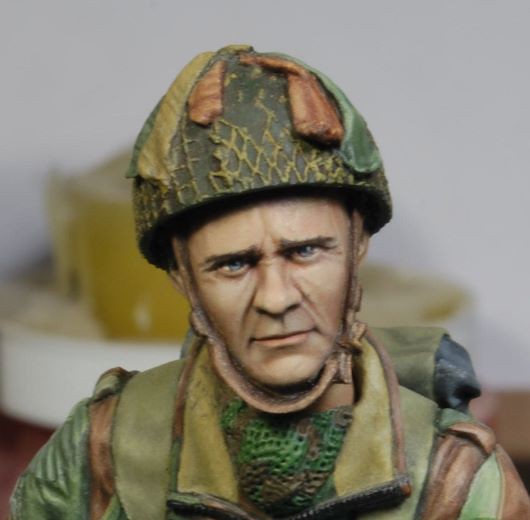
_DSC2643b-vi.jpg


This was the result of working with her process on one of the Arnhem figures. This was by far one of the most realistic faces I have painted up to that time and I'm still pushing for more realism. Not quite there, not by a long shot, but I'm liking what I'm seeing.

_DSC0122c-vi.jpg


Oh, and before I forget, as I did earlier, lol, learning to paint figures is best learned on Large Scale figures. 1/35th scale will only get you so far for really learning in depth, so keep that in mind if you are seriously wanting to get a good handle on this. Using a cheap bust or even 1/16th-120mm or 200mm heads will produce faster results because you will see your mistakes right up front, quickly, and you will address them immediately and learn from them. Keep it simple in the beginning and go large, it will be more enjoyable and you'll be less likely to get discouraged and want to give up. This applies to acrylics just as well as oils.

Lastly, a point to be made in regards to which medium you chose. I believe we've all seen how incredibly well some artists have been able to work acrylics to such realism that you'd be hard pressed to top the results with anything else, even in oils. But we've also seen faces done with oils that are so naturally realistic that they could be judged the same. It all comes down to personal preference and how far you want to take this, and honestly, the sky is the limit.

And if any of the other figure painters have any good links in either preferred medium, please post them for reference.
 
Steve

Your figures look very nice, and I must say that I paint almost exclusively in oils when I am in my studio. For outdoor stuff (plein air) I use gouache since it is more convenient to transport. For figures I use Acrylic as a base then use oils over the top. Incidentally you might want to try ALKYD OILS, since they have all the properties of regular oils but dry in a few hours, when thinned with white spirit etc.

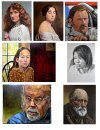
Here's a selection of my 2D works.

Portraits.jpg
John
 
Thread owner
Steve

Your figures look very nice, and I must say that I paint almost exclusively in oils when I am in my studio. For outdoor stuff (plein air) I use gouache since it is more convenient to transport. For figures I use Acrylic as a base then use oils over the top. Incidentally you might want to try ALKYD OILS, since they have all the properties of regular oils but dry in a few hours, when thinned with white spirit etc.

Here's a selection of my 2D works.

View attachment 515618
John
Wow, those a pretty dang awesome, John. I especially like the pencil work. My mother was an oil artist and taught art classes, but only passed on the pencil aspect to me. She had hung up her brushes by the time I came along, lol, being the youngest of six. I do have her original oil paint box from her college days, keeping that in the family. So, here's my brain squeeze, John, I could never transfer color to paper or canvas, and I'm sure you've heard of us. It's that mental hang-up I've never been able to shake, and I've tried. So, since 3D is not a mental issue, I enjoy it as much as I can.

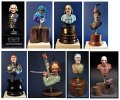
Excellent figure work too, btw, and good to see another oiler, we're becoming fewer and farther between. Your work exemplifies the artistic side of this hobby that transfers to other platforms with ease. Very well rounded I'd say.;)

P.S. I have not tried Alkyd yet, just recently heard about them actually.
 
Ok, thanks Steve, here the video I mentioned. This is by Marco Frisoni. I think he's a trained fine artist, judging by his language in this and other videos of his. (Talking of language, if his flamboyant - and fabulous - Italian inflected English is a little difficult to understand initially, stick with it - he's fully worth the effort). Marco certainly suggests that, far from being slow, painting in oils can actually be very quick indeed. I'd be interested in opinions on this from those of you already using oils.

The truth about oil paints on miniatures
 
Interesting points here Steve, however one thing I do disagree with is that you need to learn on larger scale figures. That is only true if you want to be a figure painter per se. To get effective results from 1/35 and smaller scales you need different techniques to those used on larger scale busts, so you cant learn the required techniques by painting them. You need to know what detail can be omitted and what is essential. You still need to know how to shade in the round and depict folds in clothes etc, but some texture techniques and detail work is simply not required.

A pet hate of mine is wood graining. In small scale models wood grain simply isn’t visible unless it is something extreme like zebra wood, and quickly approaches a cartoonish aspect if painted in.

Another issue I have is with over detailed eyes in smaller scales. On a 200mm bust putting in sclera, pupils, irises, catchlights etc is necessary, but trying to do that on a 1/35 figure is a recipe for madness. All too often the figure ends up looking pop eyed and toy like. Better to get the shape of the eyeball correct and put in a suggestion of the iris.

A very useful exercise is to go around one of the great galleries and really look close up at the way the masters paint things like clothing and armour. Look at them from a distance, and then close up. The economy of effort is very revealing. They only put in what is required to get the effect they need.

A summary through my early morning meanderings here is this, different scales and modelling problems need different approaches! If you are building a dio where a dozen smaller scaled figures are being used as a supporting cast to a multi element scene, full shading and detail work using oil blend techniques over many weeks of work is probably not an effective use of your limited hobby time. On the other hand, if you are building a vignette of just one or two figures that are the sole focus of the piece, then the more detail you can get in the more interesting it will be to look at.
 
A very useful exercise is to go around one of the great galleries and really look close up at the way the masters paint things like clothing and armour. Look at them from a distance, and then close up. The economy of effort is very revealing. They only put in what is required to get the effect they need.
Great point Tim


A summary through my early morning meanderings here is this, different scales and modelling problems need different approaches! If you are building a dio where a dozen smaller scaled figures are being used as a supporting cast to a multi element scene, full shading and detail work using oil blend techniques over many weeks of work is probably not an effective use of your limited hobby time. On the other hand, if you are building a vignette of just one or two figures that are the sole focus of the piece, then the more detail you can get in the more interesting it will be to look at.
I agree to an extent. When I eventually assembled and displayed my French Fusiliers diorama I felt like I had wasted a lot of effort with it because the detail was overshadowed by the whole. But then again, I had enjoyed the process. So therefore it was an effective use of my hobby time. But I'm quite sure that if I had had my work hat on, and especially supervising rather than doing the work myself, I would definitely have been urging restraint on the detail and more efficiency!
I think the answer is, you do whatever you enjoy doing
 
A very useful exercise is to go around one of the great galleries and really look close up at the way the masters paint things like clothing and armour. Look at them from a distance, and then close up. The economy of effort is very revealing. They only put in what is required to get the effect they need.

+1

What strikes me when I do this exercise is how, as viewers, we see what we expect and want to see, not necessarily what is actually there.

Up close, the underlying structure of the artwork can become blatantly obvious and what we thought we were looking at from a distance simply disappears, as we're presented with brushstrokes, paint blobs, scratches and scrapes - the technical nuts and bolts the artist has used to deceive us.

What's odd is that in miniature painting there's often an emphasis on flawless, super-smooth, photo-realistic finishes, when a much more impressionistic approach might be just as impactful, if not more so. ( I may be saying this because I can't actually achieve those flawless finishes myself, admittedly!)

As miniature painters, we know we are tricking the viewers eye (or rather their brain) - that's what NMM and OSL are all about, after all.

So why are we so fearful of leaving an honest brushstroke that, from a normal viewing distance, does the job perfectly well?
 
What's odd is that in miniature painting there's often an emphasis on flawless, super-smooth, photo-realistic finishes, when a much more impressionistic approach might be just as impactful, if not more so. ( I may be saying this because I can't actually achieve those flawless finishes myself, admittedly!)
What is even odder is that the smooth photorealistic finish we aim for is not really photorealistic……..we emphasise shadows to a far greater effect than any photographer would, unless they were after an “artistic “ impressionist shot. A great way to see realistic faces is to pay attention to those on the TV. Everyone watches TV at some time, but none of us really pay detailed attention to what we see. Figures on there are about the same size as our models, but the exaggerated shadows we use are totally absent. It’s like trying to emulate David Baileys portrait approach by using Rembrandts high contrast techniques and world view………personally I prefer the high contrast approach, but am aware it’s artistic impression rather than real world emulation.
 
I love making and converting figures but painting them is, to me, just a necessary evil.
The more I do it the happier I am with the results, so there's no doubt that practice makes perfect (or at least, better).
But I very rarely buy a figure for the 'pleasure' of painting it.
Says the surgeon ;)
 
What is even odder is that the smooth photorealistic finish we aim for is not really photorealistic……..we emphasise shadows to a far greater effect than any photographer would, unless they were after an “artistic “ impressionist shot. A great way to see realistic faces is to pay attention to those on the TV. Everyone watches TV at some time, but none of us really pay detailed attention to what we see. Figures on there are about the same size as our models, but the exaggerated shadows we use are totally absent. It’s like trying to emulate David Baileys portrait approach by using Rembrandts high contrast techniques and world view………personally I prefer the high contrast approach, but am aware it’s artistic impression rather than real world emulation.
That's true - maybe it's Caravaggio we're trying to emulate?
 
Thread owner
Man, I can tell I'm gonna have to stay up late or get up way early to keep up with you guys, sheesh, these are great comments and excellent points. You guys are bringing up a lot of important issues, some that are way past the beginner's stage, and some needed up front at the start. There's a lot here, so I'm going to pull some bullet points if yall don't mind, and expand on a few of them.

Marco certainly suggests that, far from being slow, painting in oils can actually be very quick indeed.
Bingo, excellent find, Paul. This is going to be a deep dive for me, time to study this guy's techniques. His accent is no problem, and thanks for that post! I will definitely let you know what I get out of it shortly.

Interesting points here Steve, however one thing I do disagree with is that you need to learn on larger scale figures. That is only true if you want to be a figure painter per se. To get effective results from 1/35 and smaller scales you need different techniques to those used on larger scale busts, so you cant learn the required techniques by painting them. You need to know what detail can be omitted and what is essential. You still need to know how to shade in the round and depict folds in clothes etc, but some texture techniques and detail work is simply not required.
Very true, Tim, good point, there would be no need for someone to go through all the time to learn just enough to paint decent figures for their dios, I agree. I was speaking towards the person who wants to learn figures in-depth and starting out large will amplify the techniques and processes that they would need to learn and understand. Point being, make it as simple as possible, then work towards the more intricate.

Another issue I have is with over detailed eyes in smaller scales. On a 200mm bust putting in sclera, pupils, irises, catchlights etc is necessary, but trying to do that on a 1/35 figure is a recipe for madness. All too often the figure ends up looking pop eyed and toy like. Better to get the shape of the eyeball correct and put in a suggestion of the iris.
No argument there, Tim, I agree completely. We've all seen it, but I have also seen some who are probably using a neutron microscope to get the pupils and that's not necessary and can be outright frustrating even attempting to do so.

A summary through my early morning meanderings here is this, different scales and modelling problems need different approaches! If you are building a dio where a dozen smaller scaled figures are being used as a supporting cast to a multi element scene, full shading and detail work using oil blend techniques over many weeks of work is probably not an effective use of your limited hobby time. On the other hand, if you are building a vignette of just one or two figures that are the sole focus of the piece, then the more detail you can get in the more interesting it will be to look at.
I would say yes, and no. Different scales do require different approaches and the time involved is great with the number of figs, naturally, but I'm a slow painter anyway, so it's no bother, just a given in the equation. Time invested is just that, regardless of my actual time per day available, imo. How fast are you wanting to put out a dio or vignette might be the question here. There again we're talking about who wants to go full out and learn figures in-depth or just enough to get by to fill their dio.

I agree to an extent. When I eventually assembled and displayed my French Fusiliers diorama I felt like I had wasted a lot of effort with it because the detail was overshadowed by the whole. But then again, I had enjoyed the process. So therefore it was an effective use of my hobby time. But I'm quite sure that if I had had my work hat on, and especially supervising rather than doing the work myself, I would definitely have been urging restraint on the detail and more efficiency!
I think the answer is, you do whatever you enjoy doing
And Neil takes this right to my point. If I'm enjoying what I'm doing, time is not in the equation unless I'm reaching burn out, then it matters. Example, painting 11 tartans. That can drive anybody bonkers and lead one to crawl the walls after the third attempt. Tartan patterns don't come in paint cans, especially in 1/35th scale, UUUGGG! Neil, I'm there man, I'm there;)

A very useful exercise is to go around one of the great galleries and really look close up at the way the masters paint things like clothing and armour. Look at them from a distance, and then close up. The economy of effort is very revealing. They only put in what is required to get the effect they need.
You nailed it, Tim. Learning from the masters is a sure way to understanding this art form. If I had a museum close by, I'd be there myself doing exactly that. Getting someone started in the learning process would benefit greatly from a few trips to see the masters, no doubt. Being a student of your chosen art is the key, imho, spot on, Tim!

As miniature painters, we know we are tricking the viewers eye (or rather their brain) - that's what NMM and OSL are all about, after all.

So why are we so fearful of leaving an honest brushstroke that, from a normal viewing distance, does the job perfectly well?
For me personally, it's an issue I've dealt with all my life, being anal retentive and the constant need to improve. My goal has always been to make my figures get off the base and "walk", so to speak, as I saw when I was in my early teens. That so impressed me, as you can tell it's still with me today. I'd have a hard time leaving anything out of place or undone, or even a brush stroke.

What is even odder is that the smooth photorealistic finish we aim for is not really photorealistic……..we emphasise shadows to a far greater effect than any photographer would, unless they were after an “artistic “ impressionist shot. A great way to see realistic faces is to pay attention to those on the TV. Everyone watches TV at some time, but none of us really pay detailed attention to what we see. Figures on there are about the same size as our models, but the exaggerated shadows we use are totally absent. It’s like trying to emulate David Baileys portrait approach by using Rembrandts high contrast techniques and world view………personally I prefer the high contrast approach, but am aware it’s artistic impression rather than real world emulation.
This is pointing to what I mentioned a while back, if I'm reading this correctly, concerning the overexaggerated results we often see from some acrylic presentations almost to the point of cartoon or commercial artistry. I know a lot of painters love this approach, but that's not life as we actually see it, I agree. I prefer to work towards a natural life like appearance.

Here are two examples from Planetfigure.com of two different artists, one using oils, the other acrylics. Both of these guys are at the top of their game and an inspiration for me personally. It's obvious to me if you are determined, the medium is just a tool, nothing more.
https://www.planetfigure.com/thread...the-russian-85th-vyborg-infantry-1908.468474/ David, call sign: MENTAL DENTAL
https://www.planetfigure.com/threads/mikes-28th-maori-bn-sgt-finished.55883/ Mike_the_Kiwi, Butler
 
I seem to remember Mike Butler posting in this site occasionally. He was a friend of Andy Belsey, who used to post a lot but seems to have drifted away now. Pity because his WW1 stuff was superb.
 
Thread owner
Those two figures are just incredible, aren't they?!
Crazy, ain't it? I feel like a Candy Striper next to those two, sheesh!

I seem to remember Mike Butler posting in this site occasionally. He was a friend of Andy Belsey, who used to post a lot but seems to have drifted away now. Pity because his WW1 stuff was superb.
Yep, both drop in at Planetfigure from time to time. That WWI museum work they did together a while ago was incredible.
 
Crazy, ain't it? I feel like a Candy Striper next to those two, sheesh!


Yep, both drop in at Planetfigure from time to time. That WWI museum work they did together a while ago was incredible.
Actually I meant scale model forum, not PF Steve ;) The WW1 stuff was blogged on here (and previously on the now defunct Military Modelling site) as it was built by Andy.
 
Thread owner
Actually I meant scale model forum, not PF Steve ;) The WW1 stuff was blogged on here (and previously on the now defunct Military Modelling site) as it was built by Andy.
Roger that, Tim, but they post on PF as well, so they do get around. https://www.planetfigure.com/threads/trench-sections.116564/ Besides, who could ever forget the clothes pinned face?:tears-of-joy:

Paul, I'm still digging into Marco's vids. He's got some useful techniques and helpful hints. If he's now making a living painting figs on YT, he's doing something right, so this is worth more study.

P.S. Marco is also using additives to speed or slow the drying time, which I do not do. I only use plain old paint thinner, been doing that for years and years.
 
Back
Top