Theme editor

Scale Model Shop

Drilling a vertical hole

PaulinKendal

SMF Supporters
Joined
Jul 13, 2021
Messages
1,729
Reaction score
266
Points
83
1/3
Thread owner
Here's a nice varnished Scale75 base for a bust I'm painting.
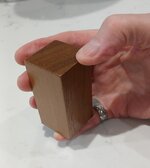
20260117_114828.jpg I need to drill a hole for a 4mm rod to support the bust, and if it isn't perfectly centred and vertical, it'll look horrible.

I don't have a pillar drill (the obvious solution) so I'm looking for an alternative method. Centring the hole shouldn't be an issue, and I guess I could just eyeball it to get it vertical, but it only has to be a little bit out to look really naff.

Probably the 'right' answer is to use a pillar drill! I have got a Dremel, so perhaps their pillar stand is worth getting. Any other ideas?
 
Thread owner
P.S. what I've done with previous bases is to drill a relatively shallow 1.5mm pilot hole. Then, if it's not quite right, finagled it with the next size up drill bit, before drilling the final hole with a 4mm bit. Not pretty, but it sort of works.
 
I suggest you drill a 4mm hole in the centre a piece of something thin, the same size as the plinth , then figure out a way of fixing it ,say, 20mm above or away from the block itself. With the centre marked on the block the two should line up vertically.
You could do it on its side as well, which might be easier to control...,
It's just a theory, I have no idea if it will work, maybe do a test on something else first?
I would still do the pilot hole to be sure of getting the drill not to stray
 
A pillar drill will, of course, make this much easier. However, if you just use a set square or tri square to visually check the hole is being drilled vertically as you drill it. That should keep your hole at the correct angle. In fact, even if the hole is slightly off, then if you glue the rod in securely you can tweak it back to true once it’s installed by bending it where the rod joins the wood block.
 
Thread owner
I am tempted to get a Dremel pillar drill accessory (they call it a workstation), for about £50. Dremels are not very powerful, so I'll need to make repeated passes, with increasing bit sizes, to get the hole I need.

I'm just a bit wary, as Dremels are pretty lightweight, and I guess the 'workstation' is a bit flimsy too.
 
A 4mm drill will easily fit in a household cordless drill. Why not use a dremel for the initial hole, then open it up using a cordless…. I’ve only done a couple of these, but when I have I simply use a pin vice. It’s easier to keep upright as well. The wood really isn’t that tough to drill end grain on. Never really got on with a dremel type drill myself. I haven’t taken mine out of the box for at last ten years….
 
Is the wood quite reflective? If so you can line up the reflection of your drill bit with the bit itself and you know it'll be perfectly straight.

Similar to the old carpenters trick of lining up the reflection of the timber in your hand saw blade. Perfectly square cuts every time with no marking needed.
 
Funny enough ive been looking to buy a cheap one but i dont want it for drilling, want to see how good a job it does with a polishing mop

Mine was quite good for that, but can be a bit fast. They are good at cutting hardened steel stock (wagon axles etc) using a carborundum cut off wheel on a mandrel as well. Not so good at drilling though. It’s a great way to break fine drills, especially in white metal, and if you drill plastic they can generate loads of cotton wool like swarf and melted workpieces 😁
 
Ive seen some with multi speed settings so im wondering how slow they will go

For drilling plastic id rather use a pin vice any way for better control...... Even with bike discs with 80 holes each lol..... I keep telling myself its theraputic lol
 
Ive seen some with multi speed settings so im wondering how slow they will go

For drilling plastic id rather use a pin vice any way for better control...... Even with bike discs with 80 holes each lol..... I keep telling myself its theraputic lol

Mine was/is single speed, so I used a railway transformer to turn it down. At low speeds the torque is lost and it’s not that useful. Modern ones may be much better though….. Personally I prefer a pin vice as well Paul, for exactly the same reasons…..the collet chucks are far better at centring the drill bits as well….
 
Thread owner
Mine has 15 speed settings, Paul, but as Tim says, at low speeds it lacks clout. I've found my Dremel much less useful than I thought it might be, although it does have its uses. The vast array of accessories for it makes you think it can do an awful lot more than it really can, IME.
 
Thread owner
So much useful advice! Andy T 's suggestion of using the reflection of the varnished wood is genius!

​​​​Buildernator 's suggestion is also clever, but would be difficult to set up accurately on such a small piece of wood.

I'd agree that Dremels are not great for drilling, and I frequently snap fine drill bits in my pin vice, so I'm sure I'd destroy them in a Dremel.

Bottom line: a proper pillar drill (not the Dremel jobby) is the best solution, but a good quality is a lot of money and takes up a lot of space.

I think I'll go with: drill pilot hole with pin vice, then open it up with pin vice as far as I can, resorting to a cordless drill only if necessary. I'm using hollow aluminium 4mm tubing, so it should allow for a bit of judicious tweaking if it's not quite straight. Wish me luck!
 
Thread owner
I've bought bases from one-man outfits in the past, and they are usually happy to drill a hole if asked, which is the best solution, if I'm honest. But they come and go, and quality and price varies a fair bit.

I'm moving to Norwich later this year, and I'm pretty sure I'll be able to find a hobby woodworker there who'll make them for me at a sensible price.
 
Back
Top