Theme editor

Scale Model Shop

Masking

The Smythe Meister

Well-known member
Joined
Jan 30, 2019
Messages
6,281
Reaction score
79
Points
48
Age
60
Location
Devon, England
1/3
Thread owner
Mornin',
Up until now I've used Tamiya tape to mask my builds with, generally,half decent results.But that's only been on AFVs,so, fairly basic stuff ;)
However,I'm not relishing the idea of trying to cut bits for aircraft/my helicopter.
So I'm considering trying "liquid mask",......
Is there a particular brand that stands out,or,is it even a good solution?
Your thoughts,as always,would be much appreciated :)
Cheers,
Andy
 
Not tried it much, not for ages, and only ever tried Humbrol Maskol myself. I found it a bit fiddly to remove, and it didn’t like acrylic paint, trying to strip the finish. I’m sure more modern types are better though.
 
I still use Tamiya tape to mask the edges and would use the liquid mask to cover the rest of the area. I find it not easy to cut liquid mask even with the sharpest blades. Brushing them on edges would be the same as hand painting the frame so bits and pieces of thinly straight cut Tamiya tape is still best for me for compound curves. You could get after market pre-cut masks if they have one for your particular kit.

Cheers,
Richard
 
Thread owner
Cheers Tim:thumb2:,
ALL comments are good..... helps give an overall picture of things;),
Andy
 
Thread owner
I still use Tamiya tape to mask the edges and would use the liquid mask to cover the rest of the area. I find it not easy to cut liquid mask even with the sharpest blades. Brushing them on edges would be the same as hand painting the frame so bits and pieces of thinly straight cut Tamiya tape is still best for me for compound curves. You could get after market pre-cut masks if they have one for your particular kit.

Cheers,
Richard
Thanks Richard,
Food for thought there:thumb2:..... After market pre cuts aren`t something i`d thought about,interesting............ ;)
Andy
 
Barry uses them a lot, he'd be the go to to ask about them, Andy.

Cheers,
Richard
 
Liquid mask is not very precise. Its like water so will flow where you dont want it too, like behind glass panels etc. Putty is the next option but looses its shape if you take too long and can leave residue over the model. Tamiya tape, AM masks, Stencils and freehand airbrush are your best bets I'm afraid. What ever you decide masking is a real pain in arse. To help with splash marks, over spray etc cover you model in a couple of coats of hairspray before masking. Therefore once you have finished the camo pattern you can easily remove any mistakes with water and a brush
 
Thread owner
Liquid mask is not very precise. Its like water so will flow where you dont want it too, like behind glass panels etc. Putty is the next option but looses its shape if you take too long and can leave residue over the model. Tamiya tape, AM masks, Stencils and freehand airbrush are your best bets I'm afraid. What ever you decide masking is a real pain in arse. To help with splash marks, over spray etc cover you model in a couple of coats of hairspray before masking. Therefore once you have finished the camo pattern you can easily remove any mistakes with water and a brush
Thanks muchly Steve :)
Some excellent advice there,(I especially love the one about using the hairspray... I wouldn't have thought of that mate !)
Cheers,
Andy
 
Liquid mask is in my opinion a waste of time and effort.
If it is canopy masking that worries you. A good shape pointed blade is the way to go.
I tend to cover the whole canopy then run a cocktail stick cut off at an angle to get the tape into the edge of the "frame" then run the scalpel carefully round in the same corner. Job done.
Very round 'bubble' type canopies I do the tape part one side and then the other. A good trick is once you have the tape sat in place along the bottom, which is normally quite straight. Slit the tape 2/3 top to bottom. Lay the one part down then the other. Gets it nice and flat.
Personally I find it a lot easier to mask an aircraft up than a tank!
I do like that hair spray trick from Steve. Have seen others use chipping fluid but Steves idea is cheaper! It also means you can do a bit of chipping along the way! bonus.
 
Thread owner
Thanks Ian...
.... There was me worrying about cutting tiny little shapes of tape to fit inside the canopy frames.... Your method is superb :)
Totally agree about Steve's hairspray idea.... Great innit ?!!!
 
Totally agree about Steve's hairspray idea.... Great innit ?!!!
I saw Matin on YouTube "the night shift" He does it always when painting camo. He hates masking so base colour, chipping fluid, camo colour then cleans up the edges and errors afterward.
Never thought of doing it with hair spray though. Much cheaper that way!
 
I suspect Ian means a good sharp blade.
Once a teacher..... lol
Sorry Sir.
I will try to improve my spelling.
 
For aircraft camouflage it depends whether you want a hard or soft edge (taking scale into consideration).

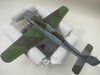
A picture is worth a thousand words, so here is a hard and straight edged camouflage, on the wing of a German aircraft. It's easily masked by cutting tape, all you need is a good straight edge and a sharp knife.

straight_hard.jpg

You can get a similar result for more curvy camouflage by masking with Blutack and tape.

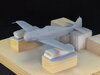
Blutack over Ocean Grey:

IMG_1723.JPG

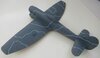
Grey masked with tape and Dark Green sprayed (you don't need to be terribly precise!):

IMG_1724.JPG

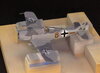
And the result (actually showing the need to touch up after spraying code and serial letters):

IMG_1746.JPG

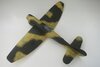
For some you will have to spray freehand, a lot of Luftwaffe and Italian camouflage was quite loosely sprayed.

IMG_0951.JPG

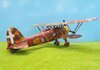
This Italian CR.42 took bloody hours, but there really is no way I could think of to mask the three colours and get anything like a realistic result!

SRQ.jpg

Hope that gives some food for thought.

BTW, for canopies I'm a tape and sharp scalpel guy, like Ian. The only exception would be some really complicated larger scale glass houses (like a Lancaster or He 111) where an investment in pre-cut masks can save your sanity.
 
Once a teacher..... lol
Sorry Sir.
I will try to improve my spelling.

Don't worry Ian. I still gave you 9/10 and a silver star!
 
Hi Andy
I wouldn't discount masking fluid. A couple of points though. First it must be the proper stuff, not stuff bought cheaply in art shops. I use Mr Hobby - Mr Masking Sol R. Secondly don't try to paint it on with a brush. Use a pointed cocktail stick and put a small blob of the fluid in the centre of the area and then using the pointy stick push the fluid to the edges and into corners. Allow it to go on at a reasonable thickness. To remove after painting don't try to remove from an edge. Use a pin or the point of a scalpel to make a hole in the mask and then you can hold with tweezers and pull off. Any stubborn bits can be removed with a cocktail stick.
This canopy was masked off with Mr Masking Sol R
P1060865.JPG

P1060871.JPG

Jim
 
Back
Top