Theme editor

Scale Model Shop

Mediums for mud

  • Thread starter Thread starter Guest
  • Start date Start date
Status
Not open for further replies.
G

Guest

Guest
Thread owner
Hey,

I know we like to use pigments to create wet/dry mud but do you guys use any other method of doing this? I was thinking about using flour mixed with glue and then painting it the desired color when dry. What do you guys think about this?

Thanks
 
Why not add your paint in when you mix the flour and glue? That way, you won't have to paint it afterwards and you'll avoid any white spots showing if pieces break away.

Or you could always use real mud from your garden ......
 
Thread owner
Your right I should just add the paint as I apply it
 
One of the best dirt or dust I use is from corners of parking lots. Don't need to mix in any colours in and used as natural. I find sand too coarse and prefer sometimes to grind pieces of clay or dried mud into powder form.
The powders that I grind then are mixed with white glue into a paste and then applied to the kit.

I do my own stones. Broken slate simulate very nice flat stones. I use soft broken red brick for worn stones by rubbing them between sand paper and then soaking them in water and sift.

Cheers,
Richard
 
Thread owner
I like acrylic gel medium, which is sold in tubes in art stores. It comes out as a thick white glue-like substance that you can apply with a spatula or a brush or similar tools, and dries a sort of transparent white; you can mix acrylic paint into it if you put it onto a palette first. It’s available in different thicknesses (I find everything other than “thick” to be too thin for modelling, though), and there are also structured types that have a sand-like appearance instead of smooth.
 
Hi Steven, I wouldn’t use flour....in damp conditions it will start to grow and you will get out of scale mould. For this sort of effect I would start with silver sand or pumice powder. Both are inert and will stay as you make them. That, in conjunction with Jakko’s acrylic gel, and pre tinting with paint, will probably give you something like the commercially available pastes.
 
Thread owner
I've just had successful results with exterior Polyfiller. The "Ils ne passe pas!" thread has a summary description.
 
Thread owner
I'm planning on using proper real genuine mud. It worked years ago on a Tamiya motocross bike I built. It was small scale so perhaps detail was less important, but I was chuffed with the result.
I seem to remember flicking it on with a brush to imitate wheel rotation & mud splatter on to the engine & body work. The engine & exhaust splatter I left dry, the rest of it I touched over with varnish to make it appear still wet.
I've discovered loads of imitation 'effects' that can be bought...but I'm determined to give this another try on my Panzer IV...which I've yet to start...having found some goodies in John's shop :smiling3:
 
Thread owner
I’ve read of people microwaving dirt from the garden that they intend to use on models or dioramas, to make sure nothing microscopic in it remains alive to possibly cause trouble later on.
 
Thread owner
I’ve read of people microwaving dirt from the garden that they intend to use on models or dioramas, to make sure nothing microscopic in it remains alive to possibly cause trouble later on.
Oooo...good tip. I'm not sure microwaves existed when I tried this last :smiling:
 
i used to have a youtube vid saved where this guy used real mud......dries it out in an oven on low heat...picks out all the twigs, stones etc,,....and mixes it with something that i cant remember before splodging it on
 
George,
I use dirt from the garden, as said previously microwave it to kill any thing in it. Then I let it dry completely. when dry sieve it to remove larger items. But keep them in a separate pot. when you have nothing but fine dust add this to a separate pot. any very small bits of vegetation I keep as well. Next make a slurry with the earth, dry filler and white glue, don't make it to wet then apply to the base let it dry for a while then lay some cling film over it and press the vehicle into it and using spare pieces of track or wheels press these in as well this should give you a good simulation of traffic and stop your vehicle sitting on top.
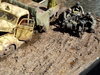
here is an example of mud I created a while ago. HTH.
View attachment 316158
 

Attachments

  • DSCF1062.JPG
    DSCF1062.JPG
    4.2 KB · Views: 0


pretty certain this is not the vid i was thinking of even those it was in my faves
 
Thread owner
George,
I use dirt from the garden, as said previously microwave it to kill any thing in it. Then I let it dry completely. when dry sieve it to remove larger items. But keep them in a separate pot. when you have nothing but fine dust add this to a separate pot. any very small bits of vegetation I keep as well. Next make a slurry with the earth, dry filler and white glue, don't make it to wet then apply to the base let it dry for a while then lay some cling film over it and press the vehicle into it and using spare pieces of track or wheels press these in as well this should give you a good simulation of traffic and stop your vehicle sitting on top.
here is an example of mud I created a while ago. HTH.
View attachment 316158
Paul.
Hope George follows your advice on this, I remember this well, it was a truely stunning build. Certainly shows what can be acheived.
John.
 
Status
Not open for further replies.
Back
Top