Hi, can anyone tell me if I need to be aware of anything regarding soldering. My big locomotive, which consists of all materials, needs some soldering during the build and then some painting, I'm assuming prime then paint, but want to check this is right before I do it. It's going to be a big old thing, 49cm but looks interesting learning new skills as its metal and wood plus some obligatory plastic. Here's hoping I can do it justice.


You are using an out of date browser. It may not display this or other websites correctly.
You should upgrade or use an alternative browser.
You should upgrade or use an alternative browser.
Soldering
- Thread starter Bortig the Viking
- Start date
Thanks for that.Be very aware of the fumes. They really are not good for you. Cannot remember the exact gas but suffice to say that a mask and ventilation is needed
Thanks for that.I'm surd there areguys who can help you. for me, soldering is a dark art I have never mastered. good luck.
peter
G
Guest
Guest
Just been watching James May reassemble a portable record player. He says you need three hands to solder properly.

... and don't burn yourself 
I used to solder a lot of electronics, I blew very subtle when adding solder to avoid being with my head into the fumes.
And don't 'move' things the first seconds when the solder is cooling down, that gives a 'matt' finish (means less strong connection)
Goodluck :thumb2:
I used to solder a lot of electronics, I blew very subtle when adding solder to avoid being with my head into the fumes.
And don't 'move' things the first seconds when the solder is cooling down, that gives a 'matt' finish (means less strong connection)
Goodluck :thumb2:

Mark, what are you soldering? Soft soldering or silver soldering? I assume soft soldering, using a tin-based solder - it used to be about 60%tin, 40% lead, but now lead is known to be dangerous there are other metals used to replace it now.
The first thing is that the surfaces to be joined must be clean bright metal, no fingerprints or grease. Second, remember that the workpiece should melt the solder, don't just blob the solder on with the iron. Ideally you want the pieces to be held together before you solder them - this might be by taping them to a tile or just putting weights on them, again on a heat-proof backing such as a tile. Keep the tip of the iron clean. Not sure what else to say really!
Pete
The first thing is that the surfaces to be joined must be clean bright metal, no fingerprints or grease. Second, remember that the workpiece should melt the solder, don't just blob the solder on with the iron. Ideally you want the pieces to be held together before you solder them - this might be by taping them to a tile or just putting weights on them, again on a heat-proof backing such as a tile. Keep the tip of the iron clean. Not sure what else to say really!
Pete

1/3
Hi Mark
have a look at the Carr’s products now owned by Phoenix Paints. There are many ways to approach this but I would recommend 145 solder with liquid flux. Don’t try and use electrical solder, you’ll drive yourself mad.....
also, before priming scrub the model with meths to remove solder flux residue.
have a look at the Carr’s products now owned by Phoenix Paints. There are many ways to approach this but I would recommend 145 solder with liquid flux. Don’t try and use electrical solder, you’ll drive yourself mad.....
also, before priming scrub the model with meths to remove solder flux residue.
1/3
One other hint...
if you drop the iron, don’t try to catch it.....been there, done that, and it really hurts.....
if you drop the iron, don’t try to catch it.....been there, done that, and it really hurts.....
Ouch, you lot are starting to scare me LOLOne other hint...
if you drop the iron, don’t try to catch it.....been there, done that, and it really hurts.....
G
Guest
Guest
Hello Mark,
Lots of good advice given above.
I use a variable temperature electric iron and low temp solder. things to remember is jig up the parts if you can, I solder on a thick smooth kitchen floor tile, that allows me to draw angles if I need to and I have also secured two 6 inch metal rules held down with double sided carpet tape as a permanent 90 degree.
I also use a torch and Carrs solder paste which you can brush on or apply with a tooth pick depending on the area to be covered.
The other item is have a look on you tube at a guy called Plasmo, he does a tutorial just for beginners, and there is not the usual 24 hours of waffle before hand, you should be able to pick up a lot from him.
Do not be worried, get some old brass etch and use the video above and get some practice in before commiting to the real job.
All of the etch brass bar armour on this Leopard was soldered with a torch and solder paste using the toothpic method, and was the first time I had used a torch.
Hope this helps,
Mike.
Lots of good advice given above.
I use a variable temperature electric iron and low temp solder. things to remember is jig up the parts if you can, I solder on a thick smooth kitchen floor tile, that allows me to draw angles if I need to and I have also secured two 6 inch metal rules held down with double sided carpet tape as a permanent 90 degree.
I also use a torch and Carrs solder paste which you can brush on or apply with a tooth pick depending on the area to be covered.
The other item is have a look on you tube at a guy called Plasmo, he does a tutorial just for beginners, and there is not the usual 24 hours of waffle before hand, you should be able to pick up a lot from him.
Do not be worried, get some old brass etch and use the video above and get some practice in before commiting to the real job.
All of the etch brass bar armour on this Leopard was soldered with a torch and solder paste using the toothpic method, and was the first time I had used a torch.
Hope this helps,
Mike.
G
Guest
Guest
Mark .
The best of luck :thumb2:
I'm currently banned from such things due to fire risk !
The best of luck :thumb2:
I'm currently banned from such things due to fire risk !
Mike, which torch do you use? I used to have a nice Ronson one, but it fell apart.I also use a torch
Pete
G
Guest
Guest
Hi PeteMike, which torch do you use? I used to have a nice Ronson one, but it fell apart.
Pete
It is called Nimrod Europe Solderpro 70. Available from numerous outlets.
Mike.
G
Guest
Guest
It depends on the type Pete, but some of them you can.
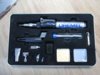
I have a couple of Snap On branded ones. The baby can't be used as a torch but the bigger one, that looks very similar to the Dremel Alan pictures, can be. I've used it as such for popping the resin bubbles on my two recent diorama.
I do have a fairly decent electrical solder station though so might look into soldering for my etch, since I still have a bit of a CA glue handicap. Looking at the Carr's site they seem to do quite a range of liquids, pastes and solders though. Could anyone advise on the most suitable combination for brass photo etch please?
I have a couple of Snap On branded ones. The baby can't be used as a torch but the bigger one, that looks very similar to the Dremel Alan pictures, can be. I've used it as such for popping the resin bubbles on my two recent diorama.
I do have a fairly decent electrical solder station though so might look into soldering for my etch, since I still have a bit of a CA glue handicap. Looking at the Carr's site they seem to do quite a range of liquids, pastes and solders though. Could anyone advise on the most suitable combination for brass photo etch please?
1/3
Hi Andy, I would go for the Carr’s 145 and their green flux, if you use an iron it will be like working with melted butter......if you can source phosphoric acid a 10% solution of that will replace the green flux and be even more effective.....wash the flux off with soda crystals dissolved in water. It’s acidic but that’s what makes it effective. Plumbers power flow flux also works well, but you wash that one off with meths.
Legal Notice
scalemodelling.co.uk is a privately operated online discussion forum. All content posted by members reflects their own views and opinions and does not necessarily represent those of the forum owners or administrators. While reasonable efforts are made to moderate content, no responsibility is accepted for user-generated material. By using this site, you agree to comply with UK law and the forum rules.