Theme editor

Scale Model Shop

LIANG 1/35 MODEL BRICK graver.

  • Thread starter Thread starter Guest
  • Start date Start date
G

Guest

Guest
Thread owner
Thought I'd do a review for this, firstly Mike " is it me " aka wibble sent it to me to ask what I thought of it. I was thrilled to see a quick and easy to use tool .:anguished:
He agreed with me a review was in order. He found it to be hard to assemble and use. That I'm not the least surprised !
First thing why call it a graver, I'd call it an engraver !
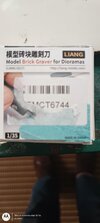
2022.jpg

The box , a U tube video that is accessed by scanning the code on the box lid . Like all advertising instructions, it makes it look easy.:smiling3:

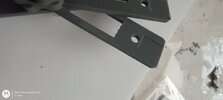
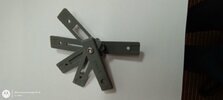
This what you get in the box, a holder, It has 2 threaded threads fixed with a hex nut.

2022_10.jpg
.2022_12.jpg
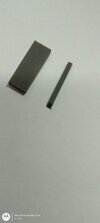
2 pieces of resin plastic to widen the cut lines , one for the brick length and the other for the line.


The blades are laid in that recess to the right lower
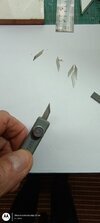
2022_15.jpg 2022_6.jpgThe blades are laid in that recess to the right lower.

It appears you have to build up the blades allowing one to each recess With that done the legs are pushed together and the bolt inserted and into the nut and tightened up .However I noticed that there was gaps in the holder, not on every one but on some. Trying to get the blades to then line up was a night mare. Eventually I managed it, agree with Mike saying you need 20 fingers and a third hand.
On the U tube and on the web site it shows another set of blades for the 1/72/48 version. They appear to have holes in for the bolts to pass through, needed here on the 1/35 as well .

A piece of exp foam was then marked with the full amount of blades, very light passes are needed. At this point both bolts were fully tightened but.

2022_17.jpg
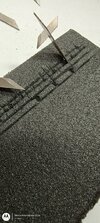
This happened, the blades moved in the holder when any pressure was applied. In fact one blade came completely out of the holder.
2022_19.jpg
By this time I had started to mark out the width of the brick. Just to see how my method work as a comparison .
2022_16.jpg
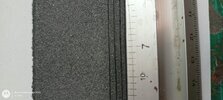
I found it just as quick to do it line by line.
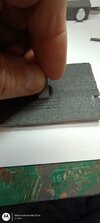
2022_18.jpgThis the Liang methods to increase the line width, I use a very thin putty , filler knife, long and far more effective.

Below is my method, at the bottom is the Liang
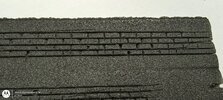
2022_22.jpg

To be fair I played with set up for some time, with the blades not being held in place with any mechanical fixing like a blot and nut it was hit and miss. The blades tended to splay apart, esp the outer one.
Some people may get on with this, suspect most won't . A shame as drawing one line at the time is slow and I thought this method would save marking out and would be quicker.
Not for me.

Hope this has been of some help, no doubt I could keep trying as practice does help , but in this case not for me.
John
 
It seems to me that it is a tool for doing something which can be more easily done by hand, as you have shown. For widening the mortar lines a piece of styrene sheet shaped to a chisel edge works fine. You'll need a narrow piece for the vertical lines. With your background I doubt very much whether you have put it together incorrectly so it seems just badly engineered. Thanks for the review - I'll not be tempted.
 
Thread owner
It seems to me that it is a tool for doing something which can be more easily done by hand, as you have shown. For widening the mortar lines a piece of styrene sheet shaped to a chisel edge works fine. You'll need a narrow piece for the vertical lines. With your background I doubt very much whether you have put it together incorrectly so it seems just badly engineered. Thanks for the review - I'll not be tempted.
Thanks Jim, even Mike had found it awkward and he's very mechanically minded.
 
Seems like an expensive gadget. Thanks for drawing our attention to it John!
why not just superglue some scalpel blades together with spacers in between? You could just use the back of the blades for grooving foam.

I have an xacto handle with two swan morton blades in for scoring a double line about 0.5mm apart (however thick a scalpel blade is, basically)-works perfectly and costs nothing.
it's quite good for cutting thin strips of tape too(when the blades are new)
 
Seems over complicated to me as well. In 1/72 it’s far easier to use a jewellers screwdriver of the correct width and impress the mortar join. I’m sure something similar could be made for 1/35.
 
Thread owner
Seems like an expensive gadget. Thanks for drawing our attention to it John!
why not just superglue some scalpel blades together with spacers in between? You could just use the back of the blades for grooving foam.

I have an xacto handle with two swan morton blades in for scoring a double line about 0.5mm apart (however thick a scalpel blade is, basically)-works perfectly and costs nothing.
it's quite good for cutting thin strips of tape too(when the blades are new)
Thanks Neil.
The gap is 2mm between the lines , making the mortar line wider results in the brick ending up under size . Actually a mortar bed should be 10 mm =.287
Brick do differ from country to country but the mortar bed seems to be universal.
UK brick is 215 X 102.8 X 65mm.
German 240. X 115 X 71mm.
Russia 250. X 120 X 65 mm.
So there not much difference between the sizes .
I'd rather have 3mm gap between lines, making the line wider, in this case not effecting the brick .
I've been looking at cutting up a plastic rule which according to the supplier is 3mm thick , fitting bolts through holes in the blade . Just got to look for blades with a 3 of 4mm hole .This will stop the twisting .
Seems over complicated to me as well. In 1/72 it’s far easier to use a jewellers screwdriver of the correct width and impress the mortar join. I’m sure something similar could be made for 1/35.
Agree Tim see my reply to Neil as to what my thought are .
 
Thread owner
Going to give it another go tomorrow having spoken to Mike.
Might have a way of fitting blades with holes !
 
John, I think you're using the wrong set of blades. Doesn't Liang come with blades specifically to fit in the square recess perhaps X-actor blades with squared off ends. The thickness of the blades also play a part I think to have a tight fit. Obviously the video didn't help, was it in Mandarin? If the contraption fits 10 blades or more I might think about it but how hard is it to scribe four lines on foam?:smiling2:

TBH I have some specialised tools in my inventory but still prefer the old tried and tested home spun ones that I have been using for ages, habit I guess. So far the only useful stuff are the leaf punches, super glue thin nylon tube applicators, drill bits and grinders, sponge sanding sticks, curved files and chisels. Everything else is hand made with sweaty palms. :smiling6:

Cheers,
Wabble
 
Thanks Neil.
The gap is 2mm between the lines , making the mortar line wider results in the brick ending up under size . Actually a mortar bed should be 10 mm =.287
Brick do differ from country to country but the mortar bed seems to be universal.
UK brick is 215 X 102.8 X 65mm.
German 240. X 115 X 71mm.
Russia 250. X 120 X 65 mm.
So there not much difference between the sizes .
.
UK bricks were standardised at nine by three by four and a half inches pre decimalisation (225 x 75 x 112mm) with a half inch mortar bed weren’t they John? My last house, an Edwardian period terrace, had bricks of this size. Modern bricks were slightly smaller so any work we had done needed bricks sourced from reclaimers. Pre industrialisation they were whatever size the local brick works made them, frequently quite a bit smaller.
 
Thread owner
John, I think you're using the wrong set of blades. Doesn't Liang come with blades specifically to fit in the square recess perhaps X-actor blades with squared off ends. The thickness of the blades also play a part I think to have a tight fit. Obviously the video didn't help, was it in Mandarin? If the contraption fits 10 blades or more I might think about it but how hard is it to scribe four lines on foam?:smiling2:

TBH I have some specialised tools in my inventory but still prefer the old tried and tested home spun ones that I have been using for ages, habit I guess. So far the only useful stuff are the leaf punches, super glue thin nylon tube applicators, drill bits and grinders, sponge sanding sticks, curved files and chisels. Everything else is hand made with sweaty palms. :smiling6:

Cheers,
Wabble
Wabble , yes indeed, simple tools are much easier!
Apparently there were other blades with a square end .None of which were in the box ! Going to try the blades that came with it in other end this morning . Quite honestly the amount of time it takes to set up to me is ridiculous. Mind you once its together and stored safely and used when needed it might be better. Never give up with out a second go :nerd:
 
Thread owner
UK bricks were standardised at nine by three by four and a half inches pre decimalisation (225 x 75 x 112mm) with a half inch mortar bed weren’t they John? My last house, an Edwardian period terrace, had bricks of this size. Modern bricks were slightly smaller so any work we had done needed bricks sourced from reclaimers. Pre industrialisation they were whatever size the local brick works made them, frequently quite a bit smaller.
Yes indeed Tim
.https://www.ids-dmv.com/masonry/top-5-ways-to-tell-if-a-brick-is-historic-or-contemporary/#:~:text=In%20around%20the%201920's%2D1930's,exact%20same%20height%2C%202.25%E2%80%B3.
If you feel like being a nerd this is a good read :nerd::smiling2:

Don't suppose one bit that the differences between the modern and the old really equate to much when being used at 1/35 .
 
John, how about just CAing two Stanley knife blades either side of a suitable spacer? As long as you degrease the blades first it should stick well. I did that a few years ago to cut strips of veneer for inlaying. Stanley blades have more gluing area than scalpel blades.
Pete
 
Thread owner
John, how about just CAing two Stanley knife blades either side of a suitable spacer? As long as you degrease the blades first it should stick well. I did that a few years ago to cut strips of veneer for inlaying. Stanley blades have more gluing area than scalpel blades.
Pete
Pete, not a bad idea. The blade would certainly give a better mark. Liking this a lot . Still considering a plastic rule cut to length, according to the seller on evil bay it's 3 mm thick. So quite a few methods to consider.Thank you .
 
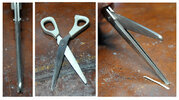
Nothing really to do with cutting brick patterns but here is a tool some scratch builders may not have seen before but they could find useful. It is a stained glass makers pattern cutter. A form of scissors with 3 blades that cuts a uniform strip out of foil, plasticard, cardboard etc. Mine cut approx a 1/16th inch strip or 1.7 mm. There are others that are even smaller.

scissors.jpg

John
 
Interesting thread 453.

Personally, it would be too much faff to set up and then, as you show very clearly, accuracy would be questionable.

I'll stick with my well tried and tested steel rule and a scalpel, or if I want thicker mortar joints, a 'Stanley' knife (Other makes will remove the top of your fingers just as easily)

None the less, thanks for taking the time to 'Review' the product. :thumb2:

570
 
Thread owner
Nothing really to do with cutting brick patterns but here is a tool some scratch builders may not have seen before but they could find useful. It is a stained glass makers pattern cutter. A form of scissors with 3 blades that cuts a uniform strip out of foil, plasticard, cardboard etc. Mine cut approx a 1/16th inch strip or 1.7 mm. There are others that are even smaller.


John
Liking that tool, thanks for showing.

Interesting thread 453.

Personally, it would be too much faff to set up and then, as you show very clearly, accuracy would be questionable.

I'll stick with my well tried and tested steel rule and a scalpel, or if I want thicker mortar joints, a 'Stanley' knife (Other makes will remove the top of your fingers just as easily)

None the less, thanks for taking the time to 'Review' the product. :thumb2:

570
Thank you 570.
Having now located the correct method for holding the blades I'm still not impressed ! Will give it a whirl in the morning hopefully.

John,
Thanks for the review, but I'm with Ron a steel rule and a sharp blade for me.
Paul ,your welcome , think this is the general consensus on here. Have in the pipeline a homemade one , this negates marking out the width which is a pain on dark XPS .That will be helpful .
Located
 
Have in the pipeline a homemade one
I've thought before of a length of something akin to miniature angle iron where one edge drops into the previously scored line and you run your blade along the other edge. Should give you perfectly straight, even gaps easily every time without the inaccuracies that can creep in with measurements

If that makes sense :thinking:
 
I've thought before of a length of something akin to miniature angle iron where one edge drops into the previously scored line and you run your blade along the other edge. Should give you perfectly straight, even gaps easily every time without the inaccuracies that can creep in with measurements

If that makes sense :thinking:
You can also use spring dividers, set to the appropriate gap size, and use those to mark off the divisions using the previous hole as a guide.
 
All this talk of bricks brings to mind the brick museum at Jedburgh about 18 miles from me, but I think I will give it a miss. :smiling5:


Andy.
 
Back
Top