Theme editor

Scale Model Shop

Masking up aircraft. your best techniques

Defiant911

New member
Joined
Feb 25, 2020
Messages
640
Reaction score
0
Points
0
1/3
Thread owner
As I’m fairly new to this I have masked up a few planes but I do find the masking quite a chore and sometimes I end up with over spray where I don’t want it. I’m sure there is a more organised approach to how I’ve been doing it so I’d be interested to hear how others tackle masking aircraft?
Carl
 
I normally approach the smaller areas first which I mask then paint the main color at the end. This minimizes the amount of masking tape needed and covering less of the large areas thus also minimizing overspray. That's the reason I do pre-shading. It's easier to control and cover mistakes with the final coat than the opposite for me that is.

Cheers,
Richard
 
Carl,
I'm afraid there isn't any easy way of masking, it's just a matter of systematically working through it. I'm always aware that overspray will find the slightest chink! I sometimes use clingfilm to cover large areas that I don't want to get any paint on, using tape to seal the edges.
Before masking make sure that the surface is clean & dry - if over another painted surface, I allow at least 24 hours before masking. Remove the masking tape when the new paint is touch dry, if you leave it a long time, then you can lift the paint. Make sure that the masking tape is burnished down at the edges - I use a paintbrush handle. You can try to seal the edges with varnish, to prevent bleed through/under, but that can cause more trouble.
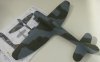
This how not to do it!!! Poor surface preparation - poor choice of primer - insufficient time to let the basecoat dry before masking - result, a lot of bad language!!
P1060313.JPG
Just about recoverable - removed as much loose paint as possible, feathered all the edges, reprimed etc etc - I lost heart, and it still ain't finished!!
Dave
 
Thread owner
I use thin flexible tape to demarcate the edges and then fill in with ordinary tape.
Jim
Do you not find
Carl,
I'm afraid there isn't any easy way of masking, it's just a matter of systematically working through it. I'm always aware that overspray will find the slightest chink! I sometimes use clingfilm to cover large areas that I don't want to get any paint on, using tape to seal the edges.
Before masking make sure that the surface is clean & dry - if over another painted surface, I allow at least 24 hours before masking. Remove the masking tape when the new paint is touch dry, if you leave it a long time, then you can lift the paint. Make sure that the masking tape is burnished down at the edges - I use a paintbrush handle. You can try to seal the edges with varnish, to prevent bleed through/under, but that can cause more trouble.
This how not to do it!!! Poor surface preparation - poor choice of primer - insufficient time to let the basecoat dry before masking - result, a lot of bad language!!

Just about recoverable - removed as much loose paint as possible, feathered all the edges, reprimed etc etc - I lost heart, and it still ain't finished!!
Dave
wow, that looks a lot of work. I’ve experienced paint coming away after masking but usually it’s the primer rather than the main coat. I imagine sanding that back over all those bumps will be very time consuming...the fun of modeling..
 
Thread owner
I normally approach the smaller areas first which I mask then paint the main color at the end. This minimizes the amount of masking tape needed and covering less of the large areas thus also minimizing overspray. That's the reason I do pre-shading. It's easier to control and cover mistakes with the final coat than the opposite for me that is.

Cheers,
Richard
Do you get any overlap lines by masking in sections?
 
Do you get any overlap lines by masking in sections?
Carl, I normally don't get overlap lines as I spray very thin coats of paint...thinner than the tape itself. One of the best ways to get the no overlap effect is to use paper masking and spray away from the edge or use Blu-Tac.

If you're painting with a paint brush I would suggest not using any masking. With an airbrush you cannot run away from masking if you want an abrubt line or sharp feathered edge. Have you tried using a paper doily placing it on a surface and spraying over it? Spray at different angles and see the results and you will start to understand the effects of masking with paper. With tape, always use a new cut strip to spray on as it will not carry any dirt or unwanted dust that the tape has picked up when left on the table. I always believe in experimenting and practise on an unwanted old kit first before attempting on a new kit.

Cheers,
Richard
 
i personally do like this..
i previously washed the model with isopropyl alcohol... when it's dry....
1. Primer a light coat with one of the camo colors ( the darkest one)
2. a thin coat of ultra matt varnish from AK interactive or MIG
3. put the flexible tape from tamiya (white one 2mm) and cover the part with paper tape from tamiya (yellow on 1cm)
4. repeat 2 (the ultramatt is to be sure that the tape will not take off the paint)
5. another camo repeat number 3
6. apply the decals
7. repeat number 2
8. wash-weathering and pigments..

PLEASE be sure to apply THIN layers of paint..
hope this helps
 
must admit that masking is one reason i dont do many aircraft....its something i really hate, especially canopies and the demarcation line on leading edges!

i tend to use very thin good quality masking tape for straight lines....blutac for curves.....coupled with patience counterbalanced by a lot of swearing
 
must admit that masking is one reason i dont do many aircraft....its something i really hate, especially canopies and the demarcation line on leading edges!

i tend to use very thin good quality masking tape for straight lines....blutac for curves.....coupled with patience counterbalanced by a lot of swearing
I dont mask wing leading edges at all, there is no need. Just spray straight down onto the wing and from above forward and the curve takes care of all the masking.

Cockpits arer fairly easy, with some models you can just mask the canopy and fix that in place. You can fix it temporarily as well if you intend to display it open. Otherwise I just pop some screwed up tissue into the pit and use masking tape around it. Little pieces of tape will do, some perhaps cut to a rough shape. The same method works for all sorts of holes and gaps.

Demarkation between upper an lower fuselage can be done using blue tac snakes with masking tape. Flowing camo shapes by using Clever Putty.
 
Carl, I normally don't get overlap lines as I spray very thin coats of paint...thinner than the tape itself. One of the best ways to get the no overlap effect is to use paper masking and spray away from the edge or use Blu-Tac.

If you're painting with a paint brush I would suggest not using any masking. With an airbrush you cannot run away from masking if you want an abrubt line or sharp feathered edge. Have you tried using a paper doily placing it on a surface and spraying over it? Spray at different angles and see the results and you will start to understand the effects of masking with paper. With tape, always use a new cut strip to spray on as it will not carry any dirt or unwanted dust that the tape has picked up when left on the table. I always believe in experimenting and practise on an unwanted old kit first before attempting on a new kit.
Cheers,
Richard
Dave

Never thought of using cling film! A great idea!

ATB

Andrew
 
1. I spray the underside colour, which is almost invariably lighter than the upper surfaces, not worrying about the demarcation, except to make sure I cover it.
2. I mask the demarcation between upper and lower colours and then mask the underside of the model. I use a combination of tape and kitchen (aluminium) foil. The foil is a lot cheaper than Tamiya tape :)
3. Spray the lighter (or lightest) camouflage colour on the upper surface. I post-shade so I do anything in a version of this colour at this stage.
4. Mask the lighter colour. A splinter type pattern can simply be done with tape. Curvy patterns can be done with Blutack.
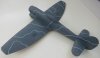
blutack.jpg

Once you are happy with the demarcations, fill in the area to be masked with tape and spray the next colour.
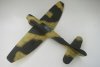
camo.jpg

Remove masking and....voila!

done.jpg

I work at 1/32, so I often spray the various national and other markings.
markings.jpg
And then do all the usual gloss coat(s) and decaling thing.
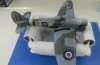
decals.jpg

Small piccies, because they are just illustrations and will load a lot faster!

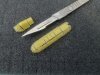
Canopies are a thing unto themselves. I like to have mine attached to the model, permanently or temporarily, when I paint because I don't want it to look 'stuck on' later. I have tried all sorts of methods, but almost always revert to the masking tape and new, sharp, No 11 scalpel blade. It is quite often a fiddle and on very complicated framing I am not averse to splashing out on some pre-cut masks. I certainly did that when I made a 1/48 Lancaster and it was worth every penny!

Cheers

Steve
 
I dont mask wing leading edges at all, there is no need. Just spray straight down onto the wing and from above forward and the curve takes care of all the masking.

Cockpits arer fairly easy, with some models you can just mask the canopy and fix that in place. You can fix it temporarily as well if you intend to display it open. Otherwise I just pop some screwed up tissue into the pit and use masking tape around it. Little pieces of tape will do, some perhaps cut to a rough shape. The same method works for all sorts of holes and gaps.

Demarkation between upper an lower fuselage can be done using blue tac snakes with masking tape. Flowing camo shapes by using Clever Putty.


you work in 1/32 where i guess its easier than the 1/72 that i work in, .....lots bigger!
 
you work in 1/32 where i guess its easier than the 1/72 that i work in, .....lots bigger!
I would have thought small scale would be easier. The last 1/72 I built was when they released a Tiffy, a year or so before the 1/24 came out!
 
I would have thought small scale would be easier. The last 1/72 I built was when they released a Tiffy, a year or so before the 1/24 came out!

you try masking a canopy for a 1/72 Me 110 or Ju 87 :tears-of-joy::tears-of-joy::tears-of-joy:
 
Thread owner
i personally do like this..
i previously washed the model with isopropyl alcohol... when it's dry....
1. Primer a light coat with one of the camo colors ( the darkest one)
2. a thin coat of ultra matt varnish from AK interactive or MIG
3. put the flexible tape from tamiya (white one 2mm) and cover the part with paper tape from tamiya (yellow on 1cm)
4. repeat 2 (the ultramatt is to be sure that the tape will not take off the paint)
5. another camo repeat number 3
6. apply the decals
7. repeat number 2
8. wash-weathering and pigments..

PLEASE be sure to apply THIN layers of paint..
hope this helps
I like the point about applying a Matt lacquer inbeteeen paint coats to try to avoid peeling paint layers with tape.
 
you try masking a canopy for a 1/72 Me 110 or Ju 87 :tears-of-joy::tears-of-joy::tears-of-joy:
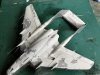
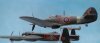
It can be done with tape and a sharp knife. I think it has to be a scalpel, and with a new blade. A No.11 blade is the perfect shape for this. These are all 1/72 and were done that way.

IMG_0623.JPG

And so is this

IMG_0986_2.jpg

The lower of which is for a Bf 110 at 1/72

IMG_0996.JPG

I made a 1/72 Ju 88 and the canopy framing was so badly molded that I used coloured decal film to make it. Unfortunately I can't find a picture, but I simply painted the film in the correct colour and cut suitably thin strips.


Cheers

Steve
 
Back
Top