Thanks Neil - you raise some interesting (and excellent!) points.
I 100% agree about good sculpts being easier to paint - this one, for example, is excellent, and that means paint placement is telegraphed to the painter, rather than needing lots of analysis and interpretation. Plus some very clean separation between different elements makes edge highlighting super-easy. And of course a good sculpt is an aesthetic pleasure to paint, rather than something where a shortcoming - in posture, finish, proportion, whatever - niggles at you all the while.
And I like your idea about focussing on purely painting projects - it certainly keeps you (and me) slapping on the paint which, as you say, is the primary route to success. As Seve Ballesteros once said: "The more I practise, the luckier I get".
I've not experimented with adding varnish to my
paints - I must do that sometime. I've been taking some very tentative steps with contrast paint (actually Vallejo's version, Xpress Color). Not sure about it, at all, but some colours come up very glossy, so I might add in some matt varnish to counter that.
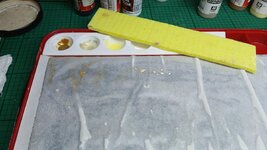
The blending trick I learned off Ataraxia was using the wells on my
DSPIAE wet pallette, with a bit of damp sponge to keep them usable. She suggests using a ceramic palette with rows of seven wells, and making up pre-mixes of blends between base colour, shade and highlight. I've not gone all the way with this (yet), but it certainly adds structure to my blending, and stops me losing certain pre-mixes as they diluted on the wet palette itself.
Her other idea is to use strong glazes, rather than over-diluting. Lots of youtubers focus on final glazes, which are necessarily very weak. But really quite strong dilutions are needed to get a good blend structure in place, before the final finessing with weaker glazes. This has certainly reduced the amount of chalkiness I was getting, and improved my ability to adjust and correct as I work towards a smooth(ish) finish.
I think just consciously addressing what is not as good as I'd like it, then researching and experimenting potential solutions, rather than blundering around aimlessly, is absolutely critical.