Theme editor

Scale Model Shop

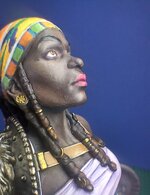
The Lioness, 1/10th scale, Stella Argentis

Thread owner
Thanks chaps - so kind!

The headwrap stays until I've done everything else - it'll only go if I'm STILL not happy with it. Her braids are full of beads, coins and ties - if I make them colourful they may act as a 'bridge' between the scarf and the rest of her clothing.
 
Thread owner
That's kind, Tony.

I think figure painting is a very different discipline to most of what happens on here - I've got a couple of 'regular' scale models on the shelf, and I keep thinking I should give them a go, but it feels like that would be a massive shift from the figure painting. So it's logical to assume that moving in the opposite direction would be equally challenging.

But do please give it a go! There's such a huge range of figures out there - I've been focused on fantasy figures for some time now, but I've been looking at Napoleonics recently, as I feel my technique is getting sufficiently competent to have a pretty good go at them. Maybe some Ancients would be an obvious transition towards that?
 
That's kind, Tony.

I think figure painting is a very different discipline to most of what happens on here - I've got a couple of 'regular' scale models on the shelf, and I keep thinking I should give them a go, but it feels like that would be a massive shift from the figure painting. So it's logical to assume that moving in the opposite direction would be equally challenging.

But do please give it a go! There's such a huge range of figures out there - I've been focused on fantasy figures for some time now, but I've been looking at Napoleonics recently, as I feel my technique is getting sufficiently competent to have a pretty good go at them. Maybe some Ancients would be an obvious transition towards that?
Ive done a few in the past mainly the venerable Airfix 54mm figures . Although I’m far from your standard I really enjoy them , but always struggle with the skin tones . if youre thinking about trying something napoleonic then theyre a good cheap option to get you into it.
 
Thread owner
Skin is definitely challenging. I've been concentrating on female figures for that reason - rough, tough men allow a certain amount of leeway with craggy complexions, but with women you really do need to get smooth, subtle colour transitions.

Freehand work is another major challenge for me, so I've been ensuring every figure has some of that, and I'm slowly gaining confidence in that area too.
 
Amazing , inspiring stuff paul , she looks superb . I like the scarf as it is , really adds to the piece . At this rate I’m going to have to give figure painting another try . Cheers tony

it's like all things, Tony, the more you do of it the more you learn and the better you get at it.
That's why I keep giving myself purely painting projects ,rather than just painting my conversions when they are done; it means a faster turn-around and therefore a bit more practice.
I would also point out that the better the sculpt ,the easier it is to paint, so if you're serious it might be worth searching out some pieces that need very little assembly, rather than the Airfix (which I DO love, of course). ICM do some good 1-32 pilot sets that might float your boat ?
cheers
Neil
 
My apologies for not commenting sooner ,Paul.
It's not my genre but I really should support the other figure guys on this forum!
That said, I also really LIKE the headwrap, sorry...
You're right about female skin-it's a real challenge, especially at this larger scale, but I have to say you're nailing it as far as I'm concerned.
As for the blending of acrylics- very tricky! I discovered a trick by accident with my PBI Burma guy, which is to use AK Ultra Matt instead of water to thin the paint. I don't know if it was just a fluke but I got the best flesh transitions I've ever achieved so far . It remains to be seen whether I can repeat the success....
So, as Churchill used to say-'Keep B*ggering on!'
 
Thread owner
Thanks Neil - you raise some interesting (and excellent!) points.

I 100% agree about good sculpts being easier to paint - this one, for example, is excellent, and that means paint placement is telegraphed to the painter, rather than needing lots of analysis and interpretation. Plus some very clean separation between different elements makes edge highlighting super-easy. And of course a good sculpt is an aesthetic pleasure to paint, rather than something where a shortcoming - in posture, finish, proportion, whatever - niggles at you all the while.

And I like your idea about focussing on purely painting projects - it certainly keeps you (and me) slapping on the paint which, as you say, is the primary route to success. As Seve Ballesteros once said: "The more I practise, the luckier I get".

I've not experimented with adding varnish to my paints - I must do that sometime. I've been taking some very tentative steps with contrast paint (actually Vallejo's version, Xpress Color). Not sure about it, at all, but some colours come up very glossy, so I might add in some matt varnish to counter that.

The blending trick I learned off Ataraxia was using the wells on my DSPIAE wet pallette, with a bit of damp sponge to keep them usable. She suggests using a ceramic palette with rows of seven wells, and making up pre-mixes of blends between base colour, shade and highlight. I've not gone all the way with this (yet), but it certainly adds structure to my blending, and stops me losing certain pre-mixes as they diluted on the wet palette itself.
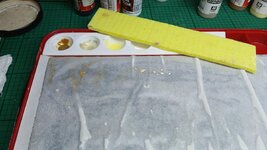
Her other idea is to use strong glazes, rather than over-diluting. Lots of youtubers focus on final glazes, which are necessarily very weak. But really quite strong dilutions are needed to get a good blend structure in place, before the final finessing with weaker glazes. This has certainly reduced the amount of chalkiness I was getting, and improved my ability to adjust and correct as I work towards a smooth(ish) finish.

I think just consciously addressing what is not as good as I'd like it, then researching and experimenting potential solutions, rather than blundering around aimlessly, is absolutely critical.
 
Used to have a lot of issues with glazing. Glazing medium helps, but very weak glazes are best achieved with dark colours as I find they thin down without chalkiness. I think it’s the lack of titanium white in the base colour that helps. I suppose they are really tints then, but it can help melt the tonal changes into each other. To be honest I haven’t painted a large figure (or a little one come to that) for a long time so I might be talking a load of cod’s……
 
Thread owner
Agree 100% about weak glazes needing to be darker. Tim Marlow . On her skin I used strong dilution of the highlight colours to take the colour up brighter than the desired value, then used weaker, darker glazes to bring them back down to what I was aiming for, and blending the whole transition together at the same time.
 
Back
Top